Cold room inventory with AI vision — knowing what is there and where without opening the door.
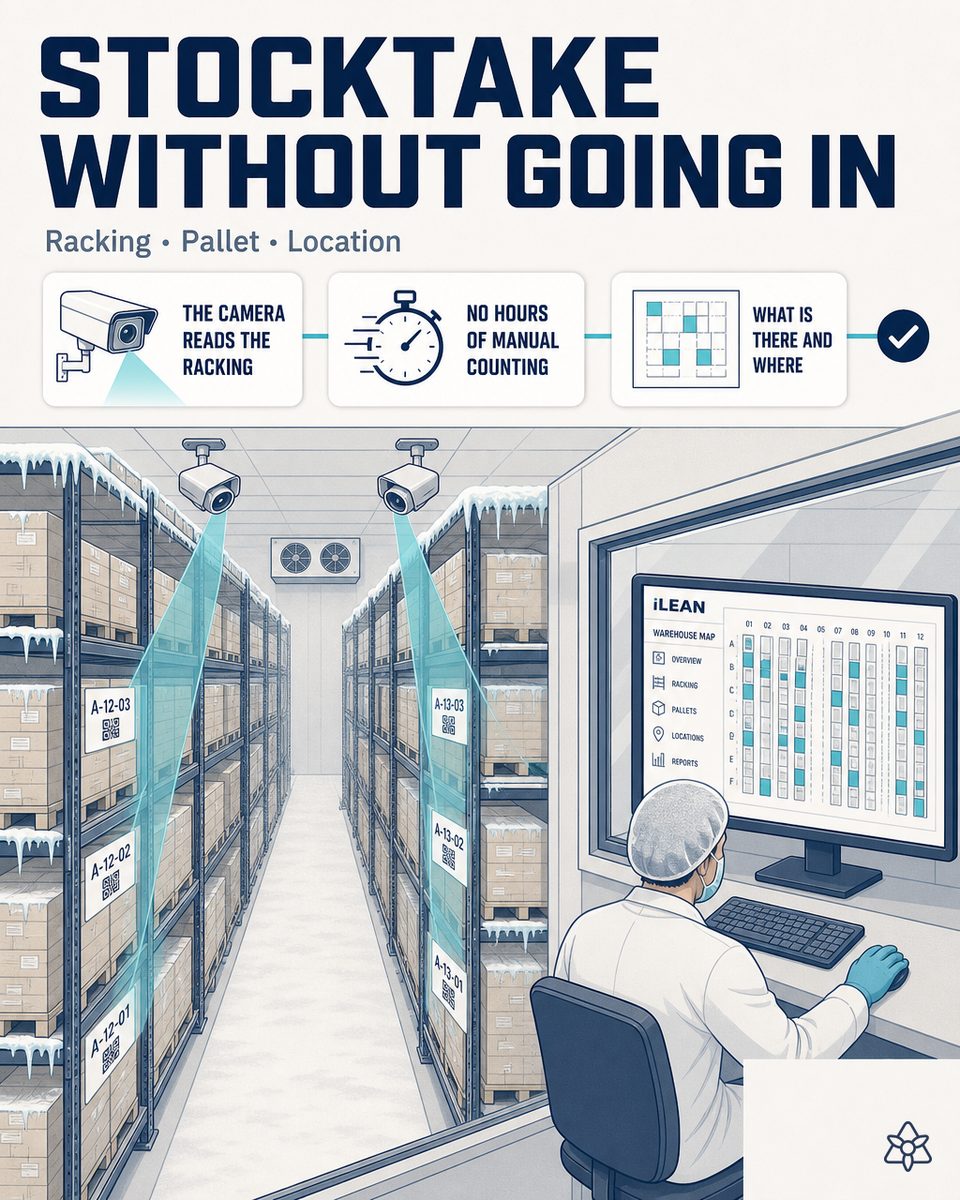
Counting stock by hand in a cold room at -25°C is slow, inaccurate and expensive work — an operator takes forever, makes mistakes, and every minute with the door open is energy. iLEAN Vision identifies pallets inside the cold room with no manual scanning and reconciles them with your WMS in real time. You know what is there and where without having to walk in.
Cold room inventory costs money before it costs you money.
A classic physical count in a freezer room carries three costs that get ignored until a customer shows up with a shortage:
- Operator time in the cold — with thermal gear, mandatory breaks and a real productivity of a few minutes per hour. A cold room with several thousand slots is measured in whole days.
- Energy lost — every door opening, every hour with the air stirred up by forklifts, drives the bill up and forces the refrigeration team to claw back setpoint.
- Discrepancy with the WMS — between two counts, the WMS “believes” it holds stock that reality no longer backs up. And when a customer's spec calls for a specific batch, you do not find out until the forklift driver opens the slot and it is not there.
The operator knows it. Management accepts it as a “cost of doing business”. And between them, a 3-5% deviation gets accepted as normal — until a retailer rejects an order, an auditor asks for traceability, and the gap between theoretical and real stock blocks an operation. The classic system works until an important customer finds the hole.
iLEAN does not replace your WMS — it fills the gap between what the WMS believes and what is actually inside the cold room.
The problem with cold room inventory is not a warehouse software problem: it is a capture problem. The WMS paints a picture of a reality it cannot see, because between the last transaction and the next one nobody has told it what is physically happening in the racks. iLEAN acts as the putty that fills that dead zone, without asking you to change WMS, labels or forklifts.
Edge sees the cold room from the inside. Connect syncs with your WMS. The agent reconciles, spots the deviation and proposes the adjustment. The person signs the stock adjustment — never the other way round.
The three iLEAN pieces applied to cold room inventory:
- iLEAN Edge (Vision) — terminals with a camera and a CNN housed in an IP66 enclosure with a heater, mounted in aisles and strategic zones. They identify the pallet, read the label (SSCC or internal code) and confirm its position in the slot. They work with no network. If the plant loses WiFi, Edge keeps identifying and recording — what is critical does not depend on connectivity.
- iLEAN Connect — syncs with the WMS (Mecalux, Manhattan, SAP EWM or your integrator's vertical) slot by slot. It also captures what arrives from outside (a supplier email with a change to the unloading plan, a WhatsApp from the carrier) at second zero, with no forwarding.
- Agent — reconciles what Edge sees with what the WMS believes, detects discrepancies, classifies them by severity and proposes an action: “slot A-12-03 flagged as product X in the WMS, Edge sees product Y, different batch — adjust or investigate?”. It does not send an email at 10 p.m.: it prepares the adjustment proposal and waits for the warehouse manager's signature.
Manual cold room counts vs. continuous inventory with iLEAN Vision
| Aspect | Manual count + RF scanning | With iLEAN Edge (Vision) + Connect + Agent |
|---|---|---|
| Inventory frequency | Periodic (quarterly, annual) + partial cycle counts | Continuous, slot by slot, 24/7 |
| Operator time in the cold | Hours and days, with mandatory breaks | Zero — the cold room “counts itself” |
| Door openings just to count | Constant throughout the count | Zero openings specifically to count |
| Detecting a deviation | At the end of the count, weeks after the fact | In real time, slot by slot |
| Operation with no network | RF goes down with the network | Edge keeps identifying and recording on its own power |
| File for the IFS/BRC auditor or the customer | Rebuilt by hand from WMS transactions | Slot-level history with a photo of the pallet and a dated read |
Impact estimate for your plant — to be validated with your numbers.
The block below is an estimate to be validated with the specific data of your cold room. We put it forward so the committee has an order of magnitude; we refine it during the diagnostic.
- Freezer room with several thousand slots, multi-customer or multi-SKU, with a theoretical vs. physical stock discrepancy that is accepted as “normal” (3-5%).
- Edge pilot in one or two critical aisles (IP66 camera + dedicated LED lighting + integration with the existing WMS). First value expected within a few weeks: continuous coverage of the highest-turnover slots.
- Indicative payback between 4 and 9 months, depending on how many physical counts are eliminated, the stock-outs avoided on a key customer order, and the operator cold-hours saved.
- Expected reduction of the stock vs. WMS discrepancy of ≥ 30% in the covered area, within the first quarter — a customer service lever more than a direct cost one.
And the warehouse manager's reasonable doubt
“What if the AI misreads a frozen label and changes stock that was correct?” — hallucination is a problem of free generation, not of anchored tasks. In tasks where the AI merely recontextualizes a piece of data (reading a label and comparing it with what the WMS says), the best models brought error below 1.5% [1]. And even so, what is critical is never decided alone: iLEAN proposes the adjustment, the person signs. The three safety rings exist precisely for this — the WMS is critical OT and nobody writes to it without human validation.
[1] OpenAI paper “Why Language Models Hallucinate”, 2025 — on the reliability of AI in anchored tasks.
What people ask about cold room inventory with AI vision
Does AI vision work at -25°C?
Yes. iLEAN Edge is housed in an IP66 enclosure with a heater and an anti-frost window, designed to run continuously in freezer rooms at -25°C and even below. The CNN runs on the terminal itself — it does not need a warm server next to it — and keeps its detection cycle going even if the plant loses the network. The image sensor and the optics are selected for low temperature; the rest is a standard mechanical mounting for a cold room. It is still sensible to check the sealing at the annual maintenance, like any other equipment inside a cold room.
Does it read labels covered in ice, frost or snow?
Yes, within reasonable limits. The CNN is trained to identify the silhouette of the pallet, its position in the rack slot and the main characters of the batch code / SSCC, not just a crisp barcode read. If the label is partly covered in frost, iLEAN cross-references the partial read with the slot map and the WMS history to confirm the pallet's identity. If the frost is so dense that the system does not reach sufficient confidence, the pallet is flagged as “to be verified” — nothing is assumed, it is escalated to a person.
Does it reconcile with the WMS in real time?
iLEAN Connect hooks up to the WMS (Mecalux, Manhattan, SAP EWM, an in-house vertical…) and syncs the inventory detected by vision with the theoretical inventory, slot by slot. Discrepancies appear in real time on the warehouse manager's dashboard; the Agents propose an adjustment or an investigation depending on the size and the zone. The golden rule: Connect carries, the Agents propose, the person signs the stock adjustment. The WMS is never modified on its own.
Do I have to change the pallet label?
No. iLEAN adapts to the labels you already issue — SSCC GS1-128, an internal code, a mix of both. If several formats coexist (plant + co-packer + external cross-dock), the CNN is trained on samples of each in a matter of hours. Changing labels in a cold room with thousands of active pallets would be expensive and risky, and iLEAN's promise is the opposite: to fill the crack between what you have today and useful data, without asking you to change label, printer or WMS.
What about poorly lit areas of the cold room?
iLEAN Edge cameras include low-temperature LED lighting where needed, switched on only at the moment of capture. In forklift traffic areas, capture is triggered by motion; in deep racking, a night-time sweep with dedicated lighting is scheduled. The cold chain is not affected: the LED is low-consumption and switches off immediately. If a specific area of the cold room cannot be lit, iLEAN flags it explicitly as a “blind zone” instead of inventing data — the system's honesty is part of the product.
More cases in food
- Cheese defect detection with AI vision — without stopping the line or depending on the end-of-shift eye.Rind cracks, abnormal eyes, deformation — iLEAN Vision detects cheese defects at the end of the line…
- Cocoa and chocolate traceability with AI — from the sack to the bar, without fighting for it by hand.iLEAN cross-checks origin delivery notes, batches, harvest blends and EUDR to trace bean to bar — no…
- Industrial AI for coffee, culinary, snacks and foodservice groupsReal industrial AI cases for coffee roasting, canning, pasta and central kitchens: capture what is lost…
- Confectionery glazing with AI vision — expensive chocolate does not get thrown away; it gets spread properly.How iLEAN sees coating, gloss and clumps at the coating pan outlet, adjusts dosing and time, and cuts…
- IFS/BRC audit always ready with AI — the quality team should not work three weeks for a one-day visit.iLEAN keeps every IFS/BRC evidence record alive. The audit stops being a sprint and becomes always ready.
- Crushed tomato and concentrate control with AI — the grade is decided in line, not in the lab.How iLEAN cross-checks refractometer, colorimeter and evaporator vision to hold Brix, color and zero…
Tell us your case and in 48h we'll send you the estimated ROI of this AI project for your freezer room.
We work on your warehouse's real data, not ours. Diagnostic with no commitment.
Request estimated ROI in 48h See food industry