Cocoa and chocolate traceability with AI — from the sack to the bar, without fighting for it by hand.
Tracing cocoa from origin to chocolate means cross-checking origin delivery notes, harvest blends and the EU's EUDR against the physical batch. iLEAN captures every intake — on paper, PDF, email or EDI — and links it to the final batch with your people signing off, without throwing away anything you already have.
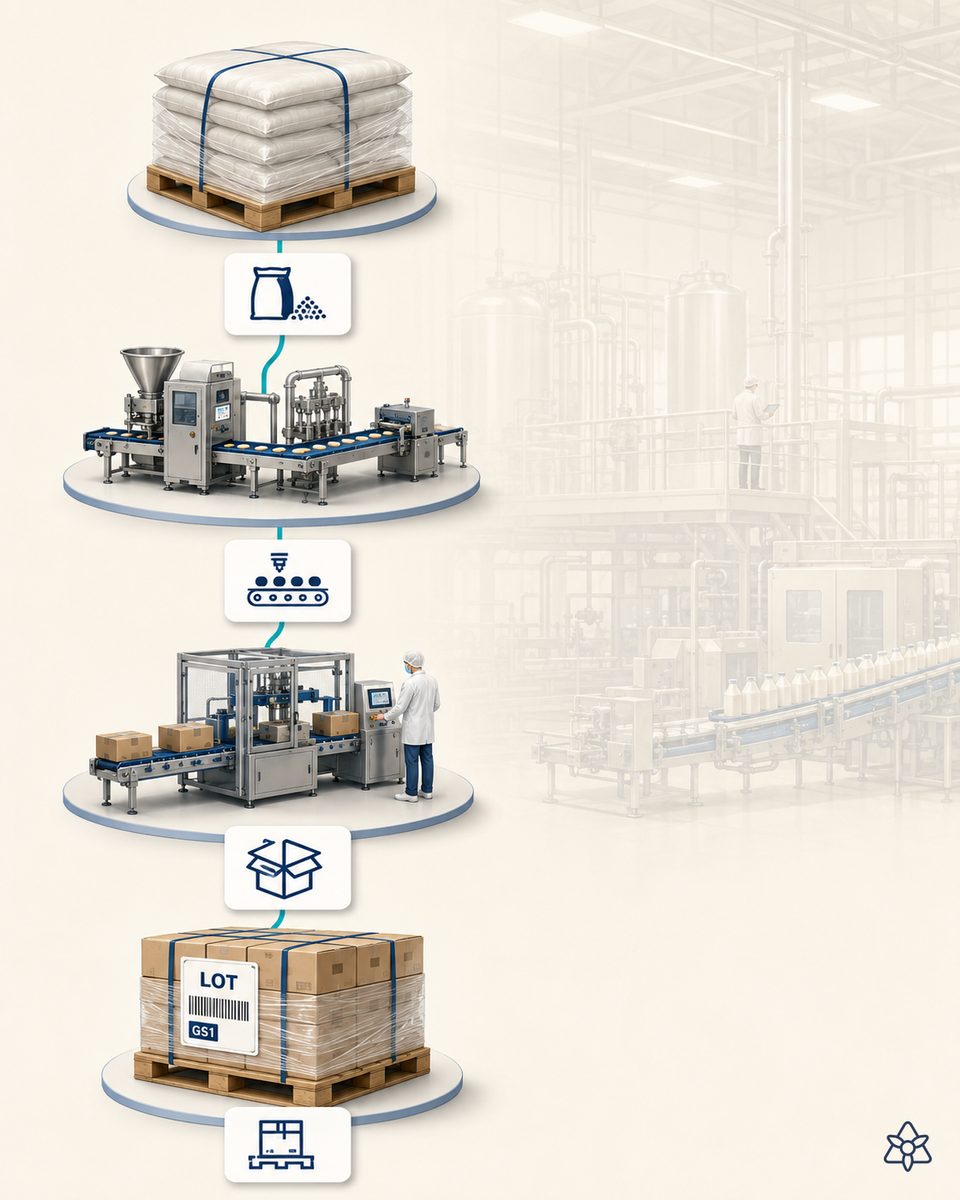
Cocoa comes in through twenty doors. Chocolate goes out through one.
A mid-sized chocolate factory can take in cocoa from eight to fifteen different origins over the course of a year, with different harvests, different certifications (UTZ, Rainforest, organic, fair trade) and different delivery-note formats. Each one comes in through a different door:
- The physical sack — with the exporter's label, sometimes illegible, sometimes carrying nothing but a code only the buyer understands.
- The delivery note — on paper from the carrier, as a PDF emailed by the importer, or by EDI if the supplier is a large one. Three routes for the same piece of data.
- The certificate — UTZ/Rainforest/organic in another email, on another day, sometimes weeks after the sack itself.
- EUDR — plot geolocation, supplier due diligence, signed declaration. One more folder.
After that, the cocoa is blended in hoppers, roasted, winnowed, conched with butter and sugar from other batches, molded. Bean-to-bar traceability has to survive that chain, and it is nearly always held together with spreadsheets, the master chocolatier's notebook and the warehouse lead's memory. It works 95% of the time. The other 5% is an EUDR complaint, a retailer audit or a batch rejected at customs.
iLEAN does not add another spreadsheet — it seals the cracks between the islands you already have.
The problem with cocoa traceability is not a lack of information: it is heterogeneous information arriving through different channels, which nobody has time to put into a common shape before the physical batch moves on. iLEAN acts as the putty that fills the gaps between supplier, warehouse, ERP and plant, without asking you to change anything.
Connect captures the delivery note however it arrives. Edge reads the physical sack. The agent maintains the batch genealogy right through to the bar. The person signs — the person always signs.
The three iLEAN pieces applied to bean-to-bar traceability:
- Connect — outward listening: the importer's email with the certificate, the supplier's WhatsApp with the plot geolocation, EDI where it exists. And inward listening: the receiving operator dictates the weight through the earpiece, the warehouse operator photographs the paper delivery note, the R&D manager says out loud “batch 2401 is 60% Ghana + 40% Ecuador”. It all enters at second zero.
- Edge — a vision + OCR terminal at receiving that reads the sack label and the printed delivery note. And on the line, above the roaster and the molding machine, it maintains the physical batch-to-product assignment at every step. It works with no network.
- Agent — cross-checks delivery note + sack + certificate + EUDR + work order and keeps the per-batch traceability dossier live and queryable. When the complaint or the auditor arrives, there is nothing to rebuild: the file already exists, with a photo of the delivery note, geolocation and the signature of whoever gave the OK.
Manual traceability vs. cross-checked traceability with iLEAN
| Aspect | Spreadsheet + notebook + email | With iLEAN Connect + Edge + Agent |
|---|---|---|
| Delivery-note capture | Paper into a folder, PDF into an inbox | Edge OCR + Connect email/EDI, at second zero |
| Sack identification | Label read by eye by the warehouse lead | Vision + reading, automatic assignment to the batch |
| Blend → bar genealogy | Rebuilt after the fact if a complaint arrives | Maintained live at every step of the process |
| Per-batch EUDR file | A digital folder full of mismatched files | Structured dossier: photo + GPS + signatures |
| Customer complaint | Weeks to answer, risk of finding nothing | Minutes, with visual evidence of the batch |
| IFS/BRC/retailer audit | One person tied up for two weeks | Export the file straight from the system |
Impact estimate for your plant — to be validated with your numbers.
The block below is an estimate to be validated with the specific data of your plant. We put it forward so the committee has an order of magnitude; we refine it during the diagnostic.
- Factory with 6-12 active origins, 2-3 lines (roasting, conching, molding), annual volume between 500 and 5,000 t of cocoa processed.
- Connect + agent pilot at receiving and roasting: delivery-note and certificate capture, per-batch dossier, integration with the scale and the ERP. First value expected within a few weeks.
- Indicative payback between 4 and 9 months, depending on how often EUDR or retailer complaints come in and on the time spent today on audits and manual reconstruction.
- The hard lever is one single consignment not rejected at customs or returned by a retailer, avoided because the file was ready. A single batch pays for the pilot.
And the quality manager's reasonable doubt
“What if the agent pulls a value off the delivery note wrong?” — hallucination is a problem of free generation, not of anchored tasks. When the AI simply recontextualizes a piece of data from a document into a system (it reads a weight, it deposits it in the right batch), the best models brought error below 1.5% [1]. And even so, what is critical is never decided alone: the dossier proposes, the person signs. The three safety rings exist precisely for this.
[1] OpenAI paper “Why Language Models Hallucinate”, 2025 — on the reliability of AI in anchored tasks.
What people ask about cocoa and chocolate traceability
What does the EU's EUDR require for cocoa?
EU Regulation 2023/1115 (EUDR) obliges any operator placing cocoa on the European market to prove that the batch does not come from land deforested after 31/12/2020. In practice: geolocation of the plot of origin, documented due diligence per supplier, batch-by-batch traceability from the cooperative through to the finished chocolate. Anyone who cannot produce the file with verifiable data cannot sell. Meeting that by hand in a spreadsheet is feasible if you have two origins; with twenty blends a week, it is not.
How do you trace a blend of different origins?
By assigning every sack of cocoa to its physical batch at intake, and propagating that identity through the whole process — roasting, winnowing, grinding, conching, tempering, molding. iLEAN Connect captures the supplier's delivery note at second zero (a photo of the document, a PDF by email, a field from the ERP), the agent cross-checks it against the work order and maintains the batch genealogy right through to the finished bar or praline. If a customer files a complaint about a batch, you know within minutes which cooperatives, which harvests and which dates went into it, with nothing to rebuild.
What if the supplier's delivery note arrives on paper?
Edge reads it. A vision- and OCR-equipped terminal photographs the document at receiving, extracts supplier, batch, cooperative, geolocation, weight and the UTZ/Rainforest certificate where applicable, and deposits it in the system as structured data. The day the supplier starts sending PDFs, Connect captures those; the day they move to EDI, it is a direct integration. It does not force you to change suppliers — the putty adapts to whatever arrives.
How is this different from artisan bean-to-bar traceability?
In a small bean-to-bar operation, one person knows every sack and every bar — the traceability lives in their head and in a notebook. That works until that person goes on vacation, or volume grows, or an auditor turns up with questions the notebook cannot answer. iLEAN does not replace the master chocolatier: it captures their judgment and makes it available 24/7 as a structured per-batch dossier, without them having to stop and document. The notebook stays, but it is no longer the only copy.
What does it cost to start a pilot in a chocolate factory?
The order of magnitude for a Connect + traceability agent pilot in a mid-sized chocolate factory covers integration with the ERP, the scale and the roaster, capture of the delivery note (Edge OCR at receiving + the supplier's email/WhatsApp) and the per-batch dossier. The payback you can reasonably take to the committee is a matter of several months — the hard lever is one single EUDR complaint resolved without panic plus retailer-facing traceability with nothing to rebuild. We ask for your plant's data and send you the estimated ROI in 48h, with your numbers, not ours.
More cases in food
- Cheese aging traceability — every wheel leaves with its full history, not in fragments.iLEAN records temperature, humidity and turning per batch throughout cheese aging. Every wheel leaves…
- AI allergen labeling in cheese dairies — a mistake is not a fine, it is a recall.How iLEAN cross-references batch ingredients, cross-contact on the line and EU Regulation 1169/2011 to…
- Cheese defect detection with AI vision — without stopping the line or depending on the end-of-shift eye.Rind cracks, abnormal eyes, deformation — iLEAN Vision detects cheese defects at the end of the line…
- Industrial AI for coffee, culinary, snacks and foodservice groupsReal industrial AI cases for coffee roasting, canning, pasta and central kitchens: capture what is lost…
- Cold room inventory with AI vision — knowing what is there and where without opening the door.iLEAN Vision identifies pallets inside the cold room with no manual scanning and reconciles them with…
- Confectionery glazing with AI vision — expensive chocolate does not get thrown away; it gets spread properly.How iLEAN sees coating, gloss and clumps at the coating pan outlet, adjusts dosing and time, and cuts…
Tell us your case and in 48h we'll send you the estimated ROI of this AI project for your chocolate operation.
We work on your plant's real data, not ours. Diagnostic with no commitment.
Request estimated ROI in 48h See food industry