Cheese aging traceability — every wheel leaves with its full history, not in fragments.
Every batch of aged cheese spends weeks or months in the room. iLEAN continuously records temperature, humidity and turning for each wheel and rebuilds its complete history — for the auditor, for the PDO regulatory council, and so the production manager knows exactly what happened to last month's batch without rebuilding a thing by hand.
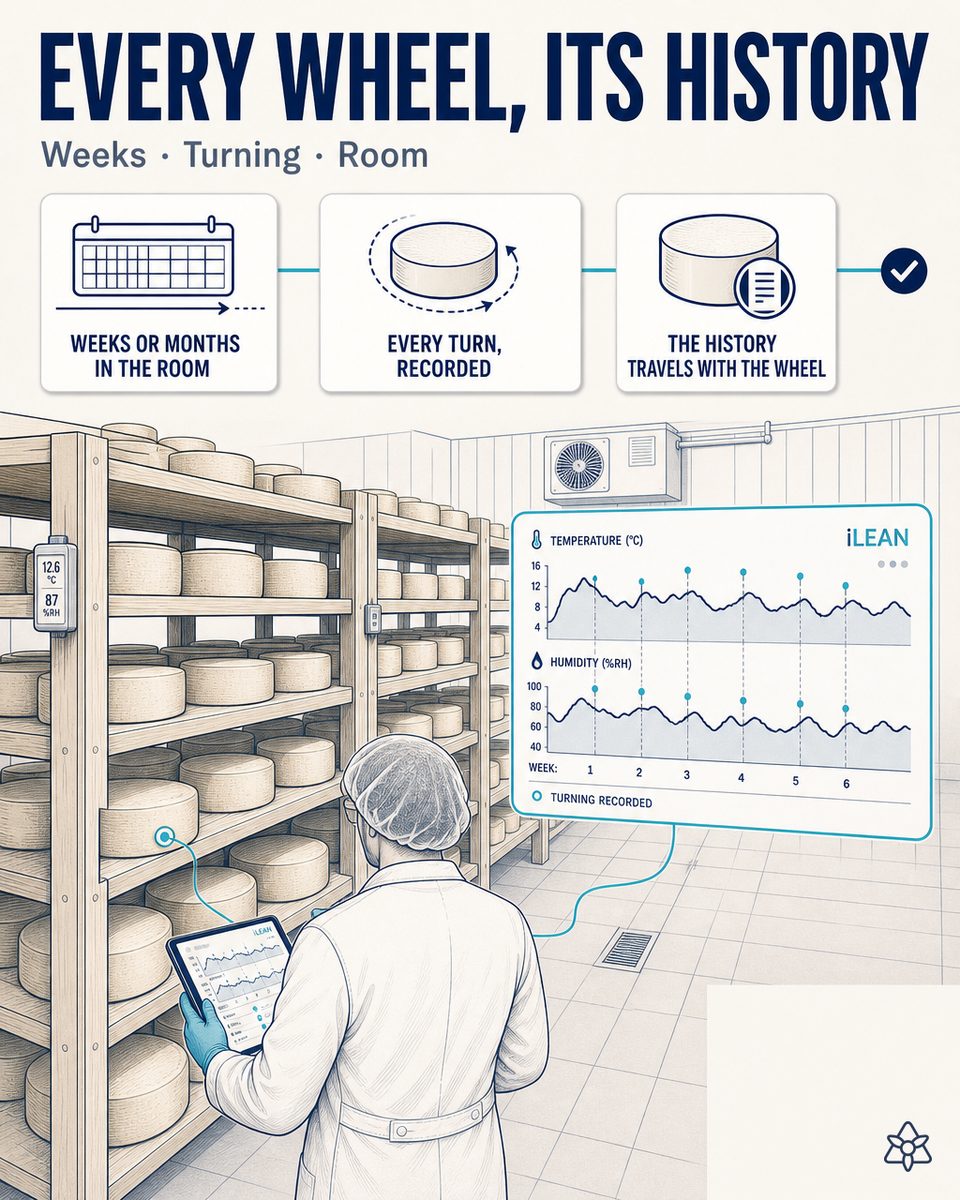
Months in the room, and a shift report to account for it.
Aging a cheese is an exercise in patience: the batch goes into the room, and across the weeks and months it spends inside, thousands of small things happen — a thermocouple that drifts, a door left open too long, a night when the climate control resets itself, a turning the operator did properly but never wrote down because the shift changed at exactly that moment. None of those things, on its own, ruins anything. All of them together do.
The classic system — shift reports every 4 hours, a manual round, a spreadsheet at the end of the month — covers the visible points. What happens between the points is recorded nowhere. And what happens between the points is exactly where these things get decided:
- The rind that comes out thin when it should have come out thick, because humidity dropped three nights running and nobody saw it.
- The batch that loses its PDO seal because the inspector asks for the full profile and all there is are 6 readings a day.
- The year sales climb and production realizes it cannot reconstruct which batch was the good one — because what it has is scraps of paper, not data.
The master cheesemaker knows — their eye carries it. The day they retire, half the plant walks out with them. That island of knowledge is the largest one, and the worst protected.
iLEAN seals the cracks between the room, the turning robot and the shift report.
The problem with aging is not a lack of sensors — it is that the data lives on islands: the room's climate in the BMS, the turning robot in its own PLC, the operator's rounds on paper, the deviations in the master cheesemaker's head. iLEAN acts as the putty that fills the gaps between those systems, without asking you to change the climate control, the robot or the ERP.
Edge measures continuously where a shift report never reached. Connect captures manual turning just as it captures the robot's. The agent rebuilds each wheel's history. The master cheesemaker signs — and the knowledge stops walking out the door with them.
The three iLEAN pieces applied to aging traceability:
- Edge — a terminal with sensors distributed across the levels and zones of the room (the top and the bottom of a large room do not breathe alike), which also reads the signal from the existing climate control and from the turning robot where there is one. It works with no network: if the plant loses WiFi, it keeps measuring and recording on the panel's own power, because what is critical cannot depend on connectivity.
- Connect — captures manual turning through whatever route the team already uses: the batch code scanned with a phone or earpiece at the end of the pass, voice dictation, a photo of the shift report. And it also captures what arrives from outside (an email from the regulatory council, a WhatsApp from the importing customer with a question about last winter's batch) at second zero, without anyone forwarding anything.
- Agent — cross-checks the room profile, the turnings, the entries and exits, the cleanings and the incidents per batch. It rebuilds the batch file the moment it is asked for, not the following week. If there is a significant deviation, it warns the master cheesemaker before the pattern sets in. The person signs — the batch is never released on its own.
Aging with shift reports vs. aging with a per-batch dossier
| Aspect | Rounds + spreadsheet | With iLEAN Edge + Connect + Agent |
|---|---|---|
| Measurement frequency | Every 4 h, at one convenient spot | Continuous, several points per room |
| Turning record | Paper checklist, signed by the shift | Robot integrated + Connect for manual turning |
| Overnight deviation | Discovered the next day, if at all | Alarm at second zero, to the manager's channel |
| Dossier for IFS/BRC/PDO auditor | Rebuilt by hand, weeks | Signed per-batch file, automatic |
| The master cheesemaker's knowledge | Lives only in their head | Captured as a pattern, stays in the plant |
| Operation without network | n/a | Edge keeps measuring on the panel's own power |
Impact estimate for your plant — to be validated with your numbers.
The block below is an estimate to be validated with the specific data of your plant. We put it forward so the committee has an order of magnitude; we refine it during the diagnostic.
- Aged-cheese dairy with several mid-sized rooms, semi-industrial profile, a mix of manual and robotic turning. Roughly what it takes to instrument one standard room as a pilot.
- First value expected within a few weeks: per-batch dossier running, deviation alarms going to the manager's channel, integration with the existing climate control.
- Indicative payback between 4 and 9 months, depending on the weight of deviation-driven scrap in your product mix and on the cost of rebuilding files by hand for the auditor or the PDO council.
- Hard levers: reduction in scrap per batch (out-of-spec rind, deformation, affinage problems) ≥ 30% as a conservative estimate; office hours spent rebuilding files eliminated; a stronger position in front of a PDO inspection.
And the technical director's reasonable doubt
“What if the AI invents a value that was never measured?” — hallucination is a problem of free generation, not of anchored tasks. In tasks where the AI simply reads a real sensor value and recontextualizes it (summarizing the room's day, generating the batch dossier, comparing against history), the best models brought error below 1.5% [1]. And even so, what is critical is never released on its own: iLEAN proposes, the person signs. The three safety rings exist precisely for this — the room's agent does not release the batch, it only prepares it.
[1] OpenAI paper “Why Language Models Hallucinate”, 2025 — on the reliability of AI in anchored tasks.
What people ask about cheese aging traceability
What has to be recorded per batch during cheese aging?
The minimum you can defend in front of an IFS/BRC auditor or a PDO regulatory council is: continuous temperature and relative humidity (not isolated readings once a shift), turnings performed with their time and the operator or robot that did them, batch entries and exits from the room, cleanings and surface treatments (washed rind, oils, preservatives), and incidents (power cut, climate system stoppage, door left open longer than X minutes). The classic system — an operator writing on a shift report every 4 hours — covers the points but loses everything in between. And what happens in between is where the year's rind is decided.
How is turning tracked, manual or automatic?
In a room with a turning robot, iLEAN integrates the robot's signal directly — every movement lands in the batch dossier with a timestamp. In a room with manual turning, Connect captures the event through whatever route the team already uses: reading the batch code with a phone or earpiece at the end of the pass, voice dictation (“line 2, batch 247, turned”), or a photo of the shift report. Connect carries, the agent decides, the person signs. The result is the same: every wheel has a record of how many times it has been turned, when, and by whom, with no paper checklist to lose.
What happens if a room drifts out of range for 2 hours?
Edge detects the deviation at second zero and raises the alarm through whichever channel you use (phone, earpiece, call). The agent weighs the severity — how many degrees, how many minutes, what aging stage that batch is at — against the room's history and proposes an action: hold the batch for sensory review, adjust the curve, or document and carry on. The person signs. Even if the plant loses its network, Edge keeps measuring and recording on the panel's own power, because what is critical cannot depend on there being WiFi.
Can I certify traceability for a PDO with iLEAN?
Yes — the per-batch dossier iLEAN generates covers what a PDO regulatory council asks for: unambiguous batch identification, a full temperature and humidity profile across the whole aging period, turnings and handling, effective time in the room. It delivers it as a signed file, ready for inspection, with nothing rebuilt by hand two months later. The auditor opens the batch record and sees the whole history — not a spreadsheet somebody filled in on Friday.
How much instrumentation does iLEAN put in a standard aging room?
Enough for the measurement to represent the whole room, not one convenient spot: typically several temperature/humidity sensors distributed across levels and zones (the top and the bottom of a large room do not breathe alike), a door sensor, and integration with the climate control you already have (the BMS is not replaced, it is read). In rooms with a turning robot we add the robot's signal. The cost is that of a food-industry Edge pilot: sensors + terminal + integration + annual license. An estimate to be validated against the geometry of your room and the climate system you already run.
More cases in food
- Industrial artificial intelligence for cane sugar refineries12 real AI use cases for cane sugar refining: paperless capture, in-line vision inspection and…
- Canned vegetable control with AI — F0, seam and weight, traceable without notebooks.How iLEAN cross-checks sterilization F0, hermetic seam, net weight and traceability on canned vegetable…
- Digital HACCP for dairy with AI — automate the CCPs and leave the real decisions to the team.Every CCP in the HACCP plan monitored continuously. iLEAN generates the signed per-shift record and…
- AI allergen labeling in cheese dairies — a mistake is not a fine, it is a recall.How iLEAN cross-references batch ingredients, cross-contact on the line and EU Regulation 1169/2011 to…
- Cheese defect detection with AI vision — without stopping the line or depending on the end-of-shift eye.Rind cracks, abnormal eyes, deformation — iLEAN Vision detects cheese defects at the end of the line…
- Cocoa and chocolate traceability with AI — from the sack to the bar, without fighting for it by hand.iLEAN cross-checks origin delivery notes, batches, harvest blends and EUDR to trace bean to bar — no…
Tell us your case and in 48h we'll send you the estimated ROI of continuous traceability for your aging operation.
We work on your plant's real data, not ours. Diagnostic with no commitment.
Request estimated ROI in 48h See food industry