Canned vegetable control with AI — F0, seam and weight, traceable without notebooks.
A canned vegetable stakes the whole batch on three levers: sufficient sterilization (F0), a verified hermetic seam and correct net weight. iLEAN joins the retort's SCADA, the seamer and the recipe, proposes a hold when something doesn't add up and generates the per-batch IFS/BRC dossier. The person signs.
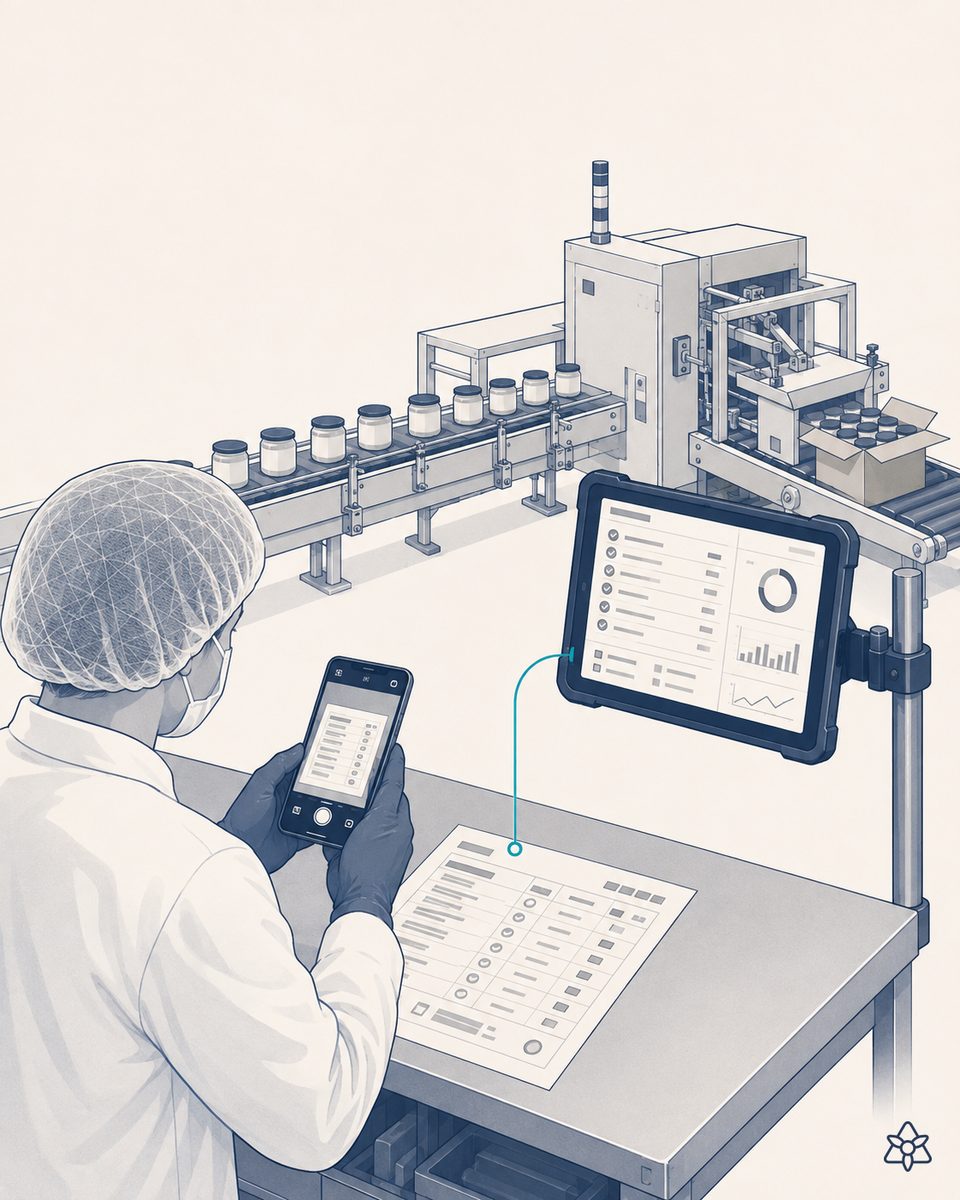
F0, seam and weight — three critical data points, three systems that don't talk to each other.
In a canned vegetable plant the quality manager carries three loads at once:
- The retort's F0 — recorded in the SCADA (or, on old batch retorts, on a paper chart) and only reviewed in full at batch close-out. A cycle with a partial steam drop mid-process may trigger no alarm and leave F0 below target.
- The can's double seam or the jar's cap — verified by destructive sampling every shift (opening cans and measuring hooks). With sampling, the problem shows up when there are already cases in the warehouse.
- Net weight and batch recipe — in the checkweigher and in the ERP/MES, kept apart, with SKU changeovers managed through a paper checklist.
The classic system works because there is a procedure. The problem is that a swollen-can health alert doesn't hit RASFF every year — but when it does, the plant shuts down for weeks. In this sector, the case for continuous quality insurance sells itself.
iLEAN doesn't replace your retort or your seamer — it seals the cracks between what you already have.
The canned vegetable problem isn't a lack of instrumentation: it's information living on islands (the retort's SCADA, the seamer's PLC, the recipe's ERP, sampling in the lab) that only gets cross-checked at the end, not in line. iLEAN acts as the putty that joins those islands and closes the see-decide-act loop before labeling.
Edge sees the double seam can by can. Connect reads F0, the seamer and the recipe. The agent cross-checks and, if something doesn't add up, holds the batch. The person signs — never the other way around.
The three iLEAN pieces applied to canned vegetables:
- Edge — terminal with machine vision (CNN) over the seamer and the label. Detects double-seam defects (short hook, false seam, wrinkle), misplaced caps on glass jars and fires the ejector in milliseconds. Works without a network: if the plant loses WiFi, Edge keeps classifying and holding.
- Connect — captures the F0 curve from the retort's SCADA (or digitizes the old batch retort's circular chart from a photo), the seamer's mechanical parameters (hook, overlap, pressure) and the batch recipe from the ERP/MES. And it captures what arrives from outside: the supplier's email about a change in the lid material, the importer's email with the new FDA rule.
- Agent — cross-checks F0, seam, net weight, recipe and the HACCP standard. If there is a deviation, it holds the batch before labeling and generates the incident dossier. For routine audits, it prepares the complete per-batch dossier. The Agents have no hands on critical OT: they propose and the person signs.
Sampling + retort chart vs. cross-checked control with iLEAN
| Aspect | Sampling + checklist + chart | With iLEAN Edge + Connect + Agent |
|---|---|---|
| F0 verification of the cycle | At batch close-out | Continuous + cross-check against the authorized recipe |
| Detecting a defective seam | Destructive sampling per shift | Edge vision can by can, ejector in ms |
| Root cause of the defect | “The lid supplier” | Cross-checked against seaming-roll wear |
| SKU changeover (allergens, weight) | Paper checklist | Agent verifies recipe and label cross-checked |
| Dossier for FDA/IFS/BRC | Manual reconstruction, weeks | Automatic per-batch dossier with image and F0 |
| Old retort's circular chart | Paper, physical archive, eventually illegible | Digitized from a photo, indexed by batch |
Impact estimate for your plant — to be validated with your numbers.
The block below is an estimate to be validated with the specific data of your plant. We put it forward so the committee has an order of magnitude; we refine it during the diagnostic.
- Plant with 1-2 canned vegetable packing lines (can or tinplate + twist-off glass), batch or continuous retorts.
- Edge + Connect pilot (cameras over the seamer and labeling + integration with the retort's SCADA and the batch recipe). First value expected within a few weeks.
- Indicative payback between 4 and 9 months, depending on your current scrap rate from defective seams and repeated cycles, plus the insurance value of a preventive hold on an F0 deviation.
- Hard lever: one avoided health alert multiplies the ROI. The recurring scrap savings on seams are the floor.
And the HACCP manager's reasonable doubt
“What if the AI approves a seam that isn't good?” — the agents don't sign: they propose, the person decides. And in anchored tasks (classifying double-seam geometry against the IFT standard), the best models brought error below 1.5% [1]. The system is calibrated toward whichever conservative side you choose: when in doubt, hold and confirm with destructive sampling. Edge adds arms to your HACCP — it doesn't decide in your place.
[1] OpenAI paper “Why Language Models Hallucinate”, 2025 — on the reliability of AI in anchored tasks.
What people ask about canned vegetable control with AI
What is F0 and why is it the critical point of a canned vegetable?
F0 is the accumulated lethality value during sterilization, expressed in minutes equivalent to 121.1 °C. It is the indicator that proves the thermal treatment was sufficient to inactivate Clostridium botulinum in low-acid foods (pH > 4.6) such as green beans, asparagus or artichokes. Any downward deviation from the expected F0 (a retort temperature deviation, an interrupted cycle, a badly stacked crate) is a HACCP critical control point and forces a batch hold — it is not up for debate.
How is the hermetic seal of the can or glass jar controlled in line?
By combining vision inspection with seamer data. iLEAN Edge runs a CNN trained to detect double-seam defects on cans (body hook, cover hook, overlap) and misplaced caps on glass jars. If a defect exceeds the threshold, the agent cross-checks against the seamer's mechanical parameters from the SCADA: if the hook is short because the seamer's seaming roll wore down, the root cause is raised as a maintenance alert, not just a quality alarm.
How is traceability maintained for an IFS/BRC audit or an FDA request?
iLEAN generates an automatic per-batch dossier that combines: F0 charts from the retort's SCADA, cycle records (ramp, hold, cooling), net weight from the checkweigher, sampled seam images, raw-material batch data and the quality manager's signature. For an IFS, BRC or GMP audit or an FDA request for export, the dossier is out in minutes. It doesn't replace your systems — it joins them and makes them searchable as a single per-batch file.
Can iLEAN integrate with old retorts without changing the machine?
Yes. iLEAN Connect scales to whatever the retort has: if it has a modern SCADA, direct integration with the F0 curve and the traceability; if it only exposes an old isolated local panel, Connect hooks in and extracts the data; if the record is analog (a circular chart), a person photographs the chart at the end of the cycle and the data enters as an image extracted by inference. It does not force you to change the retort — putty fills the cracks; it doesn't demolish.
What payback is reasonable in a canned vegetable plant?
An Edge + Connect pilot on a canned vegetable line (cameras over the seamer and labeling + integration with the retort's SCADA and the batch recipe) is in the same order of magnitude as any Edge pilot in a food plant. First value in a few weeks; indicative payback between 4 and 9 months. The hard lever is the scrap avoided from defective seams (a reasonable reduction is ≥30%), fewer repeated cycles from out-of-range F0 and the cost of one avoided health-alert recall — which, happening just once, pays for the pilot and multiplies the ROI. We ask for your data and send you the estimated ROI in 48h.
More cases in food
- AI control of bulk wine — a tanker loaded from the wrong tank is an entire lot downgraded.iLEAN records every tank transfer from a tablet, keeps the tank map live in real time and holds the…
- Butter and margarine control with AI — a badly churned mold goes unseen until it is already in the cold room.How iLEAN cross-references recipe, churning, dosing and in-line vision to keep emulsion, weight and…
- Industrial artificial intelligence for cane sugar refineries12 real AI use cases for cane sugar refining: paperless capture, in-line vision inspection and…
- Digital HACCP for dairy with AI — automate the CCPs and leave the real decisions to the team.Every CCP in the HACCP plan monitored continuously. iLEAN generates the signed per-shift record and…
- Cheese aging traceability — every wheel leaves with its full history, not in fragments.iLEAN records temperature, humidity and turning per batch throughout cheese aging. Every wheel leaves…
- AI allergen labeling in cheese dairies — a mistake is not a fine, it is a recall.How iLEAN cross-references batch ingredients, cross-contact on the line and EU Regulation 1169/2011 to…
Tell us your case and in 48h we'll send you the estimated ROI of this AI project for your canned vegetable plant.
We work on the real data of your plant, not ours. Diagnostic with no commitment.
Request estimated ROI in 48h See food industry