Digital HACCP for dairy with AI — automate the CCPs and leave the real decisions to the team.
A well-executed HACCP plan means hundreds of records a day — and at the end of the shift someone always stays behind filling in logbooks. iLEAN automates the critical CCPs (pasteurization, pH, brine, ripening room), generates the signed per-shift record and prepares the audit on its own, leaving the team only what truly needs a person: the decisions when there is a deviation.
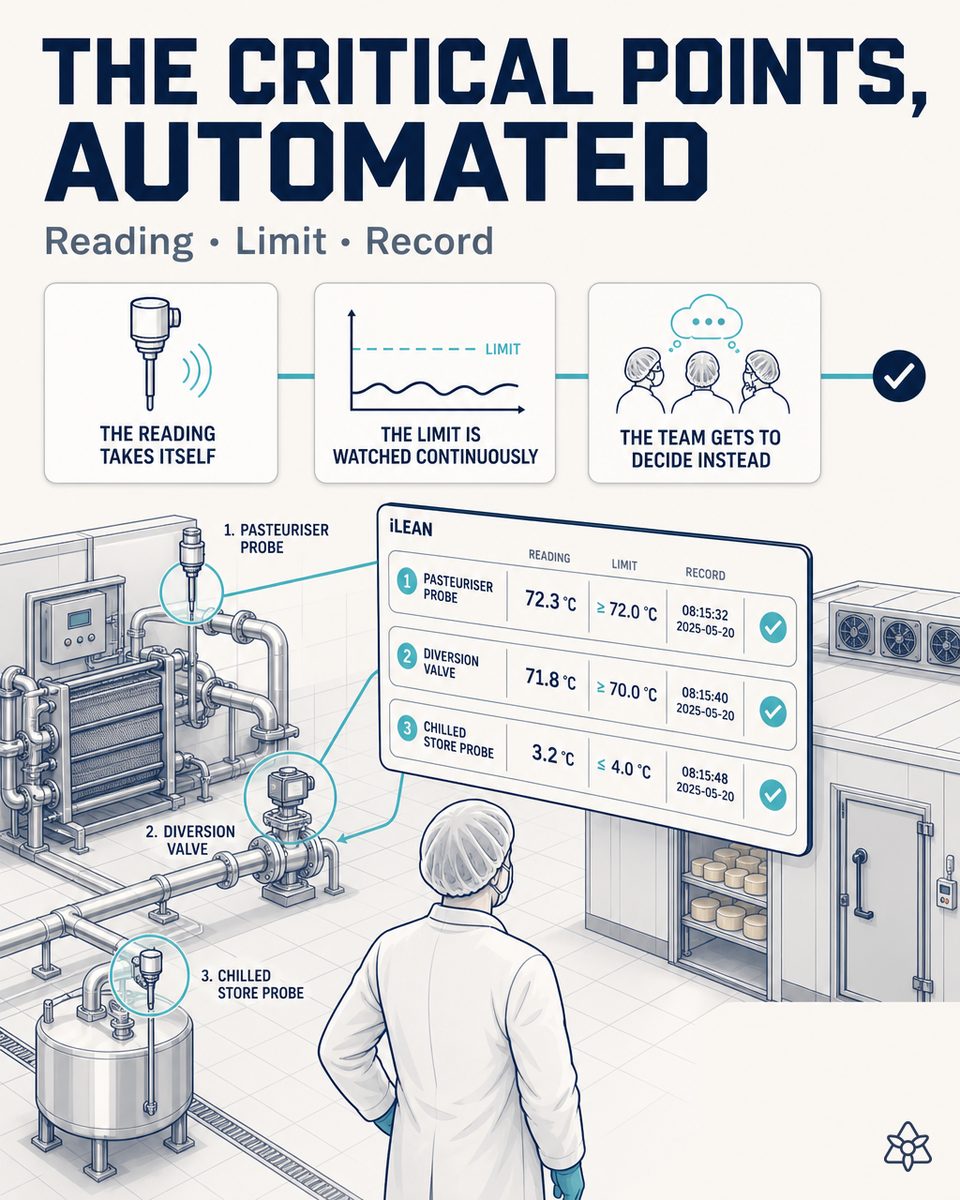
Someone fills in the logbook at the end of the shift — and that is exactly what the auditor does not want to see.
An honest HACCP plan in a dairy plant means hundreds of records a day: pasteurizer temperature every so many minutes, pH of the curd vat, brining time, ripening room temperature, cleaning at every SKU change, personnel hygiene records. On paper, everything looks fine. On the floor:
- The operator fills in at the end of the shift what they could not jot down in the moment — and sometimes, what they had not remembered to check. The record exists; the actual traceability, not entirely.
- The records live in physical logbooks or loose spreadsheets that pile up in the quality office and that nobody reviews until an audit is announced.
- When the auditor arrives, the reconstruction starts two weeks earlier: transferring logbooks into spreadsheets, assembling the dossier, hoping no day is missing and that the operator who signed is available to clarify.
The quality manager knows the system works 99% of the time — and that the remaining 1% is exactly what shows up in the audit. The quality team does not do quality: it chases paper.
iLEAN does not replace the HACCP plan — it digitizes it CCP by CCP, with no paper or spreadsheets.
The problem with HACCP on the floor is not the plan: it is that the data needed to comply with it lives in places where nobody is cross-referencing it continuously. iLEAN acts as the putty that seals the cracks between the SCADA, the thermocouples, the ripening room, the operators and the quality system — without asking you to change the plan, the ERP or the way you get audited.
Edge watches the automatable CCPs. Connect captures the manual ones. The agent generates the signed per-shift record. The quality manager only decides when there is a deviation.
The iLEAN pieces applied to dairy-plant HACCP:
- Edge — terminals on the floor next to the automatable critical points (pasteurizer outlet, curd vat, ripening room). It reads from the PLC or adds its own sensor, processes locally, and generates the CCP record continuously. It works without a network: if the plant loses WiFi, the records keep being saved and sync on reconnection.
- Connect — for the CCPs that require human intervention (visual check, sampling, seal inspection), it captures the operator's reading by voice or a photo of the panel without asking them to open a logbook. The mobile app or tablet is the entry gate — the operator dictates the reading, takes a photo, and the record is signed and dated.
- Writer (documentation agent) — compiles all the records per shift, batch, line or audit, signed with timestamp and traceability. When the IFS/BRC/ISO 22000 auditor arrives, the dossier is generated in minutes: complete records, evidence of corrective actions, batch by batch. The boring, concrete agent that closes the sale: the batch file for the auditor.
HACCP on logbook / spreadsheet vs. digital HACCP with iLEAN
| Aspect | Logbook + spreadsheet | With iLEAN Edge + Connect + Writer |
|---|---|---|
| Moment the CCP is recorded | At end of shift, from memory | Continuously, at the instant it is measured |
| Signature traceability | A scribble on paper, no timestamp | Electronic signature with timestamp and role |
| CCP deviation | If seen, noted after the fact | Batch hold + alert + templated corrective action |
| HACCP plan in a multi-product plant | Operator has to remember which logbook to open | The agent switches plans when the SKU changes |
| IFS/BRC audit preparation | Two weeks of manual reconstruction | Dossier in minutes, complete and signed |
| Quality team's time | Chasing paper | On analysis and decisions, not transcription |
Impact estimate for your plant — to be validated with your numbers.
The block below is an estimate to be validated with the specific data of your plant. We put it forward so the committee has an order of magnitude; we refine it during the diagnostic, reviewing your HACCP plan, the existing CCPs and the historical non-conformities.
- Mid-sized dairy plant (cheese, yogurt or fluid milk) with 8-20 CCPs in the HACCP plan, IFS Food or BRC Global Standard for Food Safety certification, a quality team of 2-5 people, 1-2 major audits per year.
- Edge deployment on the automatable CCPs + Connect for the manual ones + Writer for the audit dossier. First value expected within a few weeks: the first CCPs running continuously, signed records, logbook eliminated at those points.
- Indicative payback between 4 and 9 months, depending on the number of CCPs to digitize, the share of the quality team's time spent transcribing and the frequency of historical non-conformities tied to incomplete records.
- Expected reduction in the quality team's time spent transcribing records ≥ 30% after the first wave of digitization — and a near-total reduction in "record not available" non-conformities once all critical CCPs run continuously.
And the quality director's reasonable doubt
“What if the agent hallucinates and signs a CCP record that wasn't real?” — hallucination is a problem of free generation, not of anchored tasks. Reading a thermocouple from the SCADA or transcribing a reading dictated by the operator is the anchored task par excellence — the best models brought error below 1.5% [1]. And even so, what is critical is never decided alone: when there is a deviation, the agent holds the batch and the person signs the corrective action. The three safety rings exist precisely for this.
[1] OpenAI paper “Why Language Models Hallucinate”, 2025 — on the reliability of AI in anchored tasks.
What people ask about digital HACCP with AI in dairy
How does iLEAN replace the HACCP spreadsheet and paper?
It does not replace them overnight — it empties them out CCP by CCP. For each critical point (pasteurization temperature, curd pH, brining time, ripening room temperature), iLEAN reads the real signal from the SCADA, the thermocouple or the existing sensor and generates the record continuously. Where there is no automated sensor, Connect captures the operator's manual reading by voice or a photo of the panel, without asking them to write on a sheet. The record is signed by person, machine, batch and shift — the operator no longer fills in the logbook at 10 pm because there was no time during the shift.
Do IFS, BRC and ISO 22000 auditors accept iLEAN's records?
Yes — and usually better than the logbook. What an IFS/BRC auditor needs to see is traceability of every CCP, a valid electronic signature from the responsible person, evidence of action when there is a deviation, and a dossier that can be rebuilt by batch or by shift. iLEAN generates all of that automatically: every CCP is timestamped, signed by a person, tied to the batch in production and, if there was a deviation, comes with the complete corrective action record. The audit dossier is generated in minutes, not in the usual two weeks of pre-audit panic.
Who validates the electronic signature on the record?
The person who signs it — always. iLEAN signs for no one. Every operator, shift lead or quality manager has their own credentials and signs the records that fall to them under the role defined by the HACCP plan. For the auditor, the electronic signature complies with eIDAS (EU Regulation 910/2014) if configured with a qualified certificate, or as an advanced electronic signature with a timestamp in all other cases. Its validity before an IFS/BRC auditor is the same as that of the signed paper logbook — with the advantage of never getting lost and of being legible.
What does iLEAN do when a CCP deviates?
Three things at once: (1) it holds the batch downstream if the deviation warrants it (the agent blocks packing or dispatch of the affected batch), (2) it alerts the quality manager through whatever channel they use, with the detail of the deviation, time, machine and affected batches, and (3) it opens the corrective action record with a template preloaded according to the HACCP plan's procedure. The person validates and signs — the agent does not close a CCP deviation on its own. The three safety rings exist precisely for this.
Does iLEAN work in a multi-product plant with several HACCP plans?
Yes — and that is where it makes the biggest difference. A multi-product dairy plant (fluid milk + yogurt + cheese + cream) has one HACCP plan per product line, with different CCPs, different thresholds and different procedures. iLEAN understands what is being produced on each line at each moment (through MES integration or Edge capture) and applies the correct plan. When the same line changes SKU, the agent automatically switches to the corresponding HACCP plan and the right set of CCPs — without the operator having to remember which logbook to open.
More cases in food
- Butter and margarine control with AI — a badly churned mold goes unseen until it is already in the cold room.How iLEAN cross-references recipe, churning, dosing and in-line vision to keep emulsion, weight and…
- Industrial artificial intelligence for cane sugar refineries12 real AI use cases for cane sugar refining: paperless capture, in-line vision inspection and…
- Canned vegetable control with AI — F0, seam and weight, traceable without notebooks.How iLEAN cross-checks sterilization F0, hermetic seam, net weight and traceability on canned vegetable…
- Cheese aging traceability — every wheel leaves with its full history, not in fragments.iLEAN records temperature, humidity and turning per batch throughout cheese aging. Every wheel leaves…
- AI allergen labeling in cheese dairies — a mistake is not a fine, it is a recall.How iLEAN cross-references batch ingredients, cross-contact on the line and EU Regulation 1169/2011 to…
- Cheese defect detection with AI vision — without stopping the line or depending on the end-of-shift eye.Rind cracks, abnormal eyes, deformation — iLEAN Vision detects cheese defects at the end of the line…
Tell us your case and in 48h we'll send you the estimated ROI of this AI project for your HACCP plan.
We work on your plant's real data, not ours. Diagnostic with no commitment.
Request estimated ROI in 48h ‹ All dairy cases See food industry