Cheese defect detection with AI vision — without stopping the line or depending on the end-of-shift eye.
Visual cheese defects — cracks, abnormal eyes, deformation — used to be manual inspection at the end of the line. iLEAN Vision detects them continuously, routes every doubtful piece to the quality agent and, when needed, triggers the rejector. Assist and simplify, not replace: the operator decides better and with less weight.
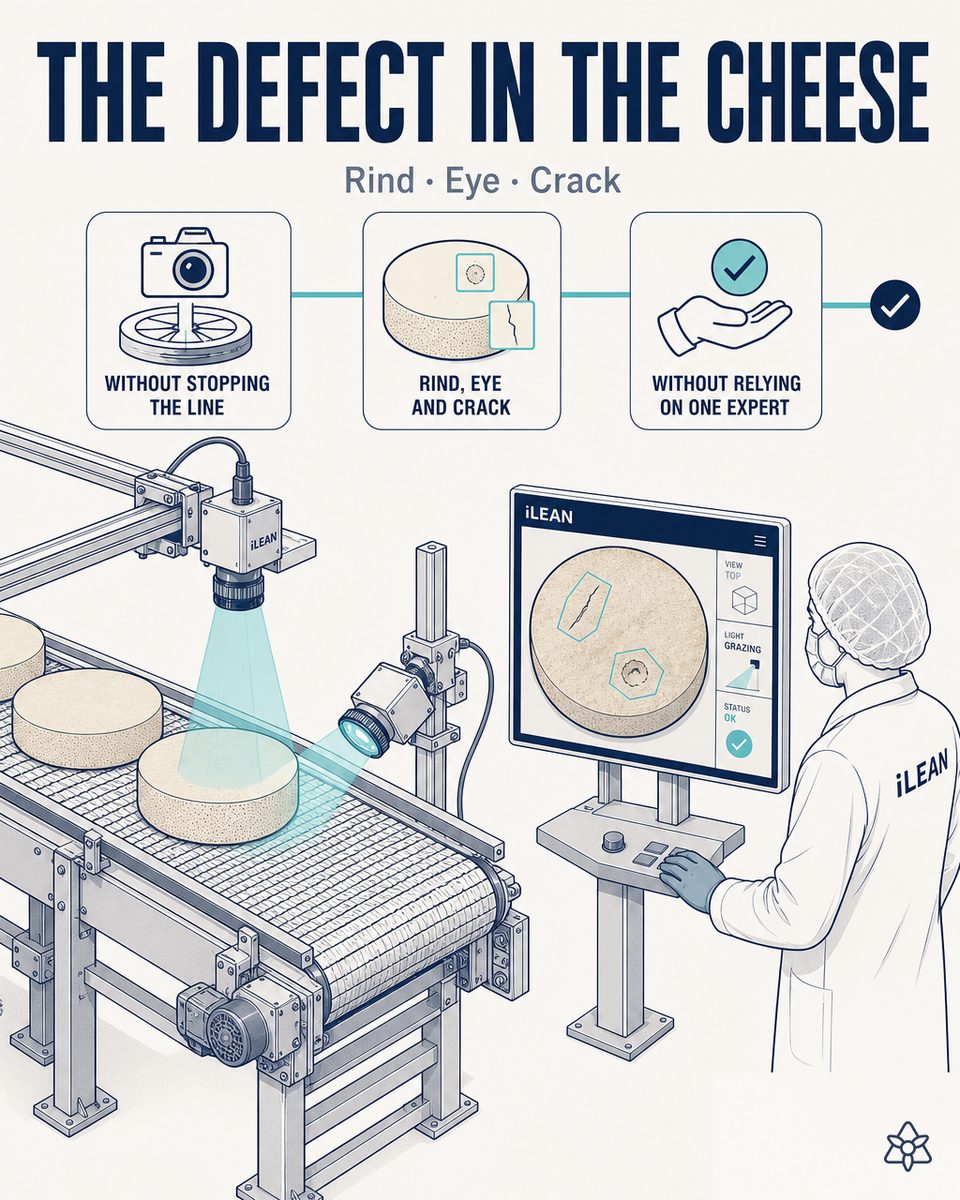
End of line, last shift, tired eye: the defect that slips through the filter.
A cheese defect is almost never massive — it's one wheel out of every so many, a fine crack you only see by turning the piece, an abnormal eye that shows up in the cut the end customer makes at their deli counter. The classic system is an operator at the end of the line inspecting every wheel. It works — 99% of the time. But three plant conditions erode it:
- Visual fatigue: 7 hours into the shift, the brain filters. The operator is still looking, but no longer sees the same things.
- Inconsistent criteria: what one operator rejects, another lets through. The quality of the batch depends on who's on shift.
- Fine defects: a 0.3 mm hairline crack on a mottled rind is invisible to the eye at line speed — but visible to a camera with a model trained on real cracks from your own plant.
The easy reproach would be “the operator is doing it wrong”. And it's unfair — they do it well, within what a human being can do over 8 hours looking at wheels. The problem isn't the person, it's the problem itself. AI, now, solves it.
iLEAN doesn't push the operator out — it takes away the dumb work and leaves them the work that matters.
The ladder of verbs matters: solve → automate → mechanize → simplify → assist. iLEAN plants its flag on simplify and assist, not on automate. The camera doesn't push the operator out; it takes away the 7 hours of looking at what was fine and leaves them the 30 doubtful pieces that genuinely call for judgment. That's the difference between the lights-out factory and the empowered factory.
Edge sees every wheel and keeps the doubtful ones. The agent routes them to the quality lead. The person signs — the system never decides alone. The operator's knowledge stays in the plant as a pattern.
The three iLEAN pieces applied to visual detection in cheese:
- Edge — a machine-vision (CNN) terminal mounted over the end-of-line belt. It detects cracks, abnormal eyes, deformation, spots. It drives the actuator you already have (ejector, light stack) in milliseconds. It works without a network: if the plant loses WiFi, the camera keeps classifying and rejecting, powered from its own panel.
- Connect — captures the operators' decisions on the doubtful pieces (“this one passes”, “this one doesn't, flag this”) through whatever channel they already use: earpiece, phone, photo. Every decision feeds the model. The plant is what teaches the system, not the other way around.
- Agent — classifies the doubtful pieces, prepares the per-shift and per-line statistics, and warns when a pattern accelerates (cracks on line 2 are up 40% this week — the curd is probably different). The person signs; the agent proposes, it doesn't stop the line on its own.
Exhaustive human inspection vs. inspection by exception with AI vision
| Aspect | Operator at the end of the line | With iLEAN Vision + agent |
|---|---|---|
| Coverage | Whatever the eye can reach at line speed | Every piece, no exceptions |
| Criteria | Varies with operator and time of day | A single model trained on your defects |
| Fine defects (hairline crack, subtle eye) | Slips through at the end of the shift | Detected at any hour of the day |
| Operator workload | 8 hours looking at wheels | Time freed up for real decisions |
| Defect statistics per shift | By hand, weekly, aggregated | Automatic, per line and per hour |
| Operation without a network | n/a | Edge keeps classifying, powered from its own panel |
Impact estimate for your plant — to be validated with your numbers.
The block below is an estimate to be validated with the specific data of your plant. We put it forward so the committee has an order of magnitude; we refine it during the diagnostic.
- End-of-line with a belt and operators inspecting, a mix of aged or table cheeses. Vision pilot on one line.
- First value expected within a few weeks: operational detection of the 2-3 defect families you reject the most, integration with the existing actuator, per-shift statistics.
- Indicative payback between 4 and 9 months, depending on the current % of defects reaching the customer, the cost of complaints/returns, and the man-hours freed from exhaustive inspection.
- Hard levers: defects reaching the customer down ≥ 30% (conservative estimate); operator time freed for tasks that genuinely call for judgment; per-shift statistics that let you attack the root cause.
And the quality lead's reasonable doubt
“What if the AI confuses two similar defects?” — positive preemption: the vision isn't a detector that says “defect yes/no” and that's it. It's a classifier that labels and leaves the doubt to the human when confidence isn't high. The clear pieces (the ones the model has already seen thousands of times) are processed on their own; the doubtful ones — the model's boundary — go to the operator's screen, where they decide and sign. In anchored tasks like this one (looking at an image and comparing it against patterns), the best models keep the error below 1.5% [2]; the rest is decided by the person, not the system.
[1] Automotive quality standard in the order of 25 PPM — Symestic.
[2] OpenAI paper “Why Language Models Hallucinate”, 2025 — on the reliability of AI in anchored tasks.
What people ask about visual cheese defect detection
What defects can it be trained to detect?
The usual suspects in table or aged cheese: rind cracks, abnormal eyes (presence or size out of spec for the type), wheel deformation, spots and off-pattern colors, illegible marking characters, visible vacuum packing defects (wrinkles, folds, residue). The base library covers most of them; the defects specific to your mix are taught to the model with real pieces from your own plant in a few days — this is the part that makes vision actually useful: we train the model on your defects, not on a catalog's.
Does it work under normal plant lighting?
Yes — and this matters. Solutions that only work inside a controlled light tunnel with calibrated illumination make deployment unfeasible in many plants that are already built. iLEAN Edge brings vision robust to real-world conditions: light changes through the day, steam from the packing line, splashes. Where the light is very poor we add a cheap standard LED ring; where it's reasonable, not even that. The AI immersion measures the real camera conditions and decides — we don't sell what isn't going to be used.
How do you teach the system a new defect?
With a few real pieces — not thousands. The quality lead sets aside, over a few shifts, the wheels rejected for the new defect, runs them past the camera with the label “this is defect X”, and the model retrains in hours. If the defect is rare, the images are augmented with standard techniques. The knowledge base becomes more yours every week, and the day the quality lead moves on, the knowledge no longer leaves with them — it stays in the system as a persistent pattern.
Does it physically flag the defective cheese?
Edge can drive the actuator you already have (pneumatic ejector, diverter arm, light stack + controlled stop), or a new one if there's nothing in place. The hand stays with the customer: three configurable modes — automatic rejection with a record, flagging for manual review, or alert only with no physical action. It's the same approach as the automotive powder-coating case: detect in time + act in time, without waiting for the defect to reach palletizing and mix in with the rest.
Does it cut human inspection to zero?
No — and promising that would be an antipattern. What it does is shift human inspection from exhaustive to by-exception: the operator stops looking at every wheel and reviews only the ones the system flags as doubtful (the model's boundary). That frees a lot of time and, above all, removes the cost of human error from fatigue at the end of a long shift. Assist and simplify — the operator is still there, decides better and with less weight, and the plant's knowledge is not lost.
More cases in food
- Digital HACCP for dairy with AI — automate the CCPs and leave the real decisions to the team.Every CCP in the HACCP plan monitored continuously. iLEAN generates the signed per-shift record and…
- Cheese aging traceability — every wheel leaves with its full history, not in fragments.iLEAN records temperature, humidity and turning per batch throughout cheese aging. Every wheel leaves…
- AI allergen labeling in cheese dairies — a mistake is not a fine, it is a recall.How iLEAN cross-references batch ingredients, cross-contact on the line and EU Regulation 1169/2011 to…
- Cocoa and chocolate traceability with AI — from the sack to the bar, without fighting for it by hand.iLEAN cross-checks origin delivery notes, batches, harvest blends and EUDR to trace bean to bar — no…
- Industrial AI for coffee, culinary, snacks and foodservice groupsReal industrial AI cases for coffee roasting, canning, pasta and central kitchens: capture what is lost…
- Cold room inventory with AI vision — knowing what is there and where without opening the door.iLEAN Vision identifies pallets inside the cold room with no manual scanning and reconciles them with…
Tell us your case and in 48h we'll send you the estimated ROI of AI vision at your end of line.
We work on your plant's real data, not ours. Diagnostic with no commitment.
Request estimated ROI in 48h ‹ All dairy cases See food industry