AI allergen labeling in cheese dairies — a mistake is not a fine, it is a recall.
Allergen labeling in a cheese dairy means cross-referencing three realities — batch ingredients, cross-contact in the plant and EU Regulation 1169/2011. iLEAN automates that cross-check with in-line vision + integration with your ERP, and holds the batch before sealing when something does not add up. The person signs.
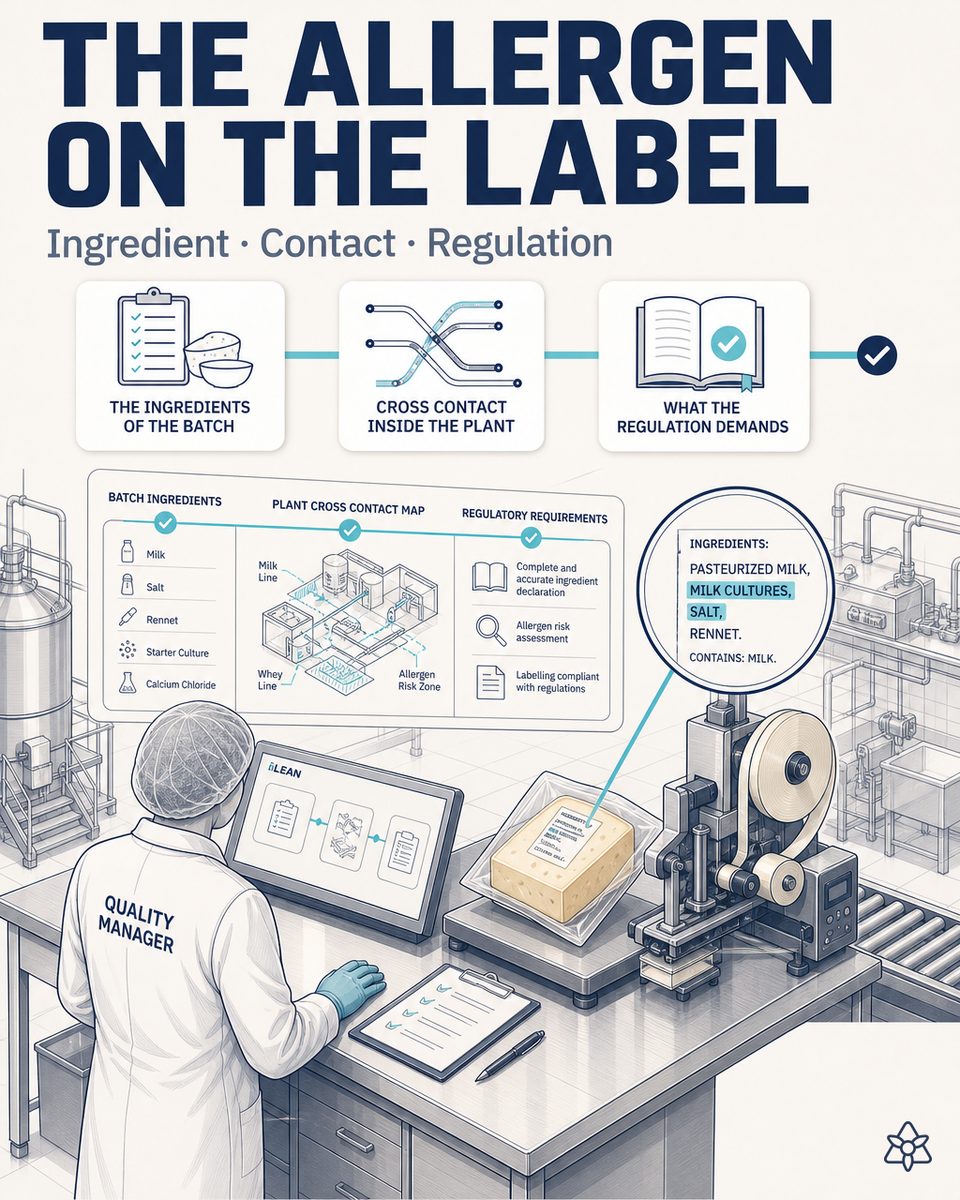
Three realities that are almost never in the same place.
A correct cheese label is the cross-reference of three data points that, in most plants, each live on their own island:
- What is in the batch — the recipe. Usually in the ERP, in an MES, or in a spreadsheet whose last editor never told packing about it.
- What ran before on the line — the production sequence and the intermediate cleaning. Often in another system, sometimes only in the shift lead's head.
- What the regulation requires — EU Regulation 1169/2011 and its 14 mandatory allergens, plus the retailer's internal rules if you export to the UK or the US.
The quality manager knows this, but cannot be in three places at once. The operator has three screens and two checklists, and the SKU changeover is precisely the most vulnerable moment. The classic system works 99% of the time. That 1% is the one that ends up in RASFF — and every time it is a recall, not an incident.
iLEAN does not add a fourth system — it seals the cracks between the three you already have.
The labeling problem is not a lack of information: it is information that lives on islands and that, at the critical moment (the SKU changeover, the upstream line that changes recipe without warning), does not reach the decision-maker in time. iLEAN acts as the putty that fills those gaps, without asking you to change your ERP, your MES or your packing line.
Edge sees the label before sealing. Connect reads the recipe wherever it lives — ERP, MES, a forgotten spreadsheet. The agent cross-references it against EU 1169/2011 and, if something does not add up, holds the batch. The person signs — never the other way round.
The three iLEAN pieces applied to allergen labeling in a cheese dairy:
- Edge — a terminal with machine vision (CNN) over the packing line. It reads the printed label in milliseconds, extracts the list of declared allergens and triggers the actuator (rejecter, stack light) if it does not match what was expected. It works without a network. If the plant loses WiFi, Edge keeps reading and holding.
- Connect — captures the batch recipe whether it comes from a modern ERP, a vertical MES, or a spreadsheet the R&D manager updates every morning in a shared folder. And it also captures what arrives from outside (an email from the importer with the new US retailer rule, a WhatsApp message from the supplier about a change in the rennet) at second zero, without anyone forwarding anything.
- Agent — cross-references the recipe, the line's history (what ran before and with what cleaning), the image of the label and EU Regulation 1169/2011. If there is a deviation, it does not send an email at 10 p.m.: it holds the batch and alerts the quality manager through whichever channel they use. The person validates and signs; the line does not restart on its own.
Manual labeling vs. cross-referenced labeling with iLEAN
| Aspect | Manual labeling + checklist | With iLEAN Edge + Connect + Agent |
|---|---|---|
| Source of the recipe | ERP, MES or spreadsheet — the operator checks one | All three unified at second zero |
| SKU changeover | Paper checklist, shift lead's signature | Edge verifies the label + the agent verifies the intermediate cleaning |
| Cross-contact | Assumption: "if we cleaned, we're fine" | Cleaning traceability cross-referenced with the production sequence |
| Error detection | Later audit or customer complaint | Before sealing, on the line, in milliseconds |
| Operation without a network | n/a | Edge keeps running on its own power |
| File for the IFS/BRC auditor | Rebuilt by hand, weeks of work | Per-batch dossier, automatic, with a photo of the label |
Impact estimate for your plant — to be validated with your numbers.
The block below is an estimate to be validated with the specific data of your plant. We put it forward so the committee has an order of magnitude; we refine it during the diagnostic.
- A mid-sized aged-cheese plant, 2 packing lines, multi-SKU with a variable recipe (with and without tree nuts, with and without egg lysozyme in long-ripened cheeses).
- Edge pilot on one line (camera over the label + actuator + integration with the batch recipe in the ERP/MES). First value expected within a few weeks.
- Indicative payback between 4 and 9 months, depending on how often labeling incidents have been documented over the last few years and the average cost of a recall or rework with your retailer.
- The hard lever is a single recall avoided: product pulled from the shelf, reverse logistics, destruction, brand damage. One recall pays for the pilot.
And the quality manager's reasonable doubt
"What if the AI gets it wrong and lets a mislabeled batch through?" — hallucination is a problem of free generation, not of anchored tasks. In tasks where the AI merely recontextualizes a piece of data from one system into another (reading the label and comparing it with the recipe), the best models brought error below 1.5% [1]. And even so, what is critical is never decided alone: iLEAN holds the batch and the person signs. The three safety rings exist precisely for this.
[1] OpenAI paper "Why Language Models Hallucinate", 2025 — on the reliability of AI in anchored tasks.
What people ask about allergen labeling in cheese dairies
What does EU law require regarding allergens in cheese?
EU Regulation 1169/2011 requires the 14 mandatory allergens to be declared visibly whenever they are present as an ingredient or as a trace from cross-contact. In a cheese dairy that means: milk and milk derivatives always, tree nuts whenever there are cheeses with walnut/almond/hazelnut, mustard and celery in flavored varieties, egg lysozyme in long-ripened cheeses. The phrase "may contain traces of X" is only valid if the allergen management system backs it with real plant data — not as generic cover.
How is cross-contact detected between cheeses with and without an allergen on the same line?
By cross-referencing three sources that today live on islands: the batch recipe (what is in it), the production sequence (what ran before on that line and with what intermediate cleaning) and the image of the pack at sealing that iLEAN Edge reads in real time. If the labeling declares "no tree nuts" but the previous batch contained walnut and the cleaning was not recorded as complete, the system holds the batch before sealing and alerts the quality manager. The person signs — the line never restarts on its own.
What recalls due to mislabeling have happened in cheese dairies?
Food safety authorities and RASFF publish recalls for undeclared allergens in European dairy products every month — and the pattern repeats: a recipe changed in a spreadsheet that never reached packing, incomplete cleaning left undocumented between two batches, a label from the previous batch reused by mistake during the SKU changeover. Every recall is hard cost (product pulled from the shelf, reverse logistics, destruction) plus brand cost, which weighs more over the medium term. The classic system (operator + checklist + eye) works 99% of the time — and that 1% is the one that ends up in RASFF.
Can iLEAN Edge read printed labels in real time?
Yes. Edge is a terminal with machine vision (CNN) on the line itself — it reads the printed label, extracts the list of declared allergens and cross-references it with the batch recipe and the line's history. If something does not add up, it triggers an actuator (stack light, rejecter) in milliseconds, before sealing. It works without a network: if the plant loses WiFi, Edge keeps reading and holding batches, because what is critical cannot depend on connectivity.
How much does AI labeling cost in a small or mid-sized cheese dairy?
The order of magnitude of an Edge pilot on a packing line in a small or mid-sized cheese dairy is close to that of any Edge pilot in a food plant: an initial investment covering terminals + cameras + actuator + integration with the ERP/MES, plus an annual license. The reasonable payback to present to the committee is several months — the hard lever is the cost of a single recall avoided (product pulled from the shelf, brand damage, potential penalty). We ask for your plant's data and send you the estimated ROI in 48h, with your numbers, not ours.
More cases in food
- Canned vegetable control with AI — F0, seam and weight, traceable without notebooks.How iLEAN cross-checks sterilization F0, hermetic seam, net weight and traceability on canned vegetable…
- Digital HACCP for dairy with AI — automate the CCPs and leave the real decisions to the team.Every CCP in the HACCP plan monitored continuously. iLEAN generates the signed per-shift record and…
- Cheese aging traceability — every wheel leaves with its full history, not in fragments.iLEAN records temperature, humidity and turning per batch throughout cheese aging. Every wheel leaves…
- Cheese defect detection with AI vision — without stopping the line or depending on the end-of-shift eye.Rind cracks, abnormal eyes, deformation — iLEAN Vision detects cheese defects at the end of the line…
- Cocoa and chocolate traceability with AI — from the sack to the bar, without fighting for it by hand.iLEAN cross-checks origin delivery notes, batches, harvest blends and EUDR to trace bean to bar — no…
- Industrial AI for coffee, culinary, snacks and foodservice groupsReal industrial AI cases for coffee roasting, canning, pasta and central kitchens: capture what is lost…
Tell us your case and in 48h we'll send you the estimated ROI of this AI project for your cheese dairy.
We work on your plant's real data, not ours. Diagnostic with no commitment.
Request estimated ROI in 48h ‹ All dairy cases See food industry