Confectionery glazing with AI vision — expensive chocolate does not get thrown away; it gets spread properly.
Confectionery glazing plays with expensive raw materials (cocoa, syrup, premium couverture) inside a coating pan that almost nobody has digitized. iLEAN Edge sees coating, gloss and clumps at the pan outlet in milliseconds, Connect reads the pan's old control panel, and an agent adjusts dosing, viscosity and layer time. The person signs — the line does not tune itself.
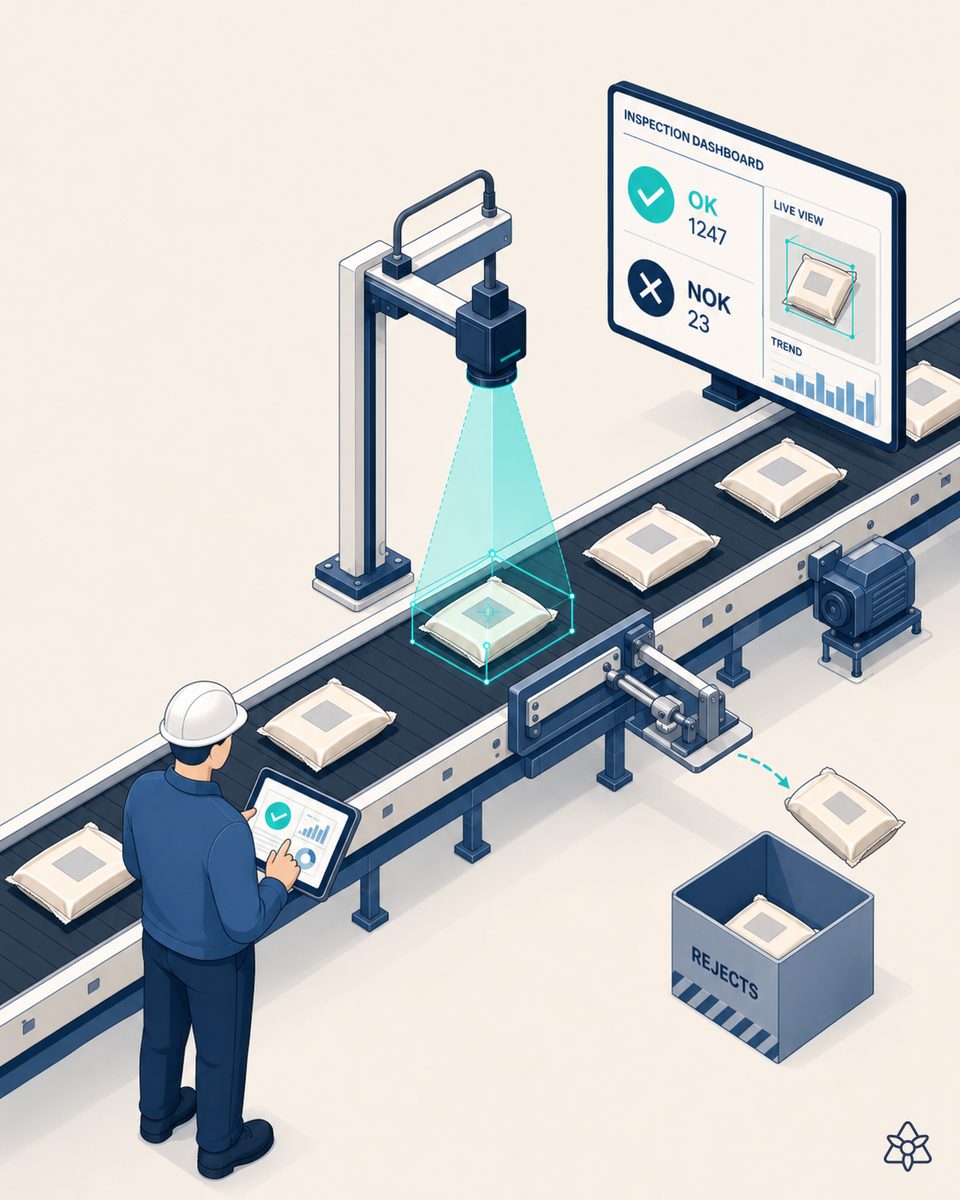
The coating pan works — but the result depends on things nobody sees in time.
The pan operator is an industrial craftsman: they look through the sight glass, listen to the sound, dip a scoop in, decide. The system works, but it rests on four variables that change without warning:
- Viscosity of the syrup or the couverture — it depends on the raw material of the batch and on the ambient temperature in the tunnel.
- Pan time and speed — adjusted by eye from experience; every SKU asks for its own recipe.
- Air humidity and temperature — they affect gloss and the risk of pieces clumping together.
- Condition of the pan — wear, residue from the previous layer, incomplete cleaning between SKUs.
The defect shows up at packing, by which time it is too late: a case with uneven coating, a batch of clumps, weak gloss that quality control rejects. When the SKU carries premium cocoa or nuts as the center, every weak pan run is hard cost. And the operator, without meaning to, over-coats defensively: adds “a little more” to be safe — and in cocoa, that is invisible money going onto the floor. The classic system works 90% of the shift. The other 10% is the quality committee at the next retailer audit.
iLEAN does not replace your coating pan — it puts eyes where you could not reach and closes the loop.
Glazing is a clear case for IRIS: the difference between success and scrap is visible to the naked eye at the pan outlet, but no current system captures it. iLEAN acts as the putty between the pan's old control panel, the recipe held by the process manager and the belt heading for packing.
Edge sees coating, gloss and clumps piece by piece. Connect reads the pan's old panel and the recipe. The agent correlates and proposes the dosing or timing adjustment. The person signs.
The iLEAN pieces applied to confectionery glazing:
- Edge — a vision terminal (CNN) at the outlet of the coating pan or the cooling tunnel. It measures coating, gloss, clumps and size piece by piece, in milliseconds. It builds a live histogram and triggers a stack light or a reject gate when the distribution moves out of range. It works with no network.
- Connect — captures the state of the pan (rotation speed, temperature, syrup dosing), the SKU recipe, the room humidity and the intermediate cleaning between SKUs. Three levels: direct integration, reading the local PC or a photo of the analog panel from the app. It does not force you to change the pan.
- Agents — correlates the visual drift with the captured variables: “coating dropped when syrup viscosity fell; increase dosing by 3% and reduce pan speed”. It proposes this to the operator through the earpiece. The person validates and applies. The agent also detects incomplete cleaning between SKUs when there is a risk of allergen carry-over.
Classic glazing vs. glazing assisted by iLEAN
| Aspect | Operator + eye + recipe in a spreadsheet | With iLEAN Edge + Connect + Agent |
|---|---|---|
| Coating | Sampled by eye, defensive over-coating | Measured piece by piece, dosing adjusted |
| Gloss | Quality rejects at packing | Edge detects the drift as it leaves the pan |
| Clumps | Packing pulls them out by hand | Detected and diverted before packing |
| SKU changeover | No guarantee the cleaning was complete | The agent verifies cleaning and recipe before startup |
| Expensive raw material (cocoa) | Over-coating “just to be safe” | Dosing adjusted to the real setpoint |
| The veteran's knowledge | In their head, and it leaves with them | Pattern captured, replicable on other pans |
Impact estimate for your plant — to be validated with your numbers.
The block below is an estimate to be validated with the specific data of your line. We put it forward so the committee has an order of magnitude; we refine it during the diagnostic.
- Confectionery plant with 1-2 coating pans, cocoa + syrup coating, multi-SKU with daily changeovers.
- Edge pilot on one pan (camera at the outlet + integration with the pan's control panel + correlation with the recipe). First value expected within a few weeks.
- Indicative payback between 4 and 9 months. Reduction of scrap from coating defects ≥30%, reduction of defensive cocoa use 1-2%, reduction of packing rejects ≥20%.
- The hard lever is the saving on expensive raw material once defensive over-coating is eliminated, plus the capacity recovered by cutting batch changeovers caused by scrap.
And the process manager's reasonable doubt
“What if the AI misreads gloss because of an odd lighting condition and discards good product?” — the Agents propose, and critical diversions are signed by the person. That is the principle of the three rings. The reliability of AI in anchored tasks (measuring coating, reading a scale, comparing against the recipe) is very different from free generation: the best models brought error below 1.5% [1]. iLEAN gives you the extra pair of eyes; you still decide when to divert.
[1] OpenAI paper “Why Language Models Hallucinate”, 2025 — on the reliability of AI in anchored tasks.
Related cluster: cocoa and chocolate traceability, biscuits in a tunnel oven.
What people ask about confectionery glazing with AI vision
What are the typical defects in confectionery glazing?
The classic defects in a coating pan are uneven coating (areas with less chocolate or syrup than specified), clumps (pieces stuck together that packing rejects), low gloss (poor syrup distribution or a drifting pan temperature), and variation in final size between batches from one layer too many or too few. Each has a different cause (dosing, syrup viscosity, pan time, air humidity) and today it is diagnosed by eye, which means it is diagnosed too late.
How does iLEAN Edge measure coating and gloss in line?
Edge is a terminal with machine vision (CNN) over the belt at the outlet of the coating pan or the cooling tunnel. In milliseconds it measures coating (percentage of surface covered and uniformity), gloss (intensity and evenness of reflection), clumps (pieces stuck together) and final size piece by piece. It builds a live histogram and, when the process drifts from setpoint, it triggers a stack light and proposes a cause. It works with no network — if the plant loses WiFi, Edge keeps measuring and alerting.
Does it work if the pan is manual or semi-automatic with only an analog panel?
Yes — that is exactly the typical case in confectionery. Many coating pans are decades old and have an analog panel (temperature, rotation speed, manual valves). iLEAN Connect captures the state of the pan at three levels: direct integration if it has a modern PLC, reading the local PC if it is an isolated proprietary system, or a photo of the panel from the operator's app if all there is is analog. What Edge adds at the outlet is the vision that closes the loop: the pan does not change; what changes is that the operator knows within seconds whether the layer is going well or not.
How much chocolate and sugar do you actually save?
There are three hard levers behind the saving: (1) less defensive over-coating (the operator tends to add “a little more” to be safe), (2) fewer pieces rejected for insufficient coating or clumping, (3) fewer batch changeovers caused by out-of-spec size ranges. With expensive raw materials such as cocoa or premium couverture, a 1-2% improvement in efficient use pays for the pilot quickly. Conservative estimate to be validated: reduction of scrap from glazing defects ≥30%.
How much does it cost to deploy AI vision on a confectionery glazing line?
The order of magnitude of an Edge pilot on a glazing line is comparable to other food Edge pilots: a camera over the belt at the pan outlet + an actuator (stack light or reject gate) + integration with the pan's control panel and with the ERP/MES, plus an annual license. A reasonable payback is a matter of several months; the hard lever is the avoided cost of expensive raw material (cocoa, nuts as the center) and of rejected SKUs. We ask for your line's data and send you the estimated ROI in 48h.
More cases in food
- Cocoa and chocolate traceability with AI — from the sack to the bar, without fighting for it by hand.iLEAN cross-checks origin delivery notes, batches, harvest blends and EUDR to trace bean to bar — no…
- Industrial AI for coffee, culinary, snacks and foodservice groupsReal industrial AI cases for coffee roasting, canning, pasta and central kitchens: capture what is lost…
- Cold room inventory with AI vision — knowing what is there and where without opening the door.iLEAN Vision identifies pallets inside the cold room with no manual scanning and reconciles them with…
- IFS/BRC audit always ready with AI — the quality team should not work three weeks for a one-day visit.iLEAN keeps every IFS/BRC evidence record alive. The audit stops being a sprint and becomes always ready.
- Crushed tomato and concentrate control with AI — the grade is decided in line, not in the lab.How iLEAN cross-checks refractometer, colorimeter and evaporator vision to hold Brix, color and zero…
- AI control of ham curing — the curve that decides whether the batch ships or is lost.iLEAN combines vision, weight, chamber humidity and temperature to secure the cooking and curing curve…
Tell us your case and in 48h we'll send you the estimated ROI of this AI project for your glazing line.
We work on your plant's real data, not ours. Diagnostic with no commitment.
Request estimated ROI in 48h See food industry