Biscuit tunnel oven control with AI — anticipate the bake color, don't discover it at packing.
In a tunnel oven the recipe is stable but the real curve changes every shift — dough moisture, laminated weight, heat per zone and band speed. iLEAN cross-references Edge vision at the exit with the oven thermocouples and proposes the correction before the pale or burnt biscuit reaches the packing line. The person signs.
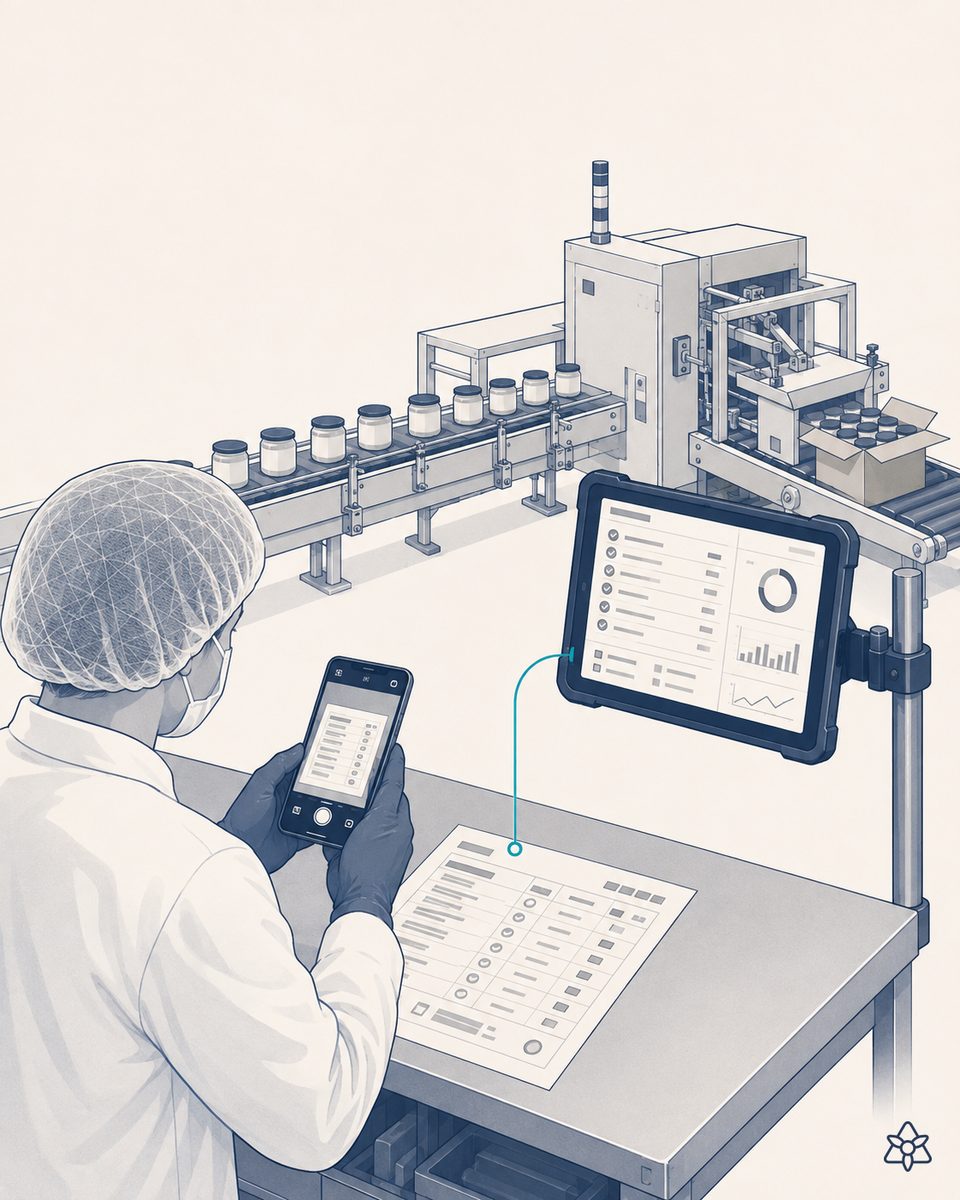
The oven's curve is the same. The shift's curve is not.
On a biscuit line the tunnel oven is the most expensive piece of equipment and the one you can least afford to stop. The SKU recipe is stable, the setpoints are programmed, and even so the biscuit comes out pale, dark, off gauge or with check cracking several times a day. It is not that the oven is “running badly”: it is that some variables change over the course of the shift and nobody cross-references them:
- The moisture of the incoming dough — a change in the flour, in water dosing or in the proofing chamber, and the piece reaches the oven with a different %H. The same curve leaves it pale or burnt.
- The weight of the laminated piece — if the gauge roller drifts by 0.1 mm, effective baking time changes and the bake color moves with it.
- Heat distribution across zones — radiation, convection and conduction do not spread the same way when the oven has been running flat out for 6 hours as when it starts up cold.
- Band speed — if the cooler or the packing machine downstream jams, the band slows down and the biscuit accumulates more heat.
The classic system is an hourly tasting panel, the shift lead's eye and sampling sent to quality. It works 99% of the time. That 1% is a pallet to rework, or biscuit sold as a lower-margin by-product — and the expensive part is not the dough, it is everything that gets baked, cooled, packed and palletized before anyone catches it.
iLEAN does not touch the oven — it puts continuous vision at its exit and tells it what it sees.
The tunnel oven's problem is not a lack of thermocouples: it is information living on islands. The per-zone thermocouples are in a PLC, dough moisture is in the MES, band speed is in another controller, and the real bake color is in the shift lead's eye. iLEAN acts as the putty that fills those gaps without asking you to change the oven, the laminator or the MES.
Edge sees bake color and gauge at the exit. Connect reads thermocouples, band speed and dough moisture. The agent cross-references with the SKU and, if the trend points to a defect, proposes the correction with time to react.
The three iLEAN pieces applied to biscuit tunnel oven control:
- Edge — a terminal with machine vision (CNN) at the oven exit, before the cooler. It reads L*a*b* bake color, gauge, deformation and incipient check cracking. If the deviation holds, it diverts product to the rework bin and raises an alert. It works without a network: if the plant loses WiFi, Edge keeps reading, because what is critical cannot depend on connectivity.
- Connect — captures the oven thermocouples per zone, band speed, incoming dough moisture and laminator weight, whether they come from a modern PLC or from an old panel photographed on the wall. It also captures what arrives from outside: the supplier's flour batch certificate, an SKU change flagged ahead of time by the shift lead.
- Agent — cross-references real bake color, the thermal curve per zone, moisture, weight, speed and the SKU recipe. When the combined trend points to pale or burnt biscuits in the next few minutes, it proposes the correction to the shift lead with margin to raise or lower a zone. The person validates and signs — the curve is never changed on its own.
Control by tasting panel vs. cross-referenced control with iLEAN
| Aspect | Hourly tasting panel + the lead's eye | With iLEAN Edge + Connect + Agent |
|---|---|---|
| Bake color reading | Subjective, every 60 min | Objective L*a*b*, every piece |
| Oven curve | Fixed setpoints per SKU | Real curve cross-referenced with moisture and speed |
| Gauge and deformation | Sample sent to the lab | Measured inline, before the cooler |
| Trend detection | “Something's wrong” 30 min late | Trend detected within a few passes |
| Zone correction | Manual reaction after the fact | Proposal to the shift lead with margin |
| IFS/BRC file per batch | Rebuilt by hand | Dossier with curve, bake color and signature |
Impact estimate for your plant — to be validated with your numbers.
The block below is an estimate to be validated with the specific data of your plant. We put it forward so the committee has an order of magnitude; we refine it during the diagnostic.
- Biscuit plant, one line with a multi-zone tunnel oven (radiation + convection), 4-8 active SKUs with different profiles (Marie, digestive, chocolate-chip cookie, sandwich).
- Edge pilot at the oven exit (bake color + gauge camera + integration with thermocouples and dough moisture). First value expected within a few weeks.
- Indicative payback between 4 and 9 months, depending on the current share of out-of-specification product and the price gap between your own brand and by-product.
- Expected reduction in scrap from off bake color or gauge of ≥30%. The hard lever is what today is sold at a lower margin or reworked, plus the oven energy spent baking what will end up out of spec.
And the production manager's reasonable doubt
“What if the AI proposes lowering zone 3 and throws the whole oven off?” — the agent proposes, it does not act. The three safety rings are designed so that the decision about the oven is signed by a person. In anchored tasks like this one (reading a curve and comparing it against a history), the error of the best models drops below 1.5% [1]. But the zone correction is signed by the shift lead — always.
[1] OpenAI paper “Why Language Models Hallucinate”, 2025 — on the reliability of AI in anchored tasks.
What people ask about biscuit tunnel oven control
What defects typically show up in a biscuit tunnel oven, and why?
The usual ones are pale biscuits (underbaking), burnt biscuits (overbaking), out-of-spec gauge (thickness or diameter), check cracking (micro-fissures caused by uneven cooling) and imprint deformation. The causes are not in the recipe — which is stable — but in the combination of variables that shift over the course of the shift: moisture in the incoming dough, weight of the laminated piece, heat distribution across the oven zones (radiation, convection, conduction), band speed and accumulated thermal load. When several variables move at once, the SKU's nominal curve stops working and the biscuit comes out of specification.
How does iLEAN read bake color and gauge inline without stopping the oven?
iLEAN Edge installs a camera with a neural network (CNN) at the tunnel oven exit, before the cooler. It reads the L*a*b* color of the bake, measures diameter and deformation, and detects incipient check cracking and pale zones. It cross-references that reading with the position of the piece on the band and with the oven zone it passed through. The signal is available at second zero — you do not wait for the tasting panel — and it triggers an actuator (stack light, diversion to a rework bin) if the deviation is persistent.
Can iLEAN anticipate the defect before the biscuit leaves the oven?
Yes. That is the logic of predictive jidoka. iLEAN Connect captures the thermocouples for each oven zone and the band speed; the agent cross-references that data with the gauge reading and the moisture of the incoming dough, and with the history of how each combination produced a given bake color and deformation. When the combined trend points to pale or burnt biscuits in the next few minutes, the agent puts it to the shift lead with enough margin to correct the curve — before the defect is born, not after.
Does it integrate with older ovens that only have a paper chart recorder?
Yes, and that is the normal case. iLEAN Connect applies graduated capture: if the oven zone has a modern PLC, direct integration; if it has an old, isolated local computer, Connect extracts from it; if all there is is an analog chart recorder or a wall panel, a camera photographs the reading and the system turns it into data every few minutes. It does not force you to replace the oven — it seals the cracks between what exists and what the agent needs to know.
What is a reasonable investment for a pilot on a biscuit line?
An Edge pilot on a tunnel oven line sits in the same order of magnitude as any Edge pilot in a food plant: an initial investment covering terminals + cameras + integration with thermocouples and MES, plus an annual license. The reasonable payback to take to the committee is a few months — the hard lever is the tonnage that today goes to rework or to lower-margin private label because the bake color was off. We ask for your plant's data and send you the estimated ROI in 48h.
More cases in food
- Carbonation and fill level in bottling — rejects pile up when nobody sees the first bad bottle.Every bottle inspected: fill level, CO2 and seal. iLEAN Edge corrects the filler before rejects pile up.
- Planning the beverage plant around what is expensive to change: the tanks and the filling line.iLEAN's Planning Agent builds the plan for a beverage plant: tank occupancy, minimum format changeovers…
- Real AI cases in beveragesReal AI cases in beverages: empty container inspection, carbonation and fill level in line, beer…
- Real AI cases in breadsticks and crispbread13 real AI cases for breadstick, crispbread and grissini factories: zero labeling recalls, paperless…
- AI control of bulk wine — a tanker loaded from the wrong tank is an entire lot downgraded.iLEAN records every tank transfer from a tablet, keeps the tank map live in real time and holds the…
- Butter and margarine control with AI — a badly churned mold goes unseen until it is already in the cold room.How iLEAN cross-references recipe, churning, dosing and in-line vision to keep emulsion, weight and…
Tell us your case and in 48h we'll send you the estimated ROI of this AI project for your biscuit line.
We work on your plant's real data, not ours. Diagnostic with no commitment.
Request estimated ROI in 48h See food industry