Carbonation and fill level in bottling — rejects pile up when nobody sees the first bad bottle.
A well-tuned bottling line fills to the gram. iLEAN Edge inspects bottle by bottle — fill level, CO2 and seal — and corrects the filler before rejects turn massive. The person signs; the line self-adjusts inside its ring.
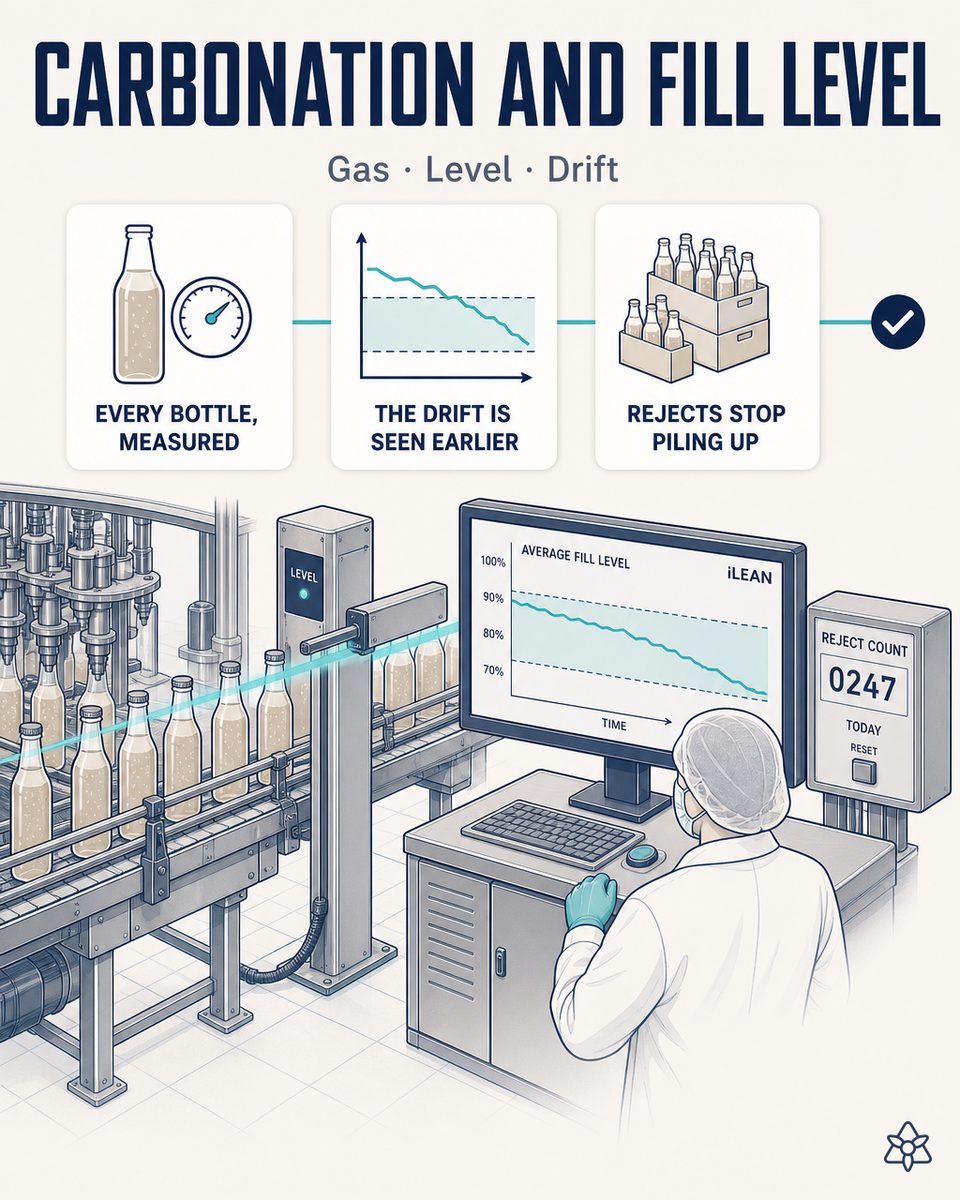
A bottling reject is not one bottle — it is three hundred in a row.
A well-designed beverage line does not fill bottles: it fills within tolerance. If the CO2 pressure rises half a bar, the filling valve overpushes and drags product; if it drops, the fill level comes up short and rejects pile up. In both directions, the operator finds out when the inspection tunnel at the end of the line starts kicking out ten bottles in a row — and the problem has already been running for minutes.
- A line speed that forgives nothing — at 36,000 bottles/hour, one out-of-tune minute is 600 units. End-of-line inspection is necessary, but it arrives late.
- A filler that drifts — valves that age, gaskets that leak, filling heads that foul during hot hours. The shift average is deceiving: what matters is the drift between heads.
- CO2 that slips out of recipe — product temperature, over-blanketing, an unstable deaerator: there are five points where carbonation escapes, and most plants watch only one (the inline meter at the outlet).
The line manager does not need another panel full of charts: they need the first bad bottle to trigger the correction, not the three-hundredth.
iLEAN does not add one more inspection — it closes the filler's control loop.
The problem with fill level and carbonation is not seeing the defect: it is closing the loop between seeing and correcting. iLEAN acts as the putty that fills the gap between end-of-line inspection and the filler's PLC — without asking you to change either one.
Edge sees every bottle at the filler itself. Connect reads the inline CO2 meter and the batch recipe. The agent cross-references per-head drift with pressure and flow, and proposes the adjustment. The person signs — always.
The three iLEAN pieces applied to carbonation and fill level control:
- Edge + Vision — a CNN-equipped terminal over the outlet of the rotary filler. It measures optical fill level bottle by bottle, identifies the head of origin and detects the foam pattern in the neck (a reliable proxy for carbonation). Actuation in milliseconds to the reject gate or the light stack. It works without a network: if the plant loses WiFi, the basic cycle keeps running.
- Connect — reads the batch recipe (target CO2, weight, format) whether it comes from the ERP, the packaging MES or a shift lead's spreadsheet. And it captures the reading from the inline CO2 meter you already have (Anton Paar, Centec, Maselli) without replacing it. The putty fills the crack between the meter that measures and the filler that fills.
- Agent — cross-references measured fill level + head + pressure + flow + CO2 + product temperature. It detects one head's drift before it enters the reject band and proposes the adjustment to the operator (valve cleaning, gasket change, recalibration). It does not move the filler on its own: the critical operation stays with the person, who signs from the HMI.
Classic inspection vs. a closed loop with iLEAN
| Aspect | End-of-line inspection | With iLEAN Edge + Connect + Agent |
|---|---|---|
| When underfill is detected | At the end-of-line inspector (tens of seconds later) | At the head outlet — within the same cycle |
| Attribution to the head | Manual, from control sheets | Automatic — every bottle knows its head of origin |
| Carbonation correction | Reactive, when the inline meter alerts | Anticipated — foam + level + pressure cross-referenced |
| Volume lost per event | Hundreds of bottles until the correction | Dozens — the correction is proposed within minutes |
| Operation without a network | n/a | Edge keeps inspecting with its own light |
| Per-shift file | Compiled by hand from three systems | Automatic dossier with per-head curve and events |
Impact estimate for your plant — to be validated with your numbers.
The block below is an estimate to be validated with the specific data of your plant. We put it forward so the committee has an order of magnitude; we refine it during the diagnostic.
- Mid-sized soda/water bottler, rotary filler, 24,000-36,000 bph, multi-format (0.5 / 1.5 L PET and returnable glass).
- Edge pilot on one filler (CNN camera over the outlet + inline CO2 integration + head reading). First value expected within a few weeks.
- Reduction in underfill/overfill rejects ≥ 30% against the baseline we measure in the diagnostic — the real lever is attributing the drift to the head without waiting for the final inspector.
- Indicative payback between 4 and 9 months, depending on the actual number of carbonation/fill-level incidents documented in recent shifts.
- Additional hard lever: compliance with your bottling customer's quality standard (global soda brand owners, the retailer's private label) — per-head traceability is what their auditors increasingly ask for.
And the sector context that rarely gets cited
The reference quality standard in automotive is on the order of 25 PPM defects[1]. Bottled beverages do not need to get there, but the curve is pulling in the same direction: the retailer wants per-batch files, the consumer posts any badly sealed bottle to social media within minutes, and the pressure on the cost of non-quality only rises. And on the reasonable fear of AI: hallucination is a problem of free generation, not of anchored tasks — reading a fill level and comparing it against the recipe is an anchored task, where the best models brought error below 1.5%[2]. And the critical operation (changing the filler) stays with the person.
[1] Automotive quality standard on the order of 25 PPM — Symestic.
[2] OpenAI paper “Why Language Models Hallucinate”, 2025 — on the reliability of AI in anchored tasks.
What people ask about carbonation and fill level control
What line speed can iLEAN Edge keep up with on a bottling line?
iLEAN Edge inspects bottle by bottle at line speed — the convolutional neural networks run on the terminal itself, not in the cloud, so the inference is decided in milliseconds. On high-volume soda and water lines (hundreds of bottles per minute) every unit is assessed before it leaves the filling area. The actuator (light stack, reject, controlled stop) fires within the same cycle, without waiting for any data to reach a server.
Does iLEAN Edge integrate with the existing filler without replacing it?
Yes — that is the whole point. iLEAN installs on top of your current filler (Krones, Sidel, KHS or a local vertical), it does not replace it. Edge reads the bottle with its own vision + an optional pressure sensor, and communicates the adjustment to the filler's PLC via dry contact, OPC-UA or Modbus, depending on what the machine accepts. If the machine is very old, Connect reads the panel from a photo and we scale the capture to whatever level the electrical equipment allows. It does not force you to change anything.
Does it also work for cans, not just bottles?
Yes — aluminum cans, glass bottles (returnable and non-returnable) and PET are the three typical beverage formats, and all three fit the same Edge terminal by swapping optics and lighting. On cans, the key reading is the fill level and the end seam; on glass, the integrity of the crown cap or stopper is added; on PET, the appearance of the thread as well. The CNN is trained on samples from your plant — the model does not come off a catalog shelf.
How does iLEAN measure CO2 online without stopping the line?
There are two paths depending on budget and criticality. The most direct: integrating with the inline CO2 meter you already have in the plant (Anton Paar, Centec, Maselli) — Connect reads its output and the agent cross-references it with the batch recipe and the bottle's optical fill level. The second: inferring carbonation deviation from the foam profile in the neck at filling (the foam tells what the sensor confirms). The two paths complement each other; iLEAN orchestrates which one acts at each moment.
Does it generate an automatic per-shift record for the quality manager?
Yes. Every inspected bottle leaves a trace: timestamp, measured fill level, pressure/CO2 if integrated, image of the closure, decision (pass/reject) and reason. At the end of the shift, the agent assembles a per-batch dossier — the boring, concrete file the IFS/BRC auditor or the retail customer asks for. Nobody puts it together on a Friday afternoon: it is delivered ready-made when the shift ends.
More cases in food
- Beef carcass identification with AI — the animal cannot get lost between the ear tag and the hook.From ear tag to carcass to cutting without losing identity. iLEAN links national registries, the bovine…
- AI control of beer fermentation — the curve does not wait for daybreak, and the brewmaster cannot be on call all night.Gravity, temperature and time monitored continuously. iLEAN alerts the brewmaster before the batch…
- Industrial AI cases for soft drink and water bottling plantsTwelve real industrial AI cases in beverage plants: shop-floor capture, in-line vision and returnable…
- Planning the beverage plant around what is expensive to change: the tanks and the filling line.iLEAN's Planning Agent builds the plan for a beverage plant: tank occupancy, minimum format changeovers…
- Real AI cases in beveragesReal AI cases in beverages: empty container inspection, carbonation and fill level in line, beer…
- Biscuit tunnel oven control with AI — anticipate the bake color, don't discover it at packing.How iLEAN cross-references vision of color, gauge and deformation with the tunnel oven curve to…
Tell us your case and in 48h we'll send you the estimated ROI of this AI project for your bottling plant.
We work on your plant's real data, not ours. Diagnostic with no commitment.
Request estimated ROI in 48h ‹ All beverage cases See food industry