Beef carcass identification with AI — the animal cannot get lost between the ear tag and the hook.
Beef traceability demands that you never lose the animal between the ear tag and the carcass, and then never lose it between the carcass and the cutting room. iLEAN brings together the ear tag read by AI vision, the digital bovine passport and the farm code into a single identity that travels with the piece all the way to dispatch. When a reading is not sharp, a person signs.
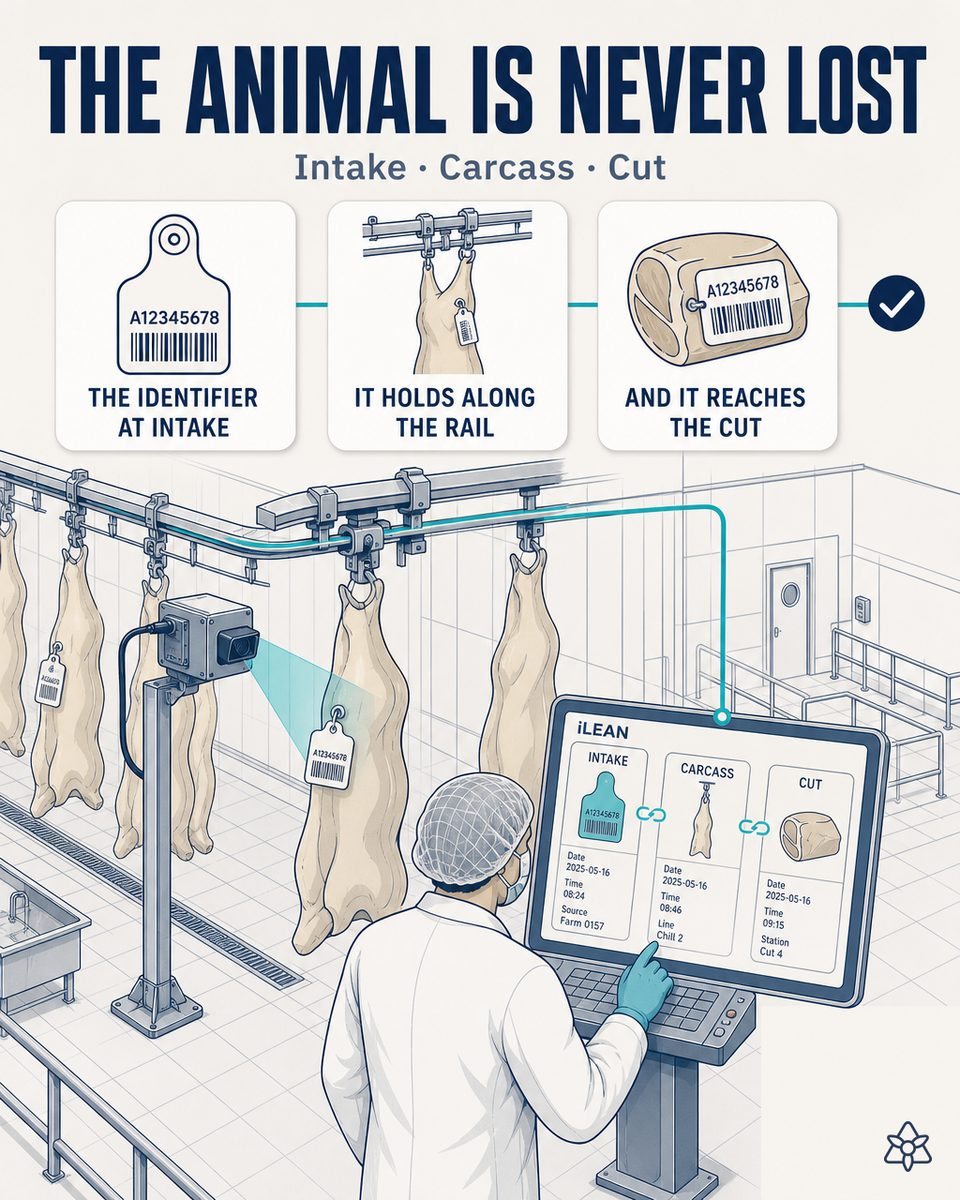
An identity that is lost at stunning is worth exactly as much as no identity at all.
European regulation is clear: every bovine animal carries two ear tags, a bovine passport and an entry in the national system. The plant has an intake record, a slaughter order and a destination for every carcass. But the chain breaks at three classic points:
- Entry to slaughter. The tag is read by hand, or the order in the pen is simply assumed. One change of order for animal welfare reasons and the next reading no longer matches.
- Stunning to hook. The animal goes onto the hook and, from that instant, there is no ear tag any more — there is a hook tag that someone had to assign correctly. One crossed assignment and two carcasses swap identities forever.
- Shift or day changeover. The operator who knew the last assignment goes home, the next one opens a notebook and starts from the best guess available.
When the inspector later asks for a dossier on a health alert, or the customer asks for traceability of one specific cut back to the farm of origin, the answer is "we'll rebuild it" — and rebuilding is never the same as having.
iLEAN does not add another registry — it seals the crack between the ones you already have.
The problem with bovine identification is not a lack of records, it is that the records live on islands and the chain breaks at the physical moment (intake, stunning, change of hook). iLEAN acts as the putty that seals those cracks with vision + assisted capture, without asking you to change SITRAN, REGA, your ERP or the line.
Edge reads the ear tag with vision and links it to the hook at second zero. Connect cross-references the bovine passport and the national registries. The agent delivers the per-carcass dossier before the inspector asks for it. The person signs whenever there is doubt.
The iLEAN pieces applied to beef carcass identification:
- Vision + Edge — a CNN camera at the stunning / slaughter point reading both ear tags. Natural redundancy: if one tag is dirty or damaged, the other one usually is not; if both fail, the animal goes to the manual procedure with all the evidence captured. Edge signs off the assignment to the hook in milliseconds. It works without a network — the identity is stored locally and synced afterwards.
- Connect — captures the digital bovine passport (or a photo of the paper one where it is not digital yet), links it to the farm code, and publishes to your ERP/MES. Integration with SITRAN/REGA goes through an API where that is allowed and through assisted capture where the administration imposes a manual channel. If a health alert arrives by email at 10 p.m. ("batch X from farm Y is placed on hold"), it enters the system at second zero and the agents locate every affected carcass still in the plant without waiting for Monday's meeting.
- Agent — keeps the per-carcass dossier live and available: image of the ear tag as read, associated bovine passport, farm code, hook position, cutting route, destination of every piece. When the inspector asks for traceability on a specific cut, the dossier already exists — it is not rebuilt.
Ear tag read by hand + notebook vs. linked identity with iLEAN
| Aspect | Manual reading + notebook / Excel | With iLEAN Vision + Connect + Agent |
|---|---|---|
| Ear tag reading | Operator at intake | CNN vision, both tags, redundant |
| Assignment to the hook | Order is assumed | Linked at second zero, with a photo |
| Shift changeover | The classic failure point | Identity inherited, never rewritten |
| Integration with SITRAN/REGA | Manual re-entry | API or assisted capture, no re-keying |
| Health alert from the farm | Email at night, meeting on Monday | Affected carcasses located in seconds |
| Dossier for the inspector | Rebuilt by hand, weeks | Already built — photo of the tag included |
Impact estimate for your plant — to be validated with your numbers.
The block below is an estimate to be validated with the specific data of your plant. We put it forward so the committee has an order of magnitude; we refine it during the diagnostic.
- Mid-sized beef slaughterhouse, one main slaughter line, current reconciliation incident rate per working day known.
- Vision + Edge pilot at the stunning point + integration with the bovine passport and the national registry. First value expected within a few weeks: identity closed on the line, per-carcass dossier available.
- Reduction in tag-to-carcass reconciliation incidents of ≥ 30% in the first months, and a sharp drop in the time it takes to put together a dossier for the inspector. Conservative estimate; the ceiling depends on how much of today's reconciliation work was avoidable versus caused physically (a torn-off tag).
- Indicative payback between 4 and 9 months, depending on volume and on the cost of each documented incident. The hard lever is the combination of office time saved + fast response to health alerts + the ability to serve markets that demand full farm-level traceability without a day's delay.
And the quality manager's reasonable doubt
"What if the vision system misreads a tag and assigns the wrong identity?" — hallucination is a problem of free generation, not of anchored tasks such as reading an ear tag code and comparing it against a record. In anchored tasks, the best models brought error below 1.5%[1]. And even so, what is critical is never decided alone: when a reading is not sharp, the system flags the animal for the manual procedure and the person signs. iLEAN's three safety rings guarantee that an identity is never assigned without human validation when there is reasonable doubt.
[1] OpenAI paper "Why Language Models Hallucinate", 2025 — on the reliability of AI in anchored tasks.
What people ask about beef carcass identification with AI
How is the ear tag linked to the carcass on the line?
At the stunning / slaughter point, iLEAN Edge reads both of the animal's ear tags with vision (left and right ear, the redundancy the regulation requires) and the plant confirms or corrects with a handheld scanner when the image is not sharp. From that instant, the identity is tied to the hook — and from hook to carcass, from carcass to half carcass, from half carcass to cutting — through a single internal code that travels with the piece. The identity is never rewritten; it is inherited.
Does it work in a high-speed slaughterhouse?
Yes. Visual identification happens in milliseconds on the image of the ear tag, and Edge closes the assignment to the hook at second zero. The bottleneck at high line speed is not the reading, it is the slaughter itself — and the vision line couples to that cadence without slowing it down. When a reading is inconclusive (dirty, damaged or badly positioned tag), the system flags the animal for human validation without stopping the line.
Does it comply with European identification regulations?
European regulations (Regulation 1760/2000 and its derivatives) require unambiguous identification of the animal of origin and full traceability throughout the process. iLEAN operates as a capture and traceability system that supports compliance — it does not replace the official ear tag or the national registries; it reads them, links them and propagates them without losing anything, with a photo of every reading kept as evidence for the inspector.
How does it integrate with national registries (SITRAN, REGA)?
iLEAN Connect has an integration module built for exactly this. The connection to SITRAN/REGA can go through an API where the system allows it, or through assisted capture (reading the digital bovine passport, an agent-assisted form) where the administration imposes a manual channel. The goal is that the slaughterhouse never has to re-key anything: what was read on the line is already in the registry, with its backing photo and the human signature of the person in charge when the regulation demands it.
What if the ear tag system or the reader goes down?
Edge keeps working: by design, if the plant loses its network, its Internet connection or its central server, the terminal maintains the basic cycle (reading + assignment to the hook) and stores locally until communication is restored. The identification is not lost — it syncs afterwards. And if what fails is the physical ear tag (an animal with a torn-off or illegible tag), the system flags the animal for the manual identification procedure required by the regulation, with all the evidence captured for the inspector.
More cases in food
- Aquaculture traceability with AI — what the retailer wants is consistency, not more paperwork.iLEAN links cage, feed batch, veterinary treatment and harvest to support ASC/BAP, EU 1379/2013 and the…
- AI control of baby food in glass jars — zero tolerance means 100% inspection, not sampling.100% AI inspection of glass baby food jars: glass integrity, closure, fill level and visible particles.…
- Real AI cases in bakeryReal AI cases in bakery: production planning by agent (tunnel oven with no stops, Excels into the…
- AI control of beer fermentation — the curve does not wait for daybreak, and the brewmaster cannot be on call all night.Gravity, temperature and time monitored continuously. iLEAN alerts the brewmaster before the batch…
- Industrial AI cases for soft drink and water bottling plantsTwelve real industrial AI cases in beverage plants: shop-floor capture, in-line vision and returnable…
- Carbonation and fill level in bottling — rejects pile up when nobody sees the first bad bottle.Every bottle inspected: fill level, CO2 and seal. iLEAN Edge corrects the filler before rejects pile up.
Tell us your case and in 48h we'll send you the estimated ROI of this AI project for your beef slaughterhouse.
We work on your plant's real data, not ours. Diagnostic with no commitment.
Request estimated ROI in 48h ‹ All meat industry cases See food industry