AI control of baby food in glass jars — zero tolerance means 100% inspection, not sampling.
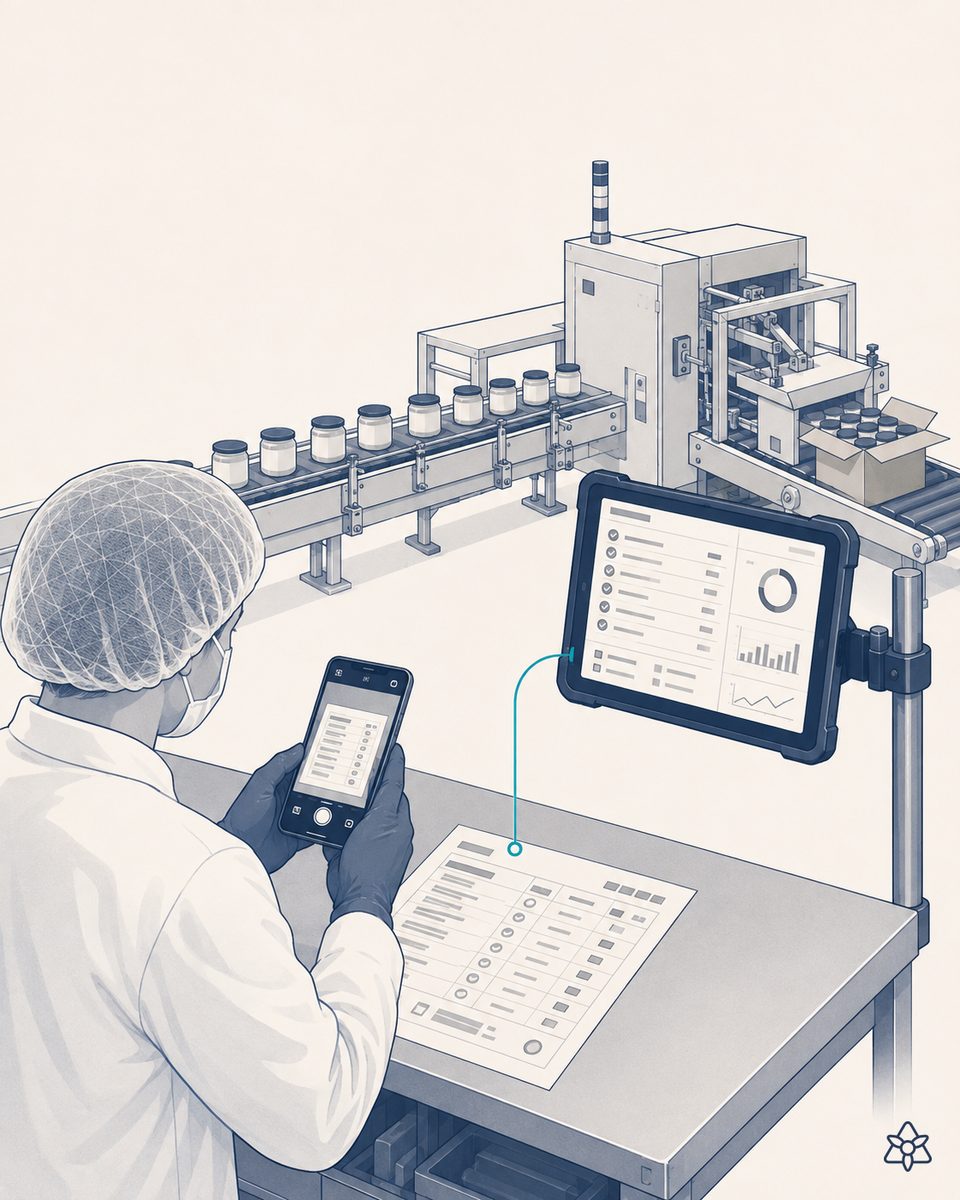
A glass fragment in baby food is the industry's worst-case scenario: a full recall and irreversible brand damage. iLEAN inspects 100% of the jars on the line's Edge — glass integrity, closure, fill level, visible particles —, holds the flow when a jar breaks and scopes the purge with per-batch evidence. The person decides; the system documents.
The most critical risk in the industry is still controlled with the least exhaustive method: sampling.
In baby food there is no “minor defect”. The end consumer can't protect themselves, the regulations are the strictest in the food chain and parents' trust isn't won back with a press release. A single glass fragment in a jar means a full batch recall — sometimes of the entire SKU — and brand damage that takes years to absorb. And yet, in many plants the actual control of the glass line still works like this:
- Inspection by sampling — a fraction of the jars is checked each shift. Statistically impeccable for tolerable defects; insufficient by design when the tolerance is zero: the jar nobody looks at is exactly the one that can reach the store shelf.
- The vacuum button and closure torque, by hand — an operator presses the lid to check the vacuum and a torque bench opens sample jars to verify the closure. Reliable on the sample; blind on the rest. A jar with a defective vacuum is a microbiological risk on top of a mechanical one.
- Jar breakage on the line — when a jar shatters at the filler or the capper, the protocol forces purging a wide margin of product “just in case”: nobody knows precisely how far the fragments traveled. Good product is destroyed for lack of data.
- Everything documented on paper — the purge, the reason, the unit range, the responsible person's signature. Handwritten sheets someone will type up later, with the gaps and the end-of-shift rush, and that will have to be reconstructed when the auditor asks for them months later.
The result is an uncomfortable asymmetry: the highest-risk point in the whole plant is the one with the least inspection coverage. The classic system works almost always. In baby food, “almost always” is not an acceptable standard.
iLEAN doesn't add another standalone camera — it puts 100% of the jars under a system that decides, scopes and documents.
The bottleneck isn't the optics: there are plenty of cameras. It's that detection lives on an island, the stop-and-purge decision lives in the shift lead's judgment and the evidence for the auditor lives on paper. None of them talks to the next without a person playing messenger. iLEAN is the putty that joins the three — without asking you to change the filler, the capper or the MES you already have.
Edge inspects 100% of the jars at line speed. JIDOKA AI holds the flow on a breakage and scopes the purge with evidence. Connect documents every purge and incident against the batch. The Agents generate the audit file. The person decides — nothing is destroyed or released without a signature.
The iLEAN pieces applied to baby food control in glass jars:
- Edge — 100% vision — vision models running at the line, in the plant's ring 1, inspecting every jar: glass integrity (finish, thread, body, base), lid seating and vacuum-button state, fill level against setpoint and visible particles on the product surface before closing. No cloud dependency to decide at production speed.
- JIDOKA AI — when a jar breaks or vision detects a critical defect, the system holds the flow at that point and scopes the purge with data: which units passed through the affected zone, between which timestamps, with an image of each one as evidence. What gets destroyed is what the data scopes, not the wide margin that data-less caution used to force. The final purge decision is signed by the person.
- Connect — logs every purge, hold and incident against the batch the moment it happens: reason, exact range, visual evidence, who signed. Nothing sits in a handwritten sheet waiting to be typed up; the record is born digital and traceable.
- Agents — generate the audit file per batch: what was inspected, what was held, what was purged and why, with the evidence linked. Ready for IFS, BRC and the infant-food-specific regulations, which are stricter on foreign bodies and traceability than the general ones.
The brain (Brain) orchestrating the agents lives in Central; critical data stays in the plant's ring 1, not in just any cloud (see the IRIS architecture and the three safety rings).
Sampling control vs. 100% control with iLEAN
| Aspect | Sampling + manual checks | With iLEAN Edge + JIDOKA AI + Connect + Agents |
|---|---|---|
| Inspection coverage | A fraction of jars per shift | 100% of jars, lids and levels, at line speed |
| Vacuum button and closure torque | By hand, on a sample | Button state verified on every unit; the torque bench stays as a cross-check |
| Jar breakage on the line | Wide “just in case” purge, scoped by eye | JIDOKA AI holds the flow and scopes the purge with per-unit evidence |
| Product destroyed per purge | Wide margin, no data to bound it | Only what the data scopes — less good product in the trash |
| Purge and incident records | Paper sheets, typed up later | Connect logs it against the batch in the moment, with visual evidence |
| Audit file (IFS/BRC + infant-food regulations) | Manual reconstruction days before the visit | The Agents generate it per batch, ready and traceable |
Impact estimate for your plant — to be validated with your numbers.
The block below is an estimate to be validated with the specific data of your line. It gives the committee an order of magnitude; we refine it during the diagnostic.
- Baby food plant with one or more glass-jar lines at medium-high speed, current control by sampling, manual vacuum and closure-torque checks, and breakage purges documented on paper.
- Deployment of Edge + JIDOKA AI + Connect + Agents on the line, integrated with the MES/ERP you already have. First value expected within a few weeks on a pilot line, starting with glass integrity and closure.
- Inspection coverage: from sampling to 100% of units. Product destroyed in breakage purges expected to drop ≥30% by scoping with data (often more, but that's the defensible floor; estimate to be validated). The hard lever is different: a single avoided recall pays for the project many times over.
- Indicative payback between 5 and 12 months, depending on line speed, breakage frequency, cost of purged product and audit-preparation cost. Estimate to be validated in the diagnostic.
And the quality team's reasonable doubt
“What if the AI is wrong on exactly the jar that matters?” — hallucination is a problem of free generation, not of anchored tasks. Classifying every jar against defined criteria (integrity, button, level, particles) is exactly an anchored task: the AI compares an image against deterministic thresholds set by your quality team, and when in doubt the criterion is conservative — hold, don't release. In this type of task, the best models brought error below 1.5% [1] — versus a sampling plan that, by design, doesn't look at most units. And even so, no purge is closed and no batch is released without the person's signature. The three safety rings are there for this.
[1] OpenAI paper “Why Language Models Hallucinate”, 2025 — on the reliability of AI in anchored tasks.
What people ask about AI control of baby food in glass jars
Why isn't sampling enough in baby food?
Because sampling is statistics, and zero tolerance admits no statistics. A 2% sampling plan leaves 98% of the jars unexamined; with a consumer who can't protect themselves, a single glass fragment is enough for a full recall and irreversible brand damage. 100% in-line inspection doesn't replace your HACCP plan: it reinforces it at the point where the risk is critical, looking at every jar, every lid and every fill level at line speed.
What does 100% vision check on each jar?
Four things on every unit: the glass integrity — finish, thread, body and base, where cracks concentrate —, the closure — lid seating and the state of the vacuum button, checked today by hand and by sampling —, the fill level against the format's setpoint, and the visible particles on the product surface before closing. The models run on the line's Edge, in the plant's ring 1, without depending on the cloud to decide at production speed.
What happens when a jar breaks on the line?
Today: the line stops, a wide margin of product is pulled “just in case” and the purge is documented on paper. With iLEAN, JIDOKA AI holds the flow the moment the breakage happens and scopes the purge with evidence: which units passed through the affected zone, between which timestamps, with an image of each one. What gets destroyed is what the data says must be destroyed — not what data-less caution used to force — and the incident is logged against the batch without anyone transcribing anything.
How does it help in an IFS/BRC or infant-food regulation audit?
Connect logs every purge, every hold and every incident tied to the batch the moment it happens, with the visual evidence linked. When the audit comes — IFS, BRC or the infant-food specific one, stricter on foreign bodies and traceability — the Agents generate the per-batch file: what was inspected, what was held, what was purged and why. The auditor receives a traceable file with evidence, instead of a folder of handwritten sheets someone has to reconstruct the week before.
Does it replace the X-ray detector or the manual vacuum check?
No — it complements them and joins them up. X-ray sees dense fragments inside the product; iLEAN's vision sees what X-ray doesn't cover: cracks in the finish and thread, a badly seated lid, a button with no vacuum, level off setpoint and visible particles before closing. And it adds what no isolated device gives: the JIDOKA decision that holds the flow on a breakage, the data-scoped purge and the per-batch file ready for audit. Your current equipment stays where it is; iLEAN puts the system around it.
More cases in food
- Yogurt line control with iLEAN Edge — 600 cups/min, every one inspected, none out of spec through to palletizing.Fill level, sealing and leaks on the yogurt line. iLEAN Edge inspects every cup at 600 units/min without…
- AI control of aluminum aerosol packing — a can with no pressure is a recall, not a complaint.iLEAN detects out-of-range internal pressure, faulty valves and dents on food-grade aluminum aerosol…
- Aquaculture traceability with AI — what the retailer wants is consistency, not more paperwork.iLEAN links cage, feed batch, veterinary treatment and harvest to support ASC/BAP, EU 1379/2013 and the…
- Real AI cases in bakeryReal AI cases in bakery: production planning by agent (tunnel oven with no stops, Excels into the…
- Beef carcass identification with AI — the animal cannot get lost between the ear tag and the hook.From ear tag to carcass to cutting without losing identity. iLEAN links national registries, the bovine…
- AI control of beer fermentation — the curve does not wait for daybreak, and the brewmaster cannot be on call all night.Gravity, temperature and time monitored continuously. iLEAN alerts the brewmaster before the batch…
Tell us your case and in 48h we'll send you the estimated ROI of this AI project for your glass-jar line.
We work on the real data of your plant and your line, not ours. Diagnostic with no commitment.
Request estimated ROI in 48h See food industry