AI control of aluminum aerosol packing — a can with no pressure is a recall, not a complaint.
A food-grade aerosol that loses pressure or has a faulty valve means a batch recall — and an explosion risk. iLEAN Edge reads the can, measures visible deformation and cross-references it with the pressure bench data, before palletizing. The line does not restart until the manager signs.
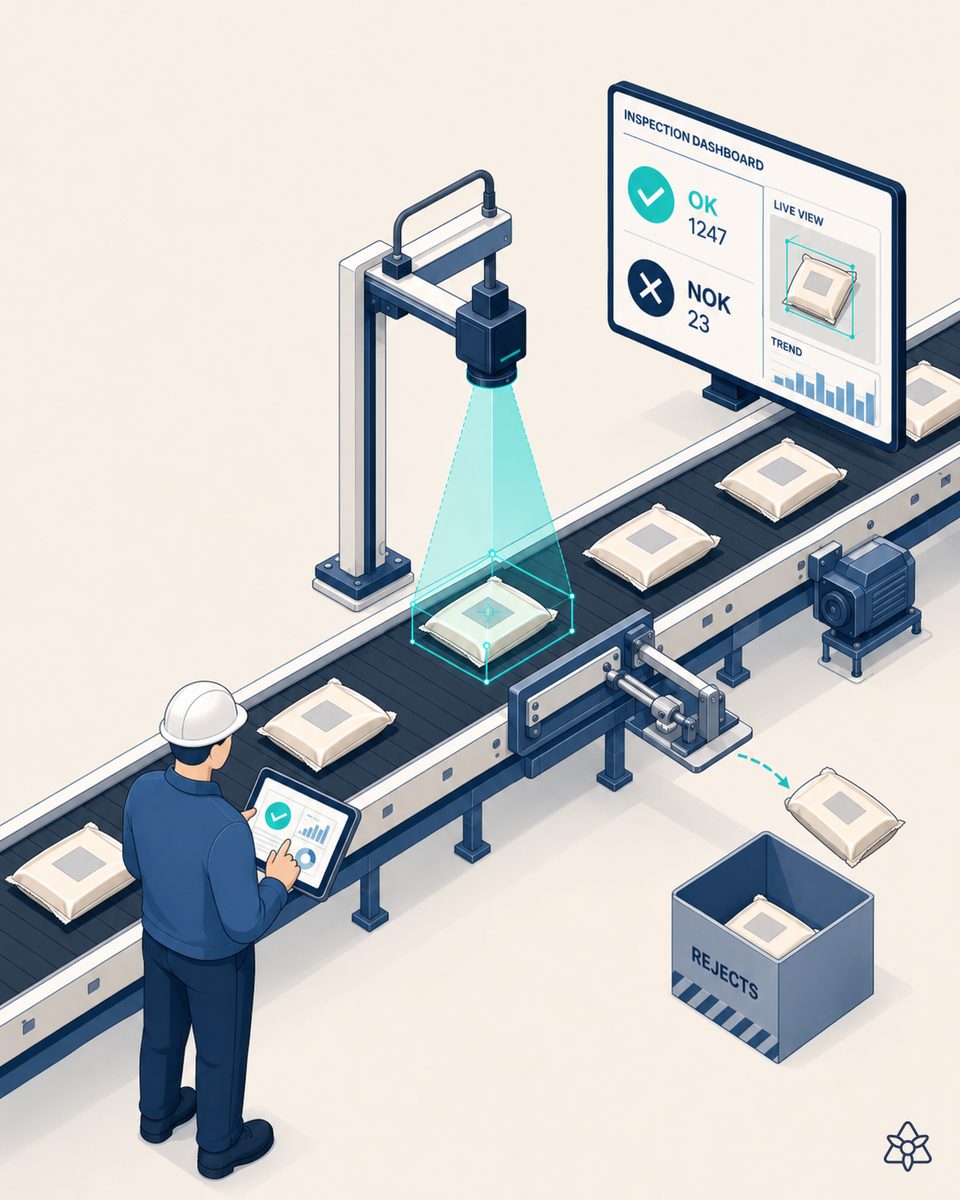
The pressure bench only tests one can in a hundred. The other 99 go to the pallet unchecked.
A food-grade aerosol packing line (whipped cream, spray oil, cocoa spray) combines three risks that do not converge at the same time in any other package:
- Internal pressure — the can is pressurized with a food-grade propellant. If the valve does not seal or the body has a microcrack caused by a dent, it loses pressure and stops working on the shelf.
- Shiny aluminum — a difficult surface for classic vision: the reflections from the light tunnel get confused with defects. The classic system (the eye + random checks) lets fine dents through.
- A sample-based pressure bench — the destructive or service-pressure test is run on small samples from the batch. If the defective cohort falls outside the sample, it reaches the customer.
The quality manager knows it. So does the operator. But nobody can eyeball 80 cans a minute, and the pressure bench does not scale to 100% of production without destroying productivity. A single defective cohort reaching the shelf means a recall — and with pressurized aerosols a recall is more expensive than with any other package, because destruction is regulated.
iLEAN does not add another checkpoint — it seals the cracks between the belt, the bench and the pallet.
The information already exists on the line: the image of the can, the bench reading, the batch of the internal product, the propellant filter change. The problem is that each piece of data lives on its own island and nobody cross-references them at belt speed. iLEAN acts as the putty that connects the operator's eye to the pressure bench, without throwing away anything you already have.
Edge sees the can in shiny aluminum. Connect reads the pressure bench and the internal batch. The agent cross-references, holds the suspect cohort and alerts the manager. The person signs — the line does not restart on its own.
The two iLEAN pieces applied to aerosol packing:
- Edge — a vision terminal with a CNN trained on samples of the customer's own can. It detects dents, deformation, faulty printing and misplaced valves. Diffuse or multi-directional lighting to cancel out the aluminum reflection. Reject actuator over the belt. ATEX certified for the relevant zone. It works with no network.
- Connect — captures the pressure bench reading, the batch data of the internal product, the propellant filter change and the operator's notes. When a bench deviation coincides with a cohort on the belt, the agent cross-references and isolates the cause: valve head, shift, propellant lot.
- Agent + Ring 1 — a pressurized can is a critical product. Holding the batch and recalling a cohort are signed off by a person, and only by a person. iLEAN proposes with the full per-cohort dossier; the quality manager decides. What the system does allow is automating the individual rejection of a defective can (which is not a regulatory-critical operation).
Random checks vs. in-line control with iLEAN
| Aspect | Sample bench + the operator's eye | With iLEAN Edge + Connect + Agent |
|---|---|---|
| Inspection coverage | 1 in every 100 to the bench, the rest by eye | 100% of cans through Edge |
| Fine dents in aluminum | Slip through whenever there is a reflection | CNN + directional lighting |
| Misplaced valve | Detected at the bench if it falls in the sample | Edge cross-references image + bench data |
| Defective cohort | Reaches the shelf, or the whole batch is recalled | Isolated by valve head + shift + batch |
| Per-can traceability | Batch level only | Per-cohort dossier + photo of the can |
| Restarting the line | The shift lead's call | The quality manager's call and signature |
Impact estimate for your plant — to be validated with your numbers.
The block below is an estimate to be validated with the specific data of your plant. We put it forward so the committee has an order of magnitude; we refine it during the diagnostic.
- Food-grade aerosol line, 40-120 cpm, pressurized internal product, sample-based pressure bench, typically ATEX zone 2.
- Edge pilot on the belt after filling + Connect to the pressure bench + a cohort agent. First value expected within a few weeks.
- Indicative payback between 4 and 9 months, dominated by avoided scrap and by the hard lever: a single avoided recall pays for the entire pilot.
- Hard levers: dent-related scrap down ≥ 30%, defective cohorts held before the pallet, a complete per-batch dossier for the auditor.
And the quality manager's reasonable doubt
“What if the AI lets a defective can through to the pallet?” — the agent proposes holding the cohort; the signature still belongs to the manager. For individual defects (rejecting one specific can) Edge does act on its own, because rejecting a package is not a regulatory-critical operation. For holding the batch and notifying the customer, the three rings require a person to decide. And the reliability of AI in these anchored tasks (reading a can, cross-referencing it with the bench) sits below 1.5% error [2].
[1] Automotive quality standard in the order of 25 PPM — Symestic. [2] OpenAI paper “Why Language Models Hallucinate”, 2025 — on the reliability of AI in anchored tasks.
What people ask about AI control of aluminum aerosol packing
Does it detect dents on shiny aluminum with reflections?
Yes. A shiny aluminum surface is the hardest case there is for classic vision — the reflections from the light tunnel get confused with the dent. iLEAN Edge uses a CNN trained specifically on samples of the customer's own can, diffuse lighting and, when the case calls for it, a multi-directional lighting technique to cancel out the reflection. Detection is validated against known parts during the pilot. If a part has grain, a dent or faulty printing, it is rejected before palletizing — and the traceability record is kept.
How does it cross-reference with the pressure test bench?
iLEAN Connect reads the data from the pressure bench (the equipment that tests the can at its service pressure or at burst pressure on a sample basis) and links it to the physical batch. If the bench detects a deviation, the agent cross-references it with the batch's own history (which valve head, which shift, which propellant filter change) and isolates the probable cause. Faulty valves almost always come in clusters — the pattern shows up before it reaches the customer.
Does it work for cream, oil and regulated ATEX zones?
Yes. The Edge terminal is installed with the certification required for the relevant ATEX zone (typically zone 2 in aerosol filling with flammable propellant). For cans with sensitive food product (whipped cream, spray oil, cocoa spray), iLEAN also cross-references the dosing temperature and the batch of the internal product — a leak can come from the valve just as easily as from a poor can seal. The agent maintains a per-batch dossier with all the evidence.
Does it reduce recalls caused by propellant leaks?
Yes, and that is the most visible lever of the project. A food-grade aerosol recall for leakage is a hard cost (product collected, reverse logistics, regulated destruction because it is pressurized) and serious brand damage — a can that loses pressure on the supermarket shelf is not just a failed package, it is a feeling of insecurity passed on to the consumer. iLEAN brings that rate down by catching the can on the line, not in a complaint. And the per-batch dossier avoids a blanket recall when the problem belongs to a single cohort.
How much does it cost to put Edge on an aerosol line?
The order of magnitude of an Edge pilot on a food-grade aerosol line covers the vision terminal, the lighting system, the reject actuator over the belt, integration with the pressure bench and the annual license. The payback you can reasonably take to the committee is several months — the hard lever is a single avoided recall plus the reduction in scrap from dents within the batch. We ask for your plant's data and send you the estimated ROI in 48h, with your numbers, not ours.
More cases in food
- Wine vintage traceability with AI — a vintage is worth twice as much when you can prove it.From harvest to bottle without losing the vintage. iLEAN binds parcel, tank, barrel and bottling into a…
- Yogurt fermentation control with AI — stop the curve at the exact point, not five minutes later.How iLEAN cross-references temperature, pH and the acidification curve to stop yogurt fermentation at…
- Yogurt line control with iLEAN Edge — 600 cups/min, every one inspected, none out of spec through to palletizing.Fill level, sealing and leaks on the yogurt line. iLEAN Edge inspects every cup at 600 units/min without…
- Aquaculture traceability with AI — what the retailer wants is consistency, not more paperwork.iLEAN links cage, feed batch, veterinary treatment and harvest to support ASC/BAP, EU 1379/2013 and the…
- AI control of baby food in glass jars — zero tolerance means 100% inspection, not sampling.100% AI inspection of glass baby food jars: glass integrity, closure, fill level and visible particles.…
- Real AI cases in bakeryReal AI cases in bakery: production planning by agent (tunnel oven with no stops, Excels into the…
Tell us your case and in 48h we'll send you the estimated ROI of this AI project for your aerosol line.
We work on your plant's real data, not ours. Diagnostic with no commitment.
Request estimated ROI in 48h See food industry