Yogurt line control with iLEAN Edge — 600 cups/min, every one inspected, none out of spec through to palletizing.
A yogurt line turns out 600 cups/min. iLEAN Edge inspects fill level, sealing and leaks on every one of them in real time and rejects out-of-spec units before palletizing — without stopping the line, integrating with the rejector you already have. The operator stops watching cups and starts making decisions.
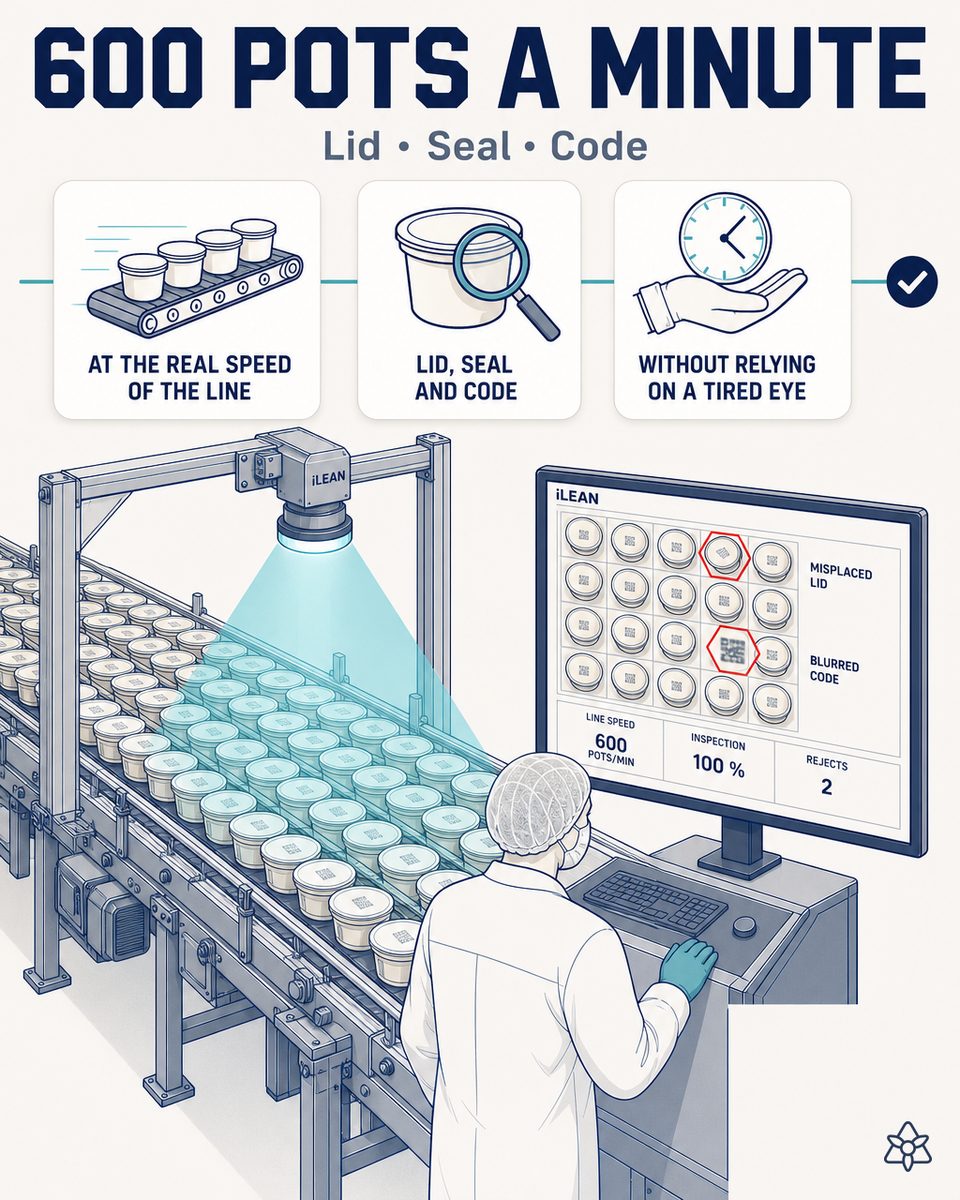
High speed, multi-lane, one-off defect: human inspection cannot keep up.
A standard yogurt line runs multi-lane at several hundred cups per minute. The operator at the end of the line cannot see every cup — it is physically impossible. What they do, and do well, is check random samples and keep an eye on the SCADA panel. The defects that get through are the ones that slip between samples:
- Fill level out of spec — the "underfilled" cup that reaches the customer and triggers a complaint. Under the retailer's rules, there is a tolerance threshold per unit and per batch.
- Defective sealing — a fold in the top film, a trace of yogurt between lid and cup, a weld gone wrong because of temperature. Visible to a camera, nearly invisible to the eye at 600/min.
- Microleak — invisible to the eye and to the camera alone. The product reaches the shelf and three days later the tray smells bad — mass returns, brand damage.
The classic system (samples + checklist + complaint) works 99% of the time — and that 1% is the batch pulled from the shelf. As in other industries, this is not about getting rid of the operator; it is about freeing them from dumb work (looking at what was fine) so they can do the work that matters (deciding on what does not add up).
iLEAN does not add another layer between the filler and the rejector — it seals the crack between them.
Your yogurt line already has a filler, a heat sealer, a rejector and a SCADA. The problem is not a lack of machines; it is that each one does its own job and nobody cross-references the results in real time. iLEAN acts as the putty that fills the cracks between those pieces, reads every cup, decides in milliseconds and fires the rejector you already have — replacing nothing.
Edge sees every cup at 600/min. The agent cross-references the batch and the SCADA. When a defect pattern appears, it proposes the root cause to the shift lead. The person signs — the line does not restart on its own.
The three iLEAN pieces applied to the yogurt line:
- Edge — terminals with machine vision (CNN) mounted over the filler and the heat sealer, integrated with the vacuum test chamber. It inspects fill level, sealing, leaks, coding. It fires whatever actuator you already have, in milliseconds. It works without a network: if the plant loses WiFi, the camera keeps inspecting and rejecting on the power from the cabinet.
- Connect — captures the data that arrives from outside the line (a lid-batch change from the supplier that purchasing flagged by email, a recipe adjustment from the R&D lead in an Excel file, new retailer parameters over WhatsApp) at second zero, with no forwarding and no meetings.
- Agent — cross-references the rejection rate by lane, by hour, by batch, against the heat sealer parameters and the recipe. If the rate climbs on line 3 at 2:20 pm, it does not send an email at 10 pm: it alerts the shift lead with the probable cause. The person decides and signs — Agents propose, the person executes.
Sample-based inspection vs. continuous AI vision inspection
| Aspect | Operator + samples + SCADA | With iLEAN Edge + Agent |
|---|---|---|
| Coverage | Random samples (typically <1%) | Every cup, every lane |
| Defect detection | Reactive: shows up in sampling or in a complaint | At second zero, before palletizing |
| Rejection | Suspect batch put on hold | Cup by cup, without stopping the line |
| Root cause | Reconstructed after the fact | Agent cross-references the SCADA and proposes it |
| Per-batch dossier | Quality sheet filled in at the end | Automatic, with a photo of the defect |
| Operation without a network | n/a | Edge keeps rejecting on the power from the cabinet |
Impact estimate for your plant — to be validated with your numbers.
The block below is an estimate to be validated with the specific data of your plant. We put it forward so the committee has an order of magnitude; we refine it during the diagnostic.
- Multi-lane packing line at several hundred cups/min, standard heat sealer, existing pneumatic rejector. Edge pilot on one line.
- First value expected within a few weeks: fill level + sealing operational with a per-batch dossier; leaks depending on whether a vacuum test chamber already exists or is added.
- Indicative payback between 4 and 9 months, depending on the current rate of defects detected late, the average cost of a retailer return and the brand cost of a microleak reaching the shelf.
- Hard levers: reduction of defects reaching the customer ≥ 30% (conservative estimate); a single avoided shelf recall pays for the pilot; operator time freed for tasks that genuinely require judgment.
And the operations director's reasonable doubt
"What if the camera drifts out of adjustment and starts rejecting good cups?" — positive preemption: the agent monitors the system's own false-positive rate and raises a flag before it gets out of hand. The quality manager sees why each cup is rejected, adjusts the sensitivity without touching code, and the system learns from the corrections. In anchored tasks (looking at a cup and comparing it with a pattern), the best models brought error below 1.5% [2]. And even so, what is critical (stopping the line, disqualifying a whole batch) is never decided alone: the agent proposes, the person signs.
[1] Automotive quality standard on the order of 25 PPM — Symestic.
[2] OpenAI paper "Why Language Models Hallucinate", 2025 — on the reliability of AI in anchored tasks.
What people ask about AI control of a yogurt line
How many cameras does a standard yogurt line need?
It depends on what you inspect: fill level usually needs one overhead or side camera per lane (food fillers typically run multi-lane); sealing requires an overhead camera over the lid after the heat sealer; leaks are detected by combining vision + differential pressure in a small in-line test chamber. We size it during the AI immersion by looking at the real line, not from a catalog. The principle is never to install more than what actually serves — a classic antipattern, money burned.
Is defective-seal detection reliable?
Yes for visible defects (a fold, a wrinkle, yogurt residue between lid and cup, a bad weld caused by temperature). For defects the camera cannot see (a microleak with no visible mark), reliable detection requires combining vision + vacuum/differential-pressure measurement in a small in-line test chamber — vision alone is not enough, and promising otherwise would be dishonest. This combination is standard in serious plants and we integrate it with the equipment you already have. Package integrity is brand defense: one tray on the shelf with a microleak triggers returns and damage that outweigh the cost of the control.
Does it integrate with the existing pneumatic rejector?
Yes — Edge fires whatever actuator you already have (pneumatic ejector, diverter arm, warning light). If all you have is a light and an operator makes the call, that is respected too. Nothing that already works gets broken: the putty fills the cracks between the camera, the rejector and the line's SCADA. Physical installation on a standard yogurt line takes hours, not days, because the work runs in parallel with production.
Does it generate a per-batch record?
Yes — every inspected cup goes into the batch dossier with its verdict, a photo of the defect if there was one, the time and the lane position. The agent prepares the file for the IFS/BRC auditor at batch close, with nothing rebuilt by hand. If the leak-rejection rate rises in a batch, the agent cross-references heat sealer data (temperature, pressure, speed) and proposes the root cause to the shift lead. The person signs — the agent only prepares the dossier.
How long does it take to deploy on a yogurt line?
An Edge pilot on a standard food packing line follows a consistent pattern: first value within a few weeks, detection operational by the end of the first quarter, expansion to the next lines carried out by the customer's own trained people within a few months. Exact timelines depend on the type of defect to inspect and on the state of the integration with the plant's SCADA/MES. Estimate to be validated during the AI immersion on your specific line.
More cases in food
- Wild-catch fishing traceability with AI — the chain does not break in the plant, it breaks at the dock.iLEAN captures the vessel delivery note, the auction record and MSC certification and links them to the…
- Wine vintage traceability with AI — a vintage is worth twice as much when you can prove it.From harvest to bottle without losing the vintage. iLEAN binds parcel, tank, barrel and bottling into a…
- Yogurt fermentation control with AI — stop the curve at the exact point, not five minutes later.How iLEAN cross-references temperature, pH and the acidification curve to stop yogurt fermentation at…
- AI control of aluminum aerosol packing — a can with no pressure is a recall, not a complaint.iLEAN detects out-of-range internal pressure, faulty valves and dents on food-grade aluminum aerosol…
- Aquaculture traceability with AI — what the retailer wants is consistency, not more paperwork.iLEAN links cage, feed batch, veterinary treatment and harvest to support ASC/BAP, EU 1379/2013 and the…
- AI control of baby food in glass jars — zero tolerance means 100% inspection, not sampling.100% AI inspection of glass baby food jars: glass integrity, closure, fill level and visible particles.…
Tell us your case and in 48h we'll send you the estimated ROI of AI control for your yogurt line.
We work on your plant's real data, not ours. Diagnostic with no commitment.
Request estimated ROI in 48h ‹ All dairy cases See food industry