Yogurt fermentation control with AI — stop the curve at the exact point, not five minutes later.
Nailing yogurt means cross-referencing temperature, pH and the historical curve of the same culture and the same milk, in a tank that drifts on its own. iLEAN projects the curve ahead, alerts the production lead before it reaches target, and leaves the batch signed off with its full biological fingerprint. The person decides — the centrifuge does not start on its own.
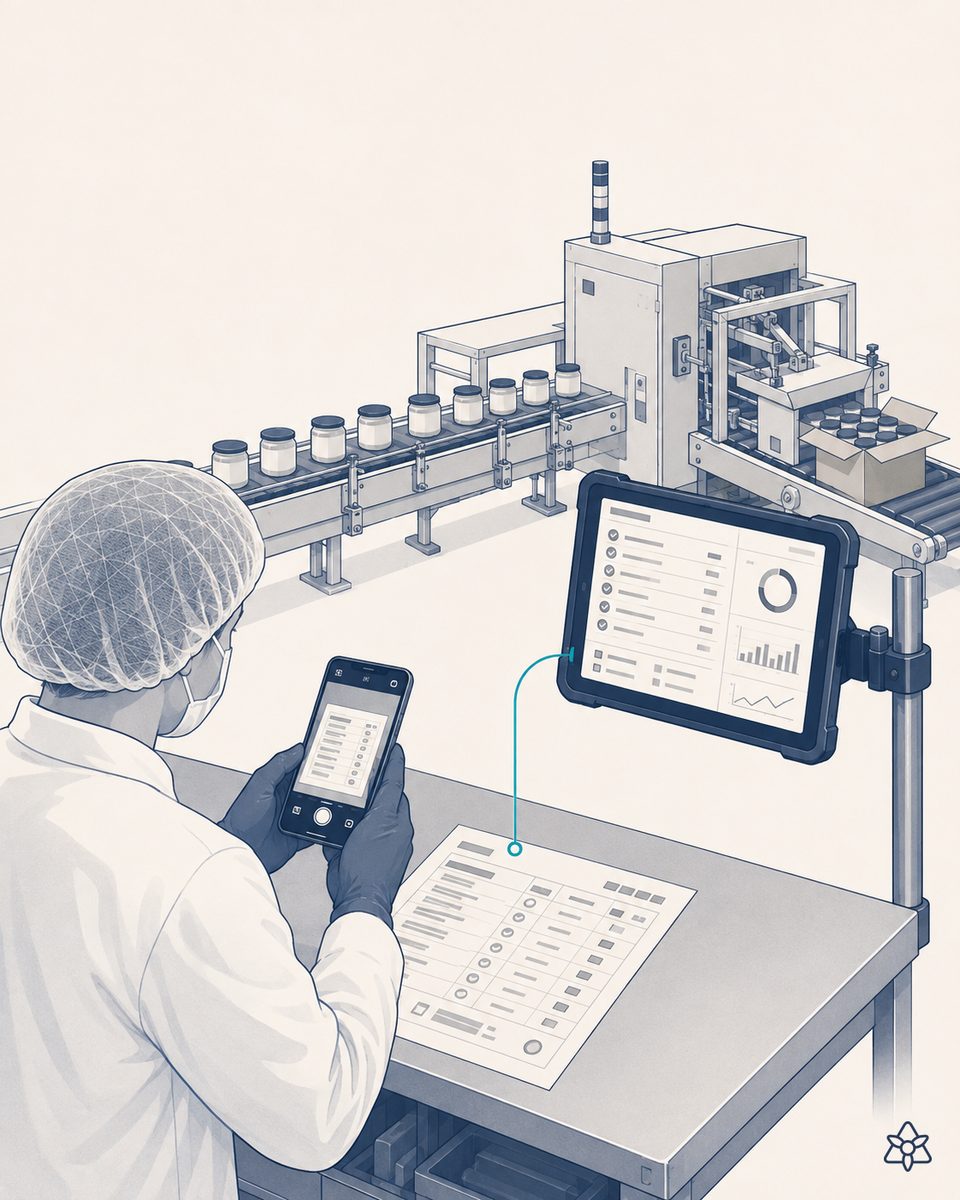
The clock says four hours. The curve says three fifty.
The protocol is clear: 42 °C, add the starter, wait for pH 4.6, cool. And even so, the batches that come out at exactly 4h are not the same. There are three plant-floor reasons, and none of the three shows up on a single screen:
- The starter varies. Today's culture is not last week's. New batch, older culture bank, a shifting ratio of Streptococcus to Lactobacillus. The curve is not the same.
- The milk varies. Solids, protein, penicillin residues if a supplier missed the withdrawal period. Acidification changes.
- The tank varies. The agitator on tank 3 is not the one on tank 5. Ambient temperature on the production floor in winter is not the one in August. The heating jacket's warm-up curve drifts.
The production lead knows this and compensates with craft: walks the floor every hour, checks the probes, touches the tank, decides. What they cannot do is be at all eight tanks at once. And the day one of them slips by twenty minutes, that batch is already outside spec — and the catch is that the cost is not today's, it is tomorrow's rework, or the consumer who sees whey on the spoon.
iLEAN does not take judgment away from the production lead — it puts all eight tanks on one screen and tells them which to check first.
The problem is not a shortage of people with craft: it is that craft cannot be at eight tanks at the same time. iLEAN is the putty between the tank probes, the culture history and the batch sheet for the day's milk. It does not ask you to change the culture, the tank or the packing system.
Edge sees the probe. Connect captures culture, milk and curve wherever they live. The agent projects the stopping point and alerts the production lead's phone. The person validates and the centrifuge starts.
The three iLEAN pieces applied to yogurt fermentation control:
- Edge — an inline terminal with machine vision (CNN) to read the analog chart recorder when the probes are not integrated, or a direct PLC read if the vessel allows it. It reads without a network — if the production floor is cut off, it keeps recording with the light on the panel.
- Connect — captures the supplier's starter batch sheet by email or photo, the day's milk analysis from the lab (PDF, spreadsheet or LIMS), and the tank sheet from the notebook or the screen. Graduated capture: you connect to the modern vessel through a direct interface, or you photograph the chart recorder on the wall. No obligation to change the equipment.
- Agent — cross-references temperature + pH + history for the same culture and the same milk, projects the curve 30-60 minutes ahead, and alerts the production lead's phone before the tank reaches target. For tanks running in parallel, it prioritizes the one to check first. It does not open the cooling loop by itself — the person decides and signs.
Fermentation by the clock vs. fermentation by the curve with iLEAN
| Aspect | Fermentation on a fixed protocol | With iLEAN Edge + Connect + Agent |
|---|---|---|
| Stopping decision | Clock + the production lead's hourly round | Curve projection per tank + phone alert |
| Variance between batches | High: depends on culture, milk, tank | Standardized: the curve adjusts itself to the batch |
| Culture history | In the production lead's head | Captured as a pattern, it does not leave with them |
| Rework from over-incubation | Recurring cost, hard to measure | Measurable reduction batch after batch |
| Syneresis in the final pot | Retailer complaint | Avoided at source |
| Batch file | Rebuilt in a spreadsheet | Per-tank dossier with the real curve and a signature |
Impact estimate for your plant — to be validated with your numbers.
The block below is an estimate to be validated with the specific data of your plant. We put it forward so the committee has an order of magnitude; we refine it during the diagnostic.
- Mid-sized multi-SKU yogurt plant (set + stirred + Greek), 6-10 fermentation tanks, 1-2 shifts.
- Pilot on 2-3 tanks: probe or chart-recorder reading + integration with the culture and milk sheets + projection agent. First value expected within a few weeks — the first round where the alert arrives before the over-incubation does.
- Indicative payback between 4 and 9 months, depending on historical rework volume and the percentage of batches with syneresis or excess acid.
- Measurable hard lever: a reduction of ≥ 30% in batches outside the optimal range, an automatic batch file, and the production lead's rounds concentrated where they are needed.
And the production lead's reasonable doubt
“What if the AI proposes stopping too early?” — the AI stops nothing here. It projects a curve and proposes a moment; the person decides. AI reliability in anchored tasks (reading a probe and comparing it against a history) brought error below 1.5% in the best models[1]. And even so, no tank is cooled without your signature. The three safety rings exist precisely for this.
[1] OpenAI paper “Why Language Models Hallucinate”, 2025 — on the reliability of AI in anchored tasks.
What people ask about yogurt fermentation control with AI
Why is yogurt fermentation still so hard to nail batch after batch?
Because three variables move at the same time, and not always in the same direction: culture activity (the starter received from the supplier, cross-contamination, the age of the culture bank), the tank's temperature profile (heating jacket, agitator, ambient conditions on the production floor) and the acidification curve (milk composition, solids, protein). The protocol says “42 °C for X hours until pH 4.6,” but the actual batch needs a few minutes more or a few minutes less. Stop too early and you get a runny texture; stop too late and you get excess acid and syneresis.
How does iLEAN detect the optimal stopping point?
By cross-referencing what today lives on separate islands: the tank's temperature and pH probes (or the chart-recorder reading if the probes are not online), the curve history for the same culture and the same milk, and the batch sheet for the starter and for the day's milk. The agent projects the curve 30-60 minutes ahead and alerts the production lead when a tank is about to reach the target pH. The person decides and signs — cooling is triggered when the operator validates it.
What happens if we miss the point and the yogurt ends up too acidic?
Depending on the level, it is reworked (blended with a milder batch to bring the acidity back), reclassified as an acidic Greek- or Bulgarian-style yogurt if the plant runs that SKU, or destroyed. All three options cost margin and tank time. The nastiest by-product is syneresis in the final pot: the customer sees whey on the spoon and the yogurt becomes a second-rate product. iLEAN anticipates so the stop arrives on time.
Does it work for set, stirred and Greek yogurt alike?
Yes. The optimal point is different in each one (set yogurt cools with the product already in the pot, stirred yogurt cools in the tank and is then pumped, Greek yogurt is centrifuged afterwards), but the principle is the same: cross-reference temperature + pH + history to stop at the right moment. iLEAN adapts to the product type and to your kind of tank — without asking you to change the culture, the milk or the equipment.
Is there a real-world case of industrial AI in lactic fermentation?
Industrial AI has been working on controlled biological variables (fermentation, curing, drying) for decades — long before the world started calling it AI. The pattern is the same in brewing, baking or yogurt: cross-reference the physicochemical curve + the starter batch + the history to anticipate the optimal point. What changed is that this is now done with LLMs that recontextualize heterogeneous data at almost zero cost — the old recipe in a spreadsheet, the master fermenter's notebook, the curve on the chart recorder hanging on the wall.
Related: yogurt line control with Edge · beer fermentation with AI · HACCP CCPs in dairy
More cases in food
- Industrial artificial intelligence in 100% agave tequila distilleries12 real industrial AI cases for 100% agave tequila distilleries: batch logs, autoclave, lab data,…
- Wild-catch fishing traceability with AI — the chain does not break in the plant, it breaks at the dock.iLEAN captures the vessel delivery note, the auction record and MSC certification and links them to the…
- Wine vintage traceability with AI — a vintage is worth twice as much when you can prove it.From harvest to bottle without losing the vintage. iLEAN binds parcel, tank, barrel and bottling into a…
- Yogurt line control with iLEAN Edge — 600 cups/min, every one inspected, none out of spec through to palletizing.Fill level, sealing and leaks on the yogurt line. iLEAN Edge inspects every cup at 600 units/min without…
- AI control of aluminum aerosol packing — a can with no pressure is a recall, not a complaint.iLEAN detects out-of-range internal pressure, faulty valves and dents on food-grade aluminum aerosol…
- Aquaculture traceability with AI — what the retailer wants is consistency, not more paperwork.iLEAN links cage, feed batch, veterinary treatment and harvest to support ASC/BAP, EU 1379/2013 and the…
Tell us your case and in 48h we'll send you the estimated ROI of this AI project for your yogurt plant.
We work on your plant's real data, not ours. Diagnostic with no commitment.
Request estimated ROI in 48h See food industry