Wine vintage traceability with AI — a vintage is worth twice as much when you can prove it.
A properly certified vintage is worth twice what the same vintage is worth without proof. iLEAN Tracer + Edge bind parcel, tank, barrel and bottling into a single identity — without asking the cellar hand to type anything on the dock. The file for the Regulatory Council and for the importer builds itself.
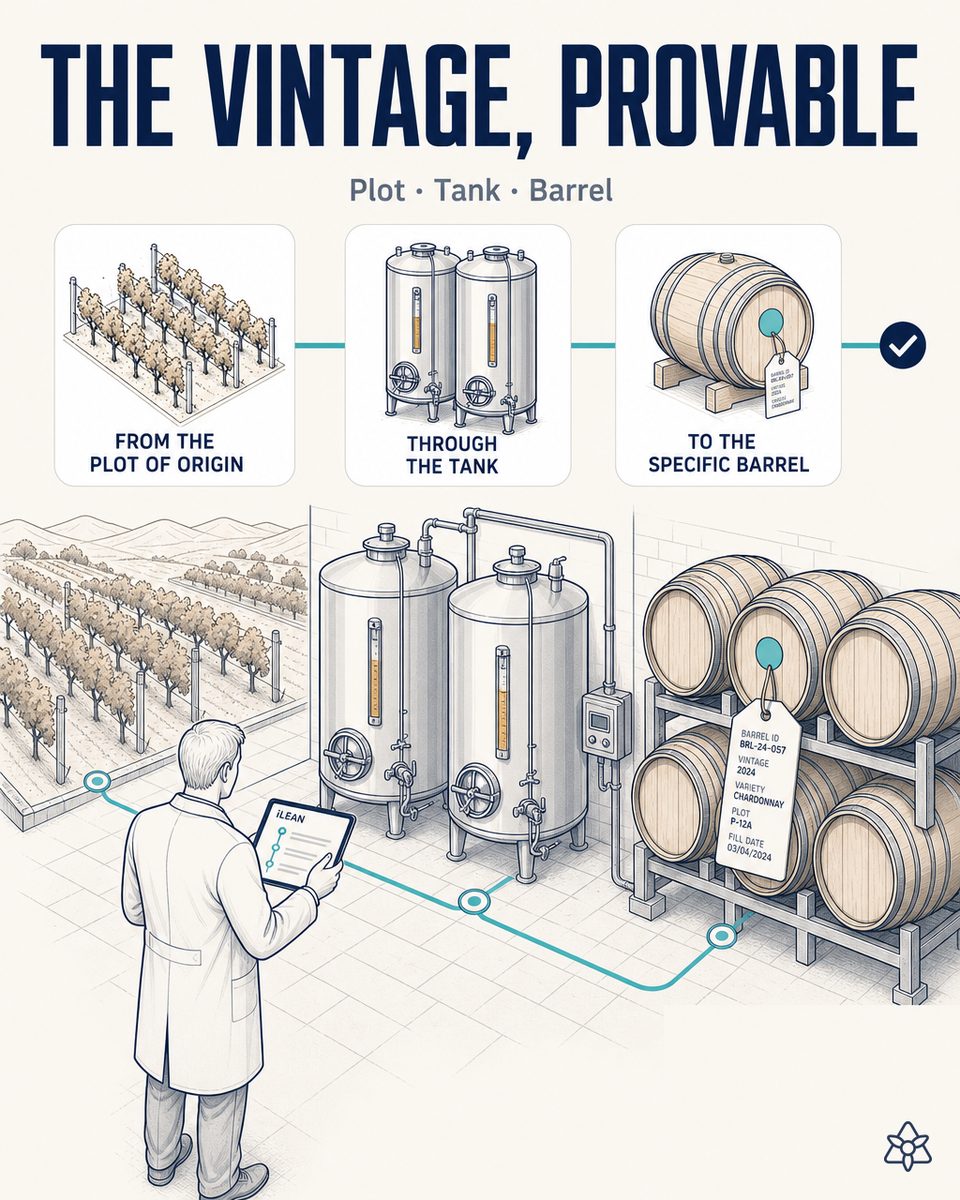
A vintage is built in six places and can be lost in any one of them.
A vintage is not born in the bottle: it is born in a specific parcel, it ferments in an identified tank, it ages in barrels with their own thermal history and it is bottled in a batch with its own legal markings. And in a winery — traditional or modern — those six steps live in six different notebooks:
- Harvest — the vineyard delivery note on paper, the weighbridge reading in another system, the winemaker's decision in his head.
- Fermentation — the tank with its probe, its thermal profile and the pump-over the cellar hand jotted in a notebook.
- Barrel — a datalogger in the hall, a racking sheet in the filing cabinet, and the cellar master's memory of which barrel was racked into which.
- Blending — a spreadsheet with the percentage from each tank used to assemble the final batch, almost never archived.
- Bottling — the machine with its counter, the labeler with its program, the batch number printed on the glass.
- Logistics — the pallet with its delivery note, the shipment to the importer with its counter-marking; the fine-grained trail is lost the moment it leaves the dock.
When the Regulatory Council, the American importer or a master sommelier's buyer asks for the file, somebody in the winery rebuilds it with a good memory and a bit of luck. “Traceability” translates into “hours of the technical director's Saturday”. And top buyers are asking for more of it every year, not less.
iLEAN does not invent a seventh ledger — it seals the cracks between the six that already exist.
The vintage problem is not a lack of data: every step has its own. The problem is that the data never joins up. iLEAN acts as the putty that bridges the six islands — harvest, fermentation, barrel, blending, bottling, logistics — and keeps the vintage identity intact from parcel to bottle, without pulling the cellar hand out of his routine.
Connect captures what already exists — delivery note, weighbridge, the supervisor's voice, the datalogger. Tracer keeps the vintage identity alive at every step. Edge steps in wherever there is a machine (bottling, labeling). The person validates; iLEAN assembles the file.
The iLEAN pieces applied to wine vintage traceability:
- Connect — a photo of the vineyard delivery note, a reading of the weighbridge display, the vineyard manager's voice through the earpiece identifying the parcel, integration with the barrel room datalogger (Testo, HOBO, whatever you run), capture of the importer's WhatsApp with a new US market requirement. Everything comes in and becomes usable data, with no forms to type.
- Tracer — the vintage identity that travels with the wine: parcel → tank → barrel → blend → bottling → pallet → importer. It carries the inheritance of percentages through blends and lets you look up the full lineage of any bottle in one click.
- Edge — wherever there is a machine (bottling line, labeler), a vision terminal reads the bottle, verifies that the label matches the batch, validates the code on the glass and records it. The same capability as in any other packaging operation, tuned to the rhythm of a winery.
- Agent — assembles the PDO file when the Regulatory Council asks for it, prepares the dossier for the importer, answers the retailer's audit with verified data. The critical operation (declaring the vintage, releasing the batch for export) still belongs to the person — the three rings guarantee that iLEAN proposes and the technical lead signs.
Reconstructed traceability vs. a living identity with iLEAN
| Aspect | Classic traceability (ledgers + spreadsheets) | With iLEAN Tracer + Connect + Edge |
|---|---|---|
| Capture at harvest | Paper delivery note + weighbridge in another system | Photo + voice + integrated weighbridge, in the same second |
| Thermal history of the barrel | Unconnected datalogger, read by hand once a month | Integrated and cross-referenced with the vintage identity |
| Blend traceability | The winemaker's spreadsheet, often never archived | Percentages stored with inherited origin |
| PDO file | Rebuilt by hand on request, hours or days | Compiled automatically when requested |
| Answering an importer's audit | “I'll look for it and call you back” — days | A dossier ready to send in minutes |
| The veteran risk | The knowledge walks out with the cellar master | Captured as a permanent capability |
Impact estimate for your plant — to be validated with your numbers.
The block below is an estimate to be validated with the specific data of your winery. We put it forward so you have an order of magnitude; we refine it during the diagnostic.
- Mid-sized PDO winery, 50-300 ha, 2-3 varieties, in-house bottling. Harvest handled on a shared weighbridge, with a datalogger in the barrel room.
- Connect + Tracer pilot across one harvest (capturing delivery note + weighbridge + voice + datalogger). First value expected within a few weeks after harvest: a PDO file that can be compiled on demand.
- A ≥ 30% reduction in the effort of rebuilding documentation against the baseline we measure during the diagnostic (hours of the technical director's time spent reconstructing).
- Indicative payback between 4 and 9 months, depending on the frequency of PDO/importer audits and the average price of an exported vintage.
- Additional hard lever: the price differential between a certified vintage and one with no proven traceability in export markets (a single US order with a premium file covers a good part of the pilot).
And the reasonable fear of trusting AI with something regulated
“What if the AI makes up a figure in the file?” — hallucination is a problem of free generation (asking the AI to write something from scratch), not of anchored tasks (extracting a figure from a delivery note, reading a display, recontextualizing what was captured). In those tasks, the best models brought error below 1.5%[1]. And in any case, the critical operation (signing the PDO declaration, releasing the batch for export) still belongs to the person: iLEAN's three rings exist precisely to guarantee that the AI proposes and the person signs.
[1] OpenAI paper “Why Language Models Hallucinate”, 2025 — on the reliability of AI in anchored tasks.
What people ask about vintage traceability with AI
How is the harvest recorded without slowing down grape intake?
During harvest the bottleneck is the weighbridge on the dock — and nobody is going to stick a tablet there. iLEAN Connect captures what already exists: the photo of the vineyard delivery note, the weight from the weighbridge (direct reading or a photo of the display), and the voice of the vineyard manager saying which parcel is coming in. The agent extracts parcel, variety, estimated Baumé degree and weight, and creates the vintage identity before the trailer pulls away. Zero new screens for the cellar hand.
What sensors do I need in the barrel room?
The useful minimum: room temperature (one or two probes per hall) and a count of rackings (when and where to). Added when the wine justifies it: in-barrel probes (internal temperature), humidity and free SO2 — but only where the vintage pays for the sensor. iLEAN integrates whatever you already have (Testo or HOBO dataloggers, industrial IoT) and, for what you do not have, Edge records with its own sensors. We do not ask you to rebuild the room — we seal the cracks between what is already measured and what never reaches the system.
How does it satisfy the PDO and EU Regulation 1308/2013?
The PDO requires you to prove origin, variety, yield per hectare and batch traceability all the way to the bottle. iLEAN Tracer assembles the PDO file by vintage from the data it has already captured: parcels harvested, kilos per parcel, tanks where it fermented, barrels where it aged, final bottling. The file comes out automatically when the Regulatory Council asks for it — no weeks of reconstruction. The boring, concrete part: documentary batch traceability for the auditor.
How many references can a multi-vintage, multi-variety winery handle at once?
There is no architectural limit — iLEAN works with identities, and every batch (parcel × tank × barrel × bottling) is one. A mid-sized winery with 3 varieties, 2 active vintages and 4-6 final SKUs handles dozens of simultaneous identities effortlessly. The real complexity is not in the number but in the blends (coupages, wine from several tanks) — and that is exactly where the agents earn their keep, because they carry the inheritance of every percentage into the resulting blend.
Does it suit a small or boutique winery, or only large-format producers?
It suits a small winery, and in fact the ROI there is usually cleaner: boutique wine gains value when it can prove its origin, and the difference between selling a certified vintage and selling the same vintage with no traceability can double the export price. iLEAN scales to size: in a small winery we start with Connect (voice + photo + datalogger integration) and Tracer, without installing Edge until bottling justifies it. The pilot fits inside a single harvest.
More cases in food
- Sunflower oil refining with AI — a container rejected for poorly precipitated wax is not an incident. It is a day's work lost.How iLEAN cross-checks acidity, color, peroxides and winterization to stabilize sunflower oil refining —…
- Industrial artificial intelligence in 100% agave tequila distilleries12 real industrial AI cases for 100% agave tequila distilleries: batch logs, autoclave, lab data,…
- Wild-catch fishing traceability with AI — the chain does not break in the plant, it breaks at the dock.iLEAN captures the vessel delivery note, the auction record and MSC certification and links them to the…
- Yogurt fermentation control with AI — stop the curve at the exact point, not five minutes later.How iLEAN cross-references temperature, pH and the acidification curve to stop yogurt fermentation at…
- Yogurt line control with iLEAN Edge — 600 cups/min, every one inspected, none out of spec through to palletizing.Fill level, sealing and leaks on the yogurt line. iLEAN Edge inspects every cup at 600 units/min without…
- AI control of aluminum aerosol packing — a can with no pressure is a recall, not a complaint.iLEAN detects out-of-range internal pressure, faulty valves and dents on food-grade aluminum aerosol…
Tell us your case and in 48h we'll send you the estimated ROI of this AI project for your winery.
We work on the real data of your harvest, not on ours. Diagnostic with no commitment.
Request estimated ROI in 48h See food industry