AI control of beer fermentation — the curve does not wait for daybreak, and the brewmaster cannot be on call all night.
A beer fermentation will go wrong if nobody reads the curve 24/7. iLEAN reads it for you — gravity, temperature, time, continuously — and alerts the brewmaster before the deviation is beyond saving. It learns the signature of each recipe from your own history, not from a generic manual.
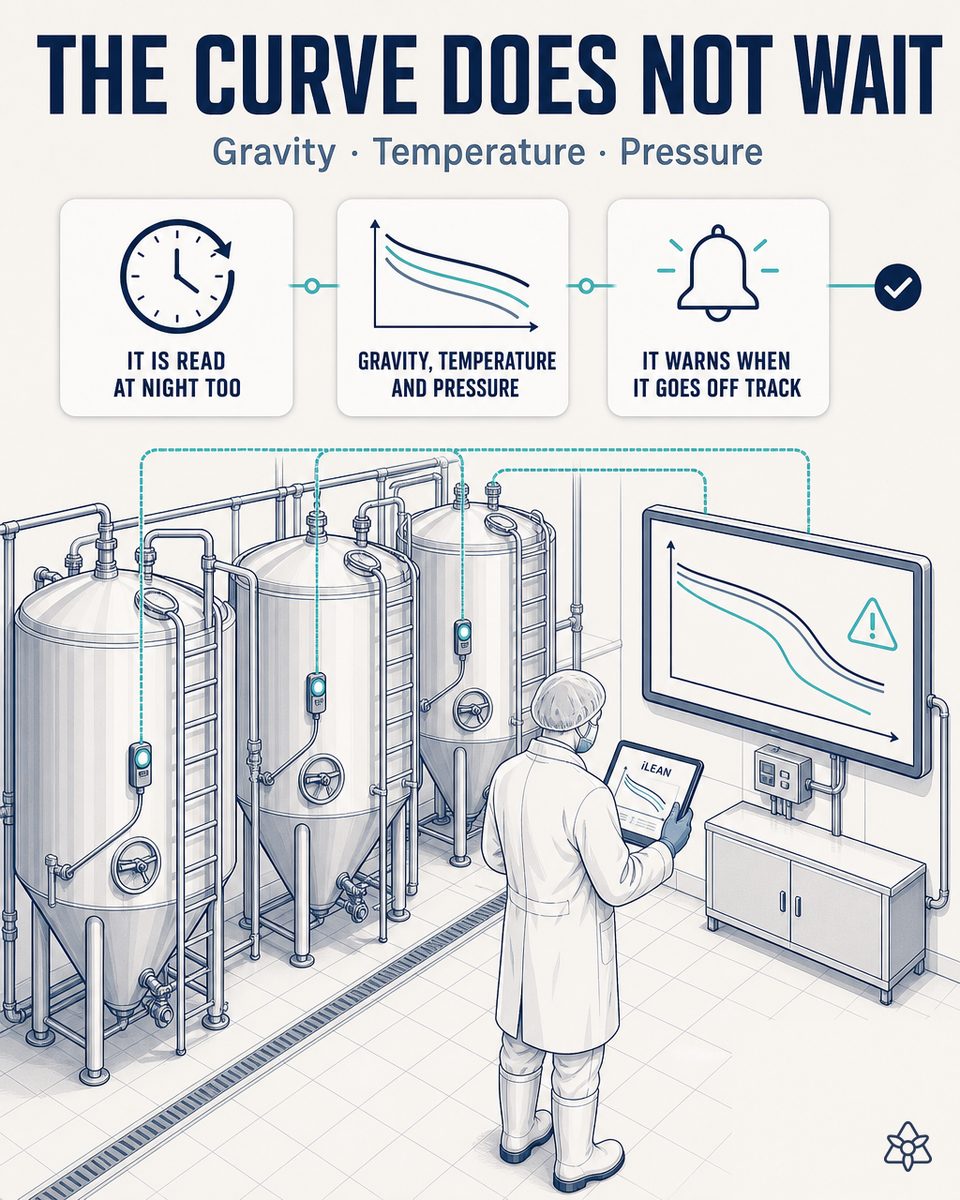
Fermentation is a living process — and it lives while nobody is watching it.
The brewmaster knows their plant and their recipes. They know that an Ale starts fast in the first 24 hours, that a Lager demands low temperature and patience, that an IPA copes worse with a thermal spike on day three. But no brewmaster can be watching the tank at three in the morning, and fermentation problems keep no schedule:
- Start-up failure — the yeast does not pitch properly (old batch, wort temperature off during transfer, poorly cleaned tank) and after 12 hours the gravity has not dropped as far as it should. If nobody sees it until morning, a day of tank time is already lost.
- Thermal spike — the exothermic phase of primary fermentation releases heat; if the tank's cooling system partially fails and the operator does not see it until the morning reading, the ester and higher-alcohol profile changes and the batch comes out with a different sensory profile.
- Stuck fermentation — the curve flattens out halfway to final gravity. There is room to rescue it (re-pitch, rouse gently, raise a degree), but only if it is caught in time.
- Cross-contamination — a pH that climbs slowly instead of falling is the signature of bacterial contamination. If it is caught at 48 hours instead of 96, the problem can be isolated and cleaned before it reaches other tanks.
The classic system is the manual reading at the start and end of each shift: the operator climbs to the tank, draws a sample, reads gravity and temperature, notes it on a sheet, and the brewmaster reviews it when they can. It works most of the time. The problem is that a deviated batch only becomes visible once it is already done — and a badly fermented 100 hl tank is a hard cost that cannot be spread across the rest of the year.
iLEAN does not replace the brewmaster — it gives them an AI that keeps watch while they sleep.
The valuable knowledge is in the brewmaster's head: what signature a well-started Ale has, how long a Lager takes on their specific recipe, when a deviation is noise and when it is signal. That knowledge is in no manual — it is the "veteran's eye", the biggest and worst-protected island of all. iLEAN acts as the putty that captures that pattern from the real batch history and puts it to work 24/7, without replacing the brewmaster: it only alerts them when there is a real deviation.
Edge reads gravity, temperature and time in every tank, continuously. Brain learns the signature of each recipe from the batch history. The agent alerts the brewmaster through whichever channel they use — before the deviation is beyond saving. The person decides and acts.
The iLEAN pieces applied to beer fermentation control:
- iLEAN Edge — a terminal in the fermentation hall that reads the existing sensors (inline gravity, Pt100 at several heights, pH, pressure, CO2 if you have them) and integrates them at the right frequency (every minute or finer). It works without a network: if the brewery loses WiFi in the small hours, Edge keeps reading and storing locally, because what is critical in a fermentation cannot depend on connectivity.
- Brain (Central + agents) — ingests your batch history (the real curve of each one with its final classification) and learns the characteristic signature of each of your recipes. It does not apply a textbook profile to you; it applies the profile your own brewery has demonstrated across its last few hundred batches. When a new batch drifts from that signature by a wide enough margin, it fires the alert.
- Connect (bidirectional alerts) — the alert reaches the brewmaster through whichever channel they use (phone, earpiece, tablet, WhatsApp), with the minimum useful information to decide in 30 seconds. The brewmaster replies through the same channel — confirms, dismisses or asks for more. Every decision feeds back into the agent.
The three safety rings guarantee that critical control over the fermentation (valves, cooling, transfers) stays in human hands: iLEAN proposes, the brewmaster signs.
Manual readings per shift vs. continuous monitoring with iLEAN
| Aspect | Manual reading + spreadsheet | With iLEAN Edge + Brain |
|---|---|---|
| Reading frequency | 2-3 times a day per tank | Continuous (every minute or finer) |
| Hours covered | Working hours | 24/7, including the small hours |
| Deviation detection | Whenever it shows up in a reading | The moment the curve separates from the recipe's signature |
| Knowledge used | Generic manual + the brewmaster's head | The real history of your batches (your own brewery's signature) |
| Alerting the brewmaster | The operator calls if they remember | Notification through the preferred channel with the key data |
| Batch file | A filed sheet of paper | Full curve + decisions + final classification |
Impact estimate for your plant — to be validated with your numbers.
The block below is an estimate to be validated with the specific data of your brewery. We put it forward so the committee has an order of magnitude; we refine it during the diagnostic.
- A brewery with 4-20 cylindroconical tanks (volumes between 10 and 200 hl), a varied recipe book (Ale + Lager + IPA + seasonals), an experienced brewmaster and a small team.
- Edge pilot on 2-4 tanks (the most sensitive ones or the largest by volume) + ingestion of the batch history to train each recipe's signature. First value expected within a few weeks — the alert on the first overnight deviation already shows in month one.
- Expected reduction of deviated batches of ≥30% against the baseline of the last few years (often more, but that is the defensible floor). Less brewmaster time spent on routine review, freeing them up for new recipes and development.
- Indicative payback between 4 and 9 months, depending on how often batches deviate and the average volume per batch. The hard lever is a single batch saved: a badly fermented 50 hl tank pays for a good part of the pilot.
The brewmaster's argument — the AI does not decide; you decide better
"Is the AI going to take my judgment away?" — quite the opposite. The brewmaster brings the judgment; the AI spares them the noise. Hallucination is a problem of free generation, not of anchored tasks. Comparing a real curve against a learned signature is exactly an anchored task — in this kind of task, the best models brought error below 1.5% [1]. And even so, what is critical (correcting temperature, extending fermentation, transferring) is signed by the brewmaster. iLEAN does not open valves; iLEAN alerts. Assist and simplify, not replace.
[1] OpenAI paper "Why Language Models Hallucinate", 2025 — on the reliability of AI in anchored tasks.
What people ask about AI control of beer fermentation
Which sensors are needed?
The minimum package for a useful curve is three continuous readings: gravity / apparent extract (with an inline sensor such as an Anton Paar or equivalent, or a floating digital hydrometer in the tank), temperature (Pt100 probes at several heights, not just one; large tanks are not homogeneous) and time. With a bigger investment we add pH, pressure, dissolved CO2 and conductivity. A microbrewery can start with gravity + temperature + time and grow from there; iLEAN adapts to what you have, it does not force you to buy the full package.
Does it work with both large and small tanks?
Yes — the logic is the same; the sensors and the calibration change. In large tanks (industrial cylindroconicals of 100-500 hl) the key is measuring at several heights to detect the real thermal gradient, especially during the start-up phase and at the beginning of maturation. In small tanks (10-30 hl in a microbrewery) one sensor per tank is enough, but each recipe's pattern is more sensitive to swings in outside temperature, so the agent quickly learns the signature of each style (Ale, Lager, Stout, IPA, Saison).
Does it learn from the recipe history?
Yes, and this is where the biggest value lever sits. iLEAN ingests your batch history — the real gravity/temperature/time curve of every past batch, with its final classification (batch accepted, batch deviated, batch withdrawn) — and learns the characteristic signature of each recipe. When a new batch starts drifting away from that signature at hour 36, the agent detects it and alerts the brewmaster before the curve is beyond saving. It is predictive jidoka applied to fermentation — the same pattern we applied in ceramics almost 30 years ago.
Does it send alerts to the brewmaster?
Yes, through whichever channel they use — phone, earpiece, tablet, WhatsApp or a call. Connect is bidirectional: it does not only listen, it also speaks. The alert arrives with the minimum useful information: tank, recipe, time, deviation detected and comparison against the expected curve. The brewmaster decides in 30 seconds whether to act (temperature adjustment, extending primary fermentation, transfer) or to dismiss the alert as a false positive. Every decision feeds back into the agent to refine the model for that plant.
What does it cost for a microbrewery?
A microbrewery with 4-12 tanks and an output of a few thousand hl a year can start with an Edge pilot on 2-3 tanks (the most sensitive ones or the largest by volume) plus a reduced annual license, using the sensors it already has, if it has them. Estimate to be validated: the order of magnitude is reasonable for an SME — this is not a full industrial project. The hard lever is a single batch saved: a badly fermented 30 hl tank is product that gets dumped or blended down, plus the time the tank was tied up. We ask for your plant's data and send you the estimated ROI in 48h.
More cases in food
- AI control of baby food in glass jars — zero tolerance means 100% inspection, not sampling.100% AI inspection of glass baby food jars: glass integrity, closure, fill level and visible particles.…
- Real AI cases in bakeryReal AI cases in bakery: production planning by agent (tunnel oven with no stops, Excels into the…
- Beef carcass identification with AI — the animal cannot get lost between the ear tag and the hook.From ear tag to carcass to cutting without losing identity. iLEAN links national registries, the bovine…
- Industrial AI cases for soft drink and water bottling plantsTwelve real industrial AI cases in beverage plants: shop-floor capture, in-line vision and returnable…
- Carbonation and fill level in bottling — rejects pile up when nobody sees the first bad bottle.Every bottle inspected: fill level, CO2 and seal. iLEAN Edge corrects the filler before rejects pile up.
- Planning the beverage plant around what is expensive to change: the tanks and the filling line.iLEAN's Planning Agent builds the plan for a beverage plant: tank occupancy, minimum format changeovers…
Tell us your case and in 48h we'll send you the estimated ROI of this AI project for your brewery.
We work on the real data of your fermentation hall, not ours. Diagnostic with no commitment.
Request estimated ROI in 48h ‹ All beverage cases See food industry