Crushed tomato and concentrate control with AI — the grade is decided in line, not in the lab.
In a short season, Brix, color and scorched particles decide whether the batch goes to grade A or loses margin. iLEAN cross-checks your existing refractometer and colorimeter with Edge vision over the evaporator, and proposes the correction before the batch reaches the aseptic filler. The person signs.
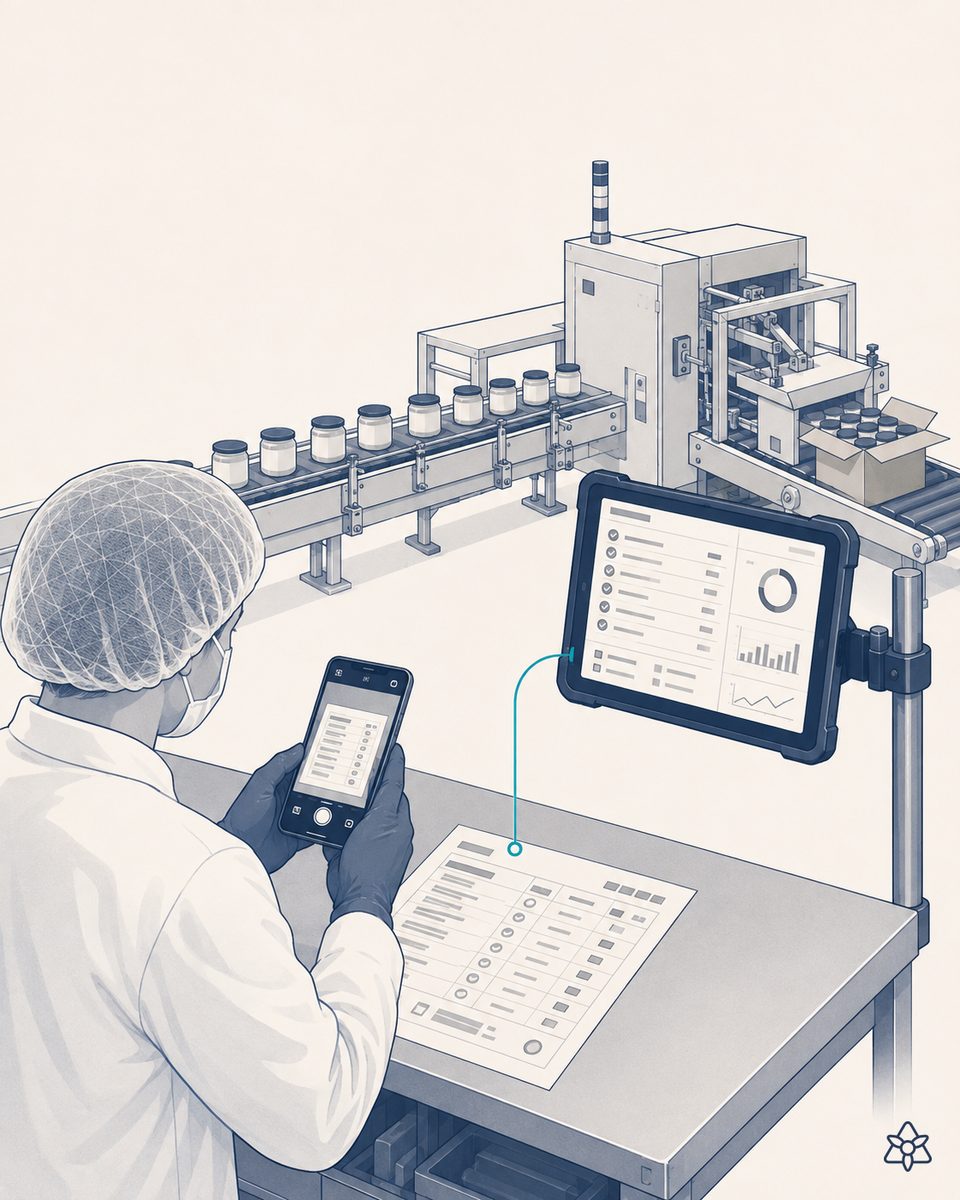
The season lasts 60 days. One shift's error downgrades the whole batch.
Processed tomato is a business of narrow margins and a concentrated season. All the fruit comes in within weeks, the lines run flat out 18-20 hours a day, and the difference between grade A and grade B concentrate is measured in cents per kilo multiplied by thousands of tons. Four parameters decide the grade:
- Brix — the actual concentration of soluble solids. If it drops, the batch misses spec and either gets concentrated further (extra energy) or gets downgraded.
- Color — Hunter a/b or equivalent. A low red penalizes grade and export price.
- Bostwick / fiber — consistency. Too runny or too lumpy drops the product down a tier.
- Scorched particles — burnt particles from the evaporator wall carried along by the flow. The importer's Howard threshold is rigid: above a certain number of particles/g, the batch does not enter the US.
The classic system is an in-line refractometer, a lab colorimeter every shift and the season manager's eye. It works 99% of the time. That 1% is a downgraded batch or, worse, a batch rejected by the importer after aseptic filling. And in a season that lasts weeks, what you lost on shift 12 you never get back. The expensive part is not the tomato: it is the evaporator's energy, the aseptic packing labor and the grade the batch carries when it reaches the end customer.
iLEAN does not replace the refractometer — it puts continuous vision on the evaporator and cross-checks everything.
The tomato concentrate problem is not a lack of instrumentation: it is that the refractometer sits in a PLC, the colorimeter in a lab Excel, the evaporator temperature on another panel, the CIP cleaning in a shift report and the scorched particles in the boss's eye. iLEAN acts as the putty that seals those gaps without asking you to change the evaporator or the lab.
Edge sees scorched particles in the flow. Connect reads Brix, color and temperature. The agent cross-checks against CIP cleaning and the recipe, and proposes the correction with margin to react — before the aseptic filler, not after.
The three iLEAN pieces applied to crushed tomato and concentrate control:
- Edge — a machine-vision terminal (CNN) at the evaporator outlet. It detects scorched particles in the flow, estimates color and visible consistency, and triggers an alert when the frequency exceeds the threshold. It works without a network: if the plant loses WiFi at 3 a.m. in the middle of the peak, Edge keeps reading and holding, because what is critical cannot depend on connectivity.
- Connect — captures refractometer, colorimeter, evaporator temperature, vacuum and time since the last CIP, whether they come from a modern PLC or a photographed old panel. And it also captures what arrives from outside: the field's quality certificate, the importer's spec sheet with Howard Mold thresholds, the season manager's WhatsApp about the variety change.
- Agent — cross-checks Brix, color, temperature, vacuum, scorched particles and CIP cleaning. When the combined trend points to grade B within the next few minutes, it proposes a stop for intermediate cleaning, a vacuum adjustment or a recipe change to the shift lead. The person validates and signs — the evaporator does not modify itself.
Hourly lab control vs. cross-checked control with iLEAN
| Aspect | Refractometer + hourly lab | With iLEAN Edge + Connect + Agent |
|---|---|---|
| Brix reading | Continuous (refractometer), but isolated | Cross-checked with color, vacuum and CIP at second zero |
| Batch color | Hourly sample to the lab | Continuous visual estimate + lab as the anchor |
| Scorched particles | The boss's eye or a later complaint | CNN camera over the flow, in-line alert |
| Intermediate CIP decision | By the clock or by "the look of it" | Proposed from particle and temperature trends |
| Season traceability | Rebuilt by hand after the season | Per-batch dossier with Brix, color and signature |
| Operation without network at the peak | Risk of data gaps | Edge keeps going on the panel's power |
Impact estimate for your plant — to be validated with your numbers.
The block below is an estimate to be validated with the specific data of your plant. We put it forward so the committee has an order of magnitude; we refine it during the diagnostic.
- Tomato processing plant with a 60-90 day season, 1-2 concentrate lines, exporting under a Howard Mold spec for the US.
- Edge pilot on one line (camera at the evaporator outlet + integration with refractometer, colorimeter and temperature). First value expected within a few weeks — the key: starting before the next season.
- Indicative payback between 4 and 9 months, frequently recovered within the very first season, depending on the grade A vs B differential and the batches historically rejected over Howard.
- Expected reduction in scorched particles over threshold and downgraded batches of ≥30%. The hard lever is the price differential per grade and the batches saved in front of the importer.
And the "we have no time to change anything during the season"
True — which is why the pilot is installed before the season, during the maintenance shutdown. The immersion takes 3-5 days, and the first value lands before the first truck arrives. And the agent learns over the season itself: the more fruit it processes, the better it calibrates the SKU's window. On anchored tasks like this one (reading Brix and color and comparing them against the spec), the error of the best models drops below 1.5% [1]. But the decision to stop the evaporator for an intermediate CIP is signed by the shift lead — always.
[1] OpenAI paper “Why Language Models Hallucinate”, 2025 — on the reliability of AI in anchored tasks.
What people ask about crushed tomato and concentrate control
Which parameters define the quality of crushed or concentrated tomato?
The four classics are Brix (degrees of sugar, measuring actual concentration), color (Hunter a/b scale or similar — a low red is penalized in grade), fiber/Bostwick (consistency) and the absence of scorched particles (burnt particles from the evaporator wall carried along by the flow). Large retailers and American importers (FDA, USDA Howard Mold Count) impose strict thresholds. In a short season with high volumes, a batch with low color or scorched particles drops a grade — and the price difference between grade A and B is what defines the season's margin.
How does iLEAN measure Brix and color continuously during the season?
iLEAN Connect integrates the existing in-line refractometer and colorimeter (or, if there are none in line, captures the lab's manual reading every shift). iLEAN Edge adds a camera with a neural network (CNN) over the outlet of the evaporator or the crusher that estimates color and detects scorched particles in the continuous flow. The agent cross-checks actual Brix, in-line color and evaporator temperature to anticipate whether the batch is heading out of grade — with margin to correct vacuum, temperature or flow before it reaches the aseptic filler.
Does it detect scorched particles before they reach the aseptic filler?
Yes. The Edge camera at the evaporator outlet identifies the dark particles in the flow and triggers an alert when their frequency exceeds the batch threshold. The agent cross-checks against the evaporator's internal temperature and the time since the last CIP cleaning, and proposes a stop for intermediate cleaning or a vacuum adjustment before the wall scorches and sheds. In a short season, that difference means not losing the whole batch to the importer's Howard Mold Count.
Does it cope with season peaks running 18-20 hour shifts?
Yes — and that is where it shows most. In a short season the lab cannot keep up with everything and the operator has to decide with less information. Connect captures the analyses that do get done and the agent cross-checks them against the continuous reading to hold the grade even when manual sampling drops. And since Edge works without a network, if the season pushes connectivity to the limit, what is critical keeps operating. The plant does not depend on the WiFi holding up.
How much does it cost to deploy AI control before the next season?
An Edge pilot on a tomato concentrate line sits in the usual order of magnitude of an Edge pilot in a food plant: an initial investment covering terminals + cameras + integration with refractometer/colorimeter/temperature, plus an annual license. The reasonable payback to present to the committee is a few months — the hard lever is the grade A vs B differential and the batch saved from failing Howard Mold. We ask for your plant's data and send you the estimated ROI in 48h.
More cases in food
- Cold room inventory with AI vision — knowing what is there and where without opening the door.iLEAN Vision identifies pallets inside the cold room with no manual scanning and reconciles them with…
- Confectionery glazing with AI vision — expensive chocolate does not get thrown away; it gets spread properly.How iLEAN sees coating, gloss and clumps at the coating pan outlet, adjusts dosing and time, and cuts…
- IFS/BRC audit always ready with AI — the quality team should not work three weeks for a one-day visit.iLEAN keeps every IFS/BRC evidence record alive. The audit stops being a sprint and becomes always ready.
- AI control of ham curing — the curve that decides whether the batch ships or is lost.iLEAN combines vision, weight, chamber humidity and temperature to secure the cooking and curing curve…
- AI control of the cheese curing chamber — quality stops depending on the shift.Continuous sensing in the curing chamber plus AI that predicts deviations before they happen. Cheese…
- Meat cutting traceability — holding the carcass → cut link is the foundation of the whole business.iLEAN Vision recognizes every cut as it leaves the cutting room and keeps its link to the original…
Tell us your case and in 48h we'll send you the estimated ROI of this AI project for your concentrate plant.
We work on your plant's real data, not ours. Diagnostic with no commitment.
Request estimated ROI in 48h See food industry