AI control of the cheese curing chamber — quality stops depending on the shift.
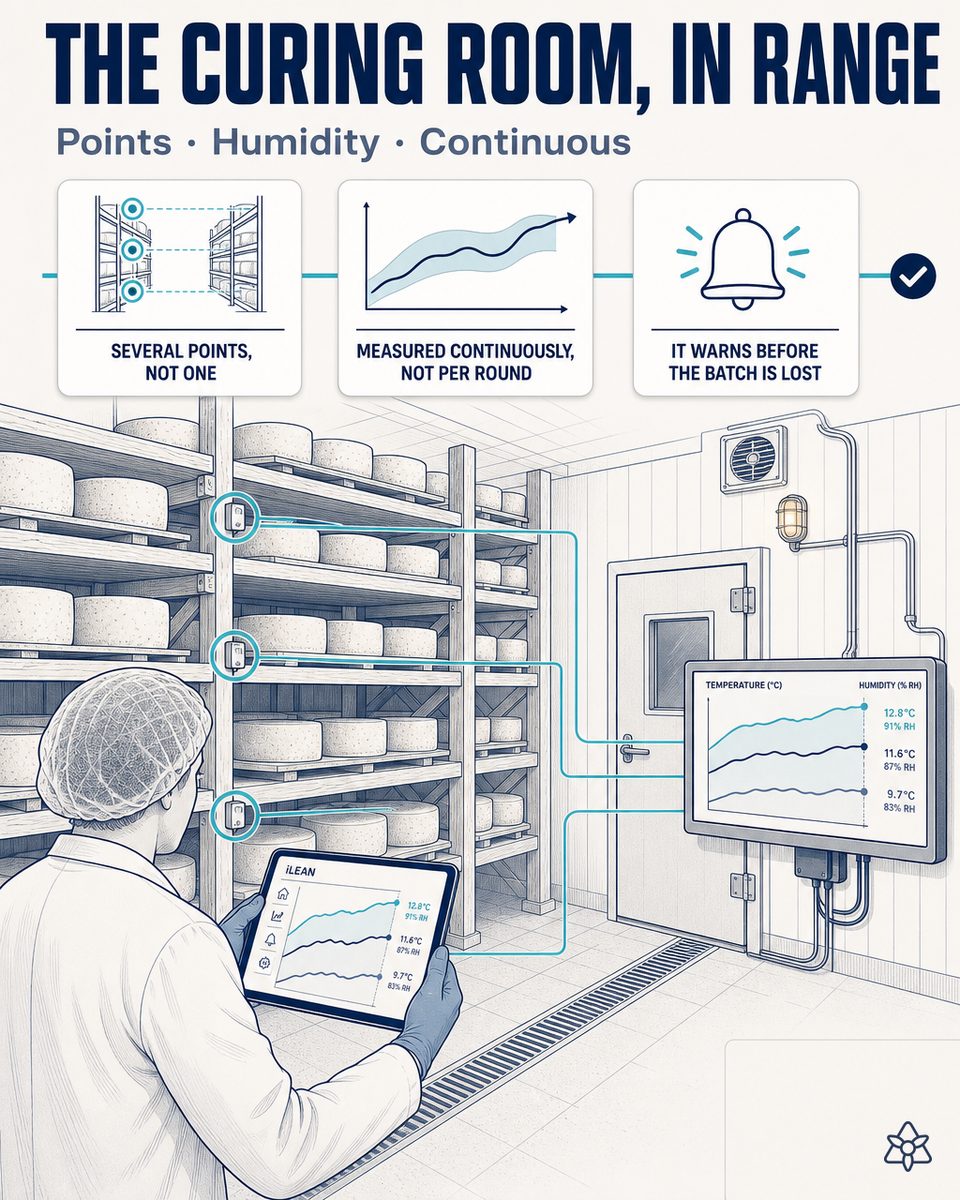
A curing chamber that runs 2 hours out of range can ruin an 800 kg batch. iLEAN Edge measures several points in the chamber continuously — not one convenient spot — and the agent warns before the range is breached, cross-referencing each batch's curing phase with that chamber's real history. The person signs.
The BMS shows green, and the batch comes out defective.
Almost every aged-cheese plant has a BMS or a decent climate control system — the problem is rarely that there is no thermostat. The problem is that the BMS controls one point, usually near the return or near the supply of the climate unit, while the chamber as a whole breathes differently:
- The top and the bottom of the chamber sit at different humidity levels.
- The area right by the door takes the hit on every opening — invisible if there is no sensor there.
- A recirculation fan losing airflow because of a slack belt shifts the whole thermal map, and the BMS never notices because its single sensor is in its usual spot.
- At night, with no operators on site, a four-hour drop is discovered at 7 a.m. on the walk-round — far too late for a batch in a critical phase.
The master cheesemaker compensates with his eye and his experience. It works 99% of the time. That 1% is the batch of hundreds of kilos that comes out of spec, taking months of chamber time with it. And when he retires, that 1% goes up.
iLEAN does not replace your BMS — it gives it eyes where it could not reach, and an agent that never sleeps.
Your climate control works — the BMS does its job. What is missing is a representative measurement (several points per chamber), operational memory (what happened the last few times this chamber drifted), and an agent that cross-references each batch's curing phase with the real pattern. iLEAN acts as the putty that seals the cracks between the BMS, the master cheesemaker and the shift paperwork — without asking you to change a thing.
Edge measures where the single sensor never reached. The agent predicts the deviation using the batch history. The person signs — the batch is never released on its own. Agents do not sleep; the chamber is never left alone.
The three iLEAN pieces applied to chamber control:
- Edge — a terminal with sensors distributed across levels and zones, a door sensor, and a read of the existing climate system (without replacing it). It works with no network: if the plant loses WiFi, it keeps measuring and recording on panel power.
- Connect — captures everything that happens outside the BMS and reaches the chamber through non-integrated channels: the climate technician writes on WhatsApp that he has changed the fan belt, the production manager dictates by voice that the long door opening at 11:20 was to pull a batch out — all of it enters the system at second zero and stays linked to the chamber and the batch, not buried in a lost email.
- Agent — cross-references the current pattern with the chamber's history and the phase of every batch inside it. It predicts the deviation before the range is breached — not at the threshold, before it. It alerts the on-call manager's channel. The person decides and signs — the agent proposes; it does not open the batch or stop the plant on its own.
Single-sensor BMS vs. a chamber read continuously with an agent
| Aspect | Classic BMS + walk-round | With iLEAN Edge + Agent |
|---|---|---|
| Measurement points per chamber | 1 (near the climate unit) | Several, distributed by level/zone |
| Detection of a night-time deviation | Next morning, on the walk-round | At second zero, to the manager's channel |
| Operational memory of the chamber | In the master cheesemaker's head | Captured as a pattern, it stays in the plant |
| Door-opening sensor | No, or only in some chambers | Yes, in every chamber that matters |
| Deviation prediction | Reactive, on a fixed threshold | Anticipated, by pattern + batch phase |
| Operation with no network | n/a | Edge keeps measuring on panel power |
Impact estimate for your plant — to be validated with your numbers.
The block below is an estimate to be validated with the specific data of your plant. We put it forward so the committee has an order of magnitude; we refine it during the diagnostic.
- Standard curing chamber, existing BMS kept in place, Edge sensing installed in parallel. Pilot in a single chamber.
- First value expected within a few weeks: a real thermal map of the chamber, fine-grained alerts to the manager's channel, a working per-batch dossier.
- Indicative payback between 4 and 9 months, depending on how much scrap from night-time deviations weighs in your product mix and the average cost of a batch ruined by an out-of-range excursion.
- Hard levers: chamber incidents that reach the batch down ≥ 30% (conservative estimate); the night-time "blind spot" eliminated; the master cheesemaker's judgment captured as a persistent pattern.
And the technical director's reasonable doubt
“What if the AI floods me with alarms?” — positive pre-emption: the agents are not fixed-threshold alarm generators. They cross-reference the current reading with the chamber's history, with the curing phase of every batch inside, and with the pattern of whoever is on call. What reaches the manager's phone is the deviation that matters, not the noise. And the system is transparent — the operator can see why the agent raised the alert, and the technical director tunes the sensitivity without touching code. In anchored tasks (reading a real value and comparing it against a pattern), the best models brought error below 1.5% [1].
[1] OpenAI paper “Why Language Models Hallucinate”, 2025 — on the reliability of AI in anchored tasks.
What people ask about AI control of the curing chamber
How many sensors does each chamber need?
Just enough for the reading to represent the whole chamber, not one convenient spot. A large chamber breathes differently zone by zone — the top and the bottom, the area right by the door and the far end. The sensible approach is to distribute several temperature and humidity sensors across levels and zones, plus a door sensor. Small chambers with good recirculation need fewer; tall or heavily loaded chambers need more. We define it during the AI immersion, working from the real geometry and a day of reference measurements.
Does it integrate with the existing BMS?
Yes — iLEAN does not replace the BMS. It reads it. If your climate system has a modern interface, we integrate directly; if it has an old, isolated local computer, Connect hooks up and pulls the data; if it is fully analog, the Edge sensors are mounted in parallel and live alongside whatever climate control you already have. Nothing that already works has to be thrown away. iLEAN is the putty that fills the cracks, not a new BMS.
What happens at night when there is nobody on the floor?
Edge keeps measuring and the agent keeps working — agents do not sleep. If a chamber starts drifting at 3:40 a.m., the agent cross-references the severity with the history (has this happened before in this chamber? what happened last time? which curing phase is the batch in?) and alerts through whichever channel you have configured: SMS to the on-call manager, a phone call, an earpiece. The plant is never left alone — and even with no network, Edge keeps recording on panel power so that by morning the full history of what happened is there.
Does the AI learn from the batch history?
Yes — that is the difference between a fixed-threshold alarm generator and a useful agent. With the chamber and batch history, the agent knows that in this particular plant a 1.5 ºC drop over 90 minutes during phase 3 of curing for this type of cheese is not a disaster, but the same drop in phase 1 is. That operational memory is what stands in for the master cheesemaker's judgment when he is not there — not to replace him, but so that plant knowledge does not walk out the door with him the day he retires.
How much does it cost to sensor a chamber with AI?
The order of magnitude of an Edge pilot in a standard aged-cheese dairy chamber is in line with any food-industry Edge pilot: terminals + distributed sensors + integration with the existing climate control + annual license. The payback you can reasonably take to the committee is between 4 and 9 months (estimate to be validated) — the hard lever is the batch of hundreds of kilos you save before a night-time deviation ruins it, not the sensors themselves. We ask for your plant's data and send you the estimated ROI in 48h, with your numbers.
More cases in food
- IFS/BRC audit always ready with AI — the quality team should not work three weeks for a one-day visit.iLEAN keeps every IFS/BRC evidence record alive. The audit stops being a sprint and becomes always ready.
- Crushed tomato and concentrate control with AI — the grade is decided in line, not in the lab.How iLEAN cross-checks refractometer, colorimeter and evaporator vision to hold Brix, color and zero…
- AI control of ham curing — the curve that decides whether the batch ships or is lost.iLEAN combines vision, weight, chamber humidity and temperature to secure the cooking and curing curve…
- Meat cutting traceability — holding the carcass → cut link is the foundation of the whole business.iLEAN Vision recognizes every cut as it leaves the cutting room and keeps its link to the original…
- Carcass grading by weight and AI in the cutting room — the class cannot change with the shift.Automatic SEUROP grading with AI vision plus the scale. Consistent classification across shifts, without…
- Real AI cases in dairyReal AI cases in dairy: predictive pasteurizer maintenance, digital CCP/HACCP, cheese defect detection…
Tell us your case and in 48h we'll send you the estimated ROI of AI control for your curing chambers.
We work on your plant's real data, not ours. Diagnostic with no commitment.
Request estimated ROI in 48h ‹ All meat industry cases See food industry