Brie and Camembert — the affineur's eye, extended to every piece in the cellar.
The ripening of Brie and Camembert is won or lost on when a piece moves to the next bed — and that call belongs to the affineur's eye on the progress of the Penicillium camemberti bloom. iLEAN Edge watches that bloom with AI vision bed by bed and proposes the moment to move; the affineur signs. The cellar does not move on its own.
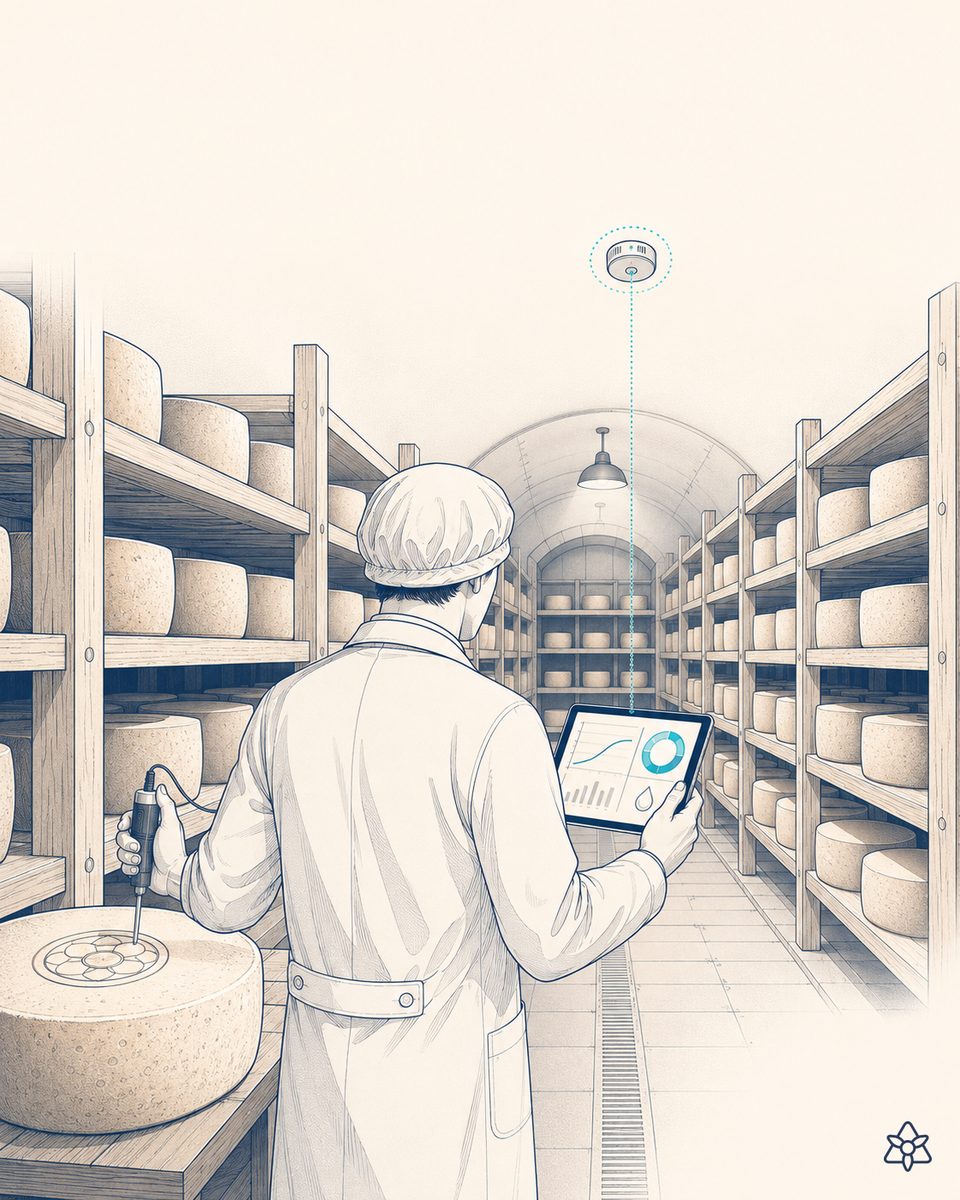
The most important decision in the cellar is still made from spot checks.
The success of a Brie or a Camembert is not cooked in the vat alone — it is cooked in the ripening cellar. And inside the cellar, the most delicate decision is when to move the piece to the next bed. Too early and the rind has not closed; too late and the paste softens too far, the flavor turns ammoniacal and the piece comes back. That call is made by the affineur with a trained eye, a nose and a hand, walking the beds and checking sample pieces.
- One pair of eyes only reaches so many pieces. A mid-sized cellar can hold several thousand pieces at any moment, each in a different ripening phase. The veteran affineur works from spot checks — and spot checks carry error.
- The camemberti bloom varies. Humidity, temperature, residual microbiota on the bed, starter culture batch, age of the rennet: small variations change the speed of the bloom. Two identical batches do not progress the same way.
- The knowledge leaves with whoever retires. The veteran affineur's judgment is the most valuable asset in the plant — and the least protected. The day they leave, half the cellar leaves with them.
The current system — affineur + spot checks + a notebook — works, but it leaves a load on the expert's shoulders that they should no longer be carrying alone. Every returned piece is hard cost; every sub-optimal piece that reaches the supermarket is brand cost.
iLEAN does not replace the affineur — it extends their eye to every piece on every bed.
A Brie and Camembert cellar is exactly the kind of process where IRIS fits as putty: it does not ask you to change the cellar or the method, it just fills the gap between the expert's eye and the number of pieces that eye cannot look at all at once. iLEAN sits above the cellar, without touching the critical OT network.
Edge watches the bloom piece by piece with AI vision. Connect brings the bed-change proposal to the affineur through their earpiece or tablet. The agent cross-references it with the batch's expected curve. The affineur signs — the bed does not move on its own.
The three iLEAN pieces applied to Brie and Camembert ripening:
- Edge — a terminal with machine vision (CNN) over each bed. It runs along the rows and reports percentage of surface covered, color uniformity and mold texture piece by piece. It works with no network. If the cellar loses WiFi, Edge keeps watching and recording, because the cellar does not stop just because the router did.
- Connect — captures the batch recipe (rennet, starter culture, source milk) whether it comes from the ERP, from the dairy MES or from a sheet kept by the ripening manager. It brings the agent's proposal to the affineur through whatever channel they use (phone, tablet, full-duplex earpiece). The affineur answers “move it” or “not yet” by voice; it is signed off.
- Agent — cross-references Edge's bloom map, the batch's expected curve, cellar conditions (humidity, temperature, ventilation captured by Connect) and the affineur's decision. It learns bed by bed. If a zone is racing ahead because of a draft, it says so beforehand — not after the piece has crossed the threshold.
Ripening by spot check vs. ripening watched piece by piece with iLEAN
| Aspect | Ripening by the expert's spot checks | With iLEAN Edge + Connect + Agent |
|---|---|---|
| Coverage of the eye | Samples from each bed, once per round | Every piece, every hour |
| The bed-change decision | The affineur's judgment on the sample | The agent's proposal on the whole map; the affineur signs |
| Variability between beds | Detected at the end, when the piece comes back | Detected when the zone starts to drift |
| Capturing the veteran's judgment | Lives in the affineur's head | Embedded in the model bed by bed, it persists after retirement |
| Operation with no network | n/a | Edge keeps running on the light of its own panel |
| Ripening dossier per batch (AOP) | Manual notebook, rebuilt by hand | Automatic file with photos, map and a signed decision |
Impact estimate for your plant — to be validated with your numbers.
The block below is an estimate to be validated with the specific data of your cellar. We put it forward so the committee has an order of magnitude; we refine it during the diagnostic.
- Cheese dairy with a bloomy-rind soft cheese cellar, several thousand pieces ripening at the same time, bed change decided from the affineur's spot checks.
- Edge pilot on one cellar (a camera on a track + integration with the batch recipe and the cellar records). First value expected within a few weeks: a bloom map per piece and a bed-change proposal for the affineur.
- Indicative payback between 4 and 9 months, depending on how often pieces come back for under- or over-ripening and on the cost of each return in your chain.
- Hard lever: a reduction in returns caused by bloom drift of the order of ≥30%, based on cross-industry experience in comparable slow-transformation processes.
And the veteran affineur's reasonable doubt
“What if the AI says it is ready and it is not?” — hallucination is a problem of free generation, not of anchored tasks. Looking at a rind and comparing its progress against the batch's expected curve is precisely an anchored task — the AI does not invent anything, it recognizes a pattern in the reality of the cellar. In tasks like that, the best models brought error below 1.5% [1]. And even so, what is critical is never decided alone: iLEAN proposes; the affineur signs. The three safety rings exist precisely for this.
[1] OpenAI paper “Why Language Models Hallucinate”, 2025 — on the reliability of AI in anchored tasks.
What people ask about ripening Brie and Camembert with AI
What decides when a Brie or a Camembert moves to the next bed?
The affineur's judgment. They look at the rind, touch it, smell it and decide when the progress of the Penicillium camemberti bloom is right for moving the piece to the next ripening bed. It is an eye formed over years in the cellar and written down in no manual. iLEAN Edge does not replace that eye — it extends it to every piece, every hour, so the affineur can sign bed by bed with data instead of spot checks.
Why is the camemberti bloom so hard to standardize?
Because it depends on several variables that never move together: relative humidity in the cellar, temperature, ventilation, age of the rennet, starter culture batch, residual microbiota on the bed. Two batches identical on paper can bloom at different speeds. The veteran affineur senses it, but cannot look at the 12,000 pieces in the cellar. Today the call is made from spot checks; with iLEAN Edge every piece has been looked at.
How does AI vision work on the bloom of the rind?
Edge is a terminal with machine vision (CNN) trained on the criteria the affineur uses: percentage of surface covered, color, uniformity, texture of the mold. Over each bed, the camera runs along the rows and reports a progress map piece by piece. The agent cross-references that map with the batch's expected curve and tells the affineur which bed is ready, which one has a lagging zone and which one has raced ahead because of a draft.
Can iLEAN move beds, or only propose it?
Only propose. The critical OT of a ripening cellar — moving beds, changing humidity or temperature parameters — lives in ring 1, where there is no AI. iLEAN Edge looks and proposes; the affineur signs from their Connect tablet or earpiece; the technician executes. That is the principle: agents propose, the person decides and acts. A cellar does not govern itself — the OT network and human judgment are both respected.
Does it work on Brie de Meaux AOP and Camembert de Normandie AOP the same way as on non-AOP soft cheeses?
Yes, and the important difference is not technical but documentary. On AOP cheeses the cahier des charges requires you to keep records of ripening, temperatures and movements. With iLEAN Edge the per-batch dossier comes out automatically — bed-to-bed traceability is recorded with a photo, a timestamp, the affineur's decision and their signature. When the inspector arrives, the file is ready instead of being rebuilt by hand.
More cases in food
- Empty container inspection — one particle in a bottle contaminates the whole product.Every empty bottle checked before filling: breakage, particles, residual contamination. iLEAN Edge at…
- European PDO cheeses — the specification is met in the vat, not on paper.Documented iLEAN cases in European cheese dairies: PDO/PGI specifications, vat and aging control, and…
- Alkaline phosphatase test after pasteurization — the data out of the lab notebook.iLEAN Connect captures the post-pasteurization alkaline phosphatase test and links it to the milk batch…
- Filatura control for PDO Mozzarella di Bufala Campana — the filatore's hands, assisted by vision.iLEAN Edge controls the filatura of PDO Mozzarella di Bufala Campana through whey temperature and curd…
- Industrial Cheddar — the belt never stops, and the acidity curve drifts before anyone has time to correct it.iLEAN Edge controls industrial Cheddar cheddaring — stacking, turning and the acidity curve on a…
- Predictive maintenance for cheese vats — the batch of milk is saved before the breakdown.iLEAN Edge predicts cheese vat and cutting harp failures by combining vibration, torque and temperature.…
Tell us your case and in 48h we'll send you the estimated ROI of this AI project for your Brie and Camembert cellar.
We work on the real data from your cellar, not ours. Diagnostic with no commitment.
Request estimated ROI in 48h See food industry