Controlling Penicillium roqueforti inoculation in Roquefort AOP — the mold is the signature, and a signature is not improvised.
Roquefort's AOP promise lives in two places: the native Penicillium roqueforti and the natural Combalou caves. The second is the mountain's work; the first is decided by the doser in the molding room — and that is where an out-of-range dose compromises the cave batch. iLEAN Edge controls inoculation and piercing in line. The person signs; the system assists.
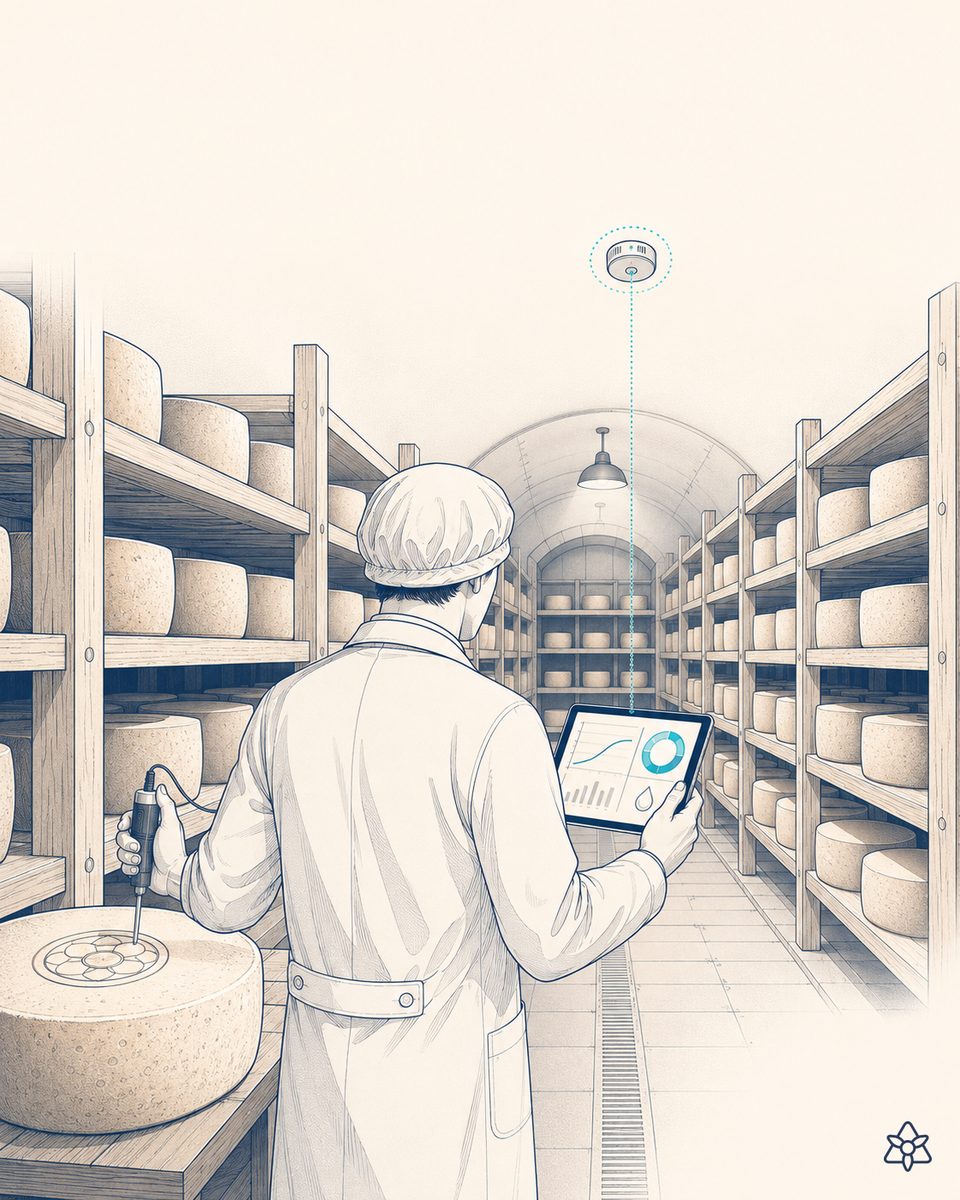
The mold is inoculated in seconds, and shows up two months later.
Roquefort AOP stakes its promise on a narrow margin. Penicillium roqueforti is inoculated in the molding room, before the cheese goes down to the cave. A slightly low dose and the veining does not develop; a slightly high dose and the cheese goes out of balance. The piercing has to be uniform so that air enters every piece equally. And all of that becomes visible not in line, but two months later, when a wheel is cut open in the cave.
In most Roquefort dairies that lives in three separate places:
- The Penicillium doser — flow, dose and mixing with the curd, often on an old PLC or an analog panel.
- The piercing machine — pattern, count, depth. Sometimes on old machinery with no interface.
- The Combalou cave — humidity, temperature, air currents (fleurines). Recorded by the affineur with a notebook and a nose.
The master affineur knows how to read all of it, but cannot be in three places at once. And on the day a curd goes out with a deviated dose, there is no way to know until it can no longer be fixed. The only thing that defends the dairy when a cave deviates is the traceability of what went down there.
iLEAN Edge does not touch the cave — it controls what is delivered to the cave.
The problem with inoculation is not a lack of information: it is information that lives on islands and only gets cross-referenced once the damage is already visible. iLEAN acts as the putty that fills those gaps, without asking you to change the doser, the piercing machine or the cave. The Combalou cave does what it has done for centuries; iLEAN makes sure that what goes down to the cave carries the right dose and the right piercing.
Edge sees the dose and the pattern in line. Connect captures the cave environment if it has sensors. The agent cross-references the cahier des charges and holds the curd if the dose deviates. The person signs — never the other way round.
The iLEAN pieces applied to Penicillium roqueforti and Combalou:
- Edge — a terminal with machine vision (CNN) and a flow sensor over the Penicillium roqueforti doser, plus vision over the piercing machine's roller. It reads the dose per curd, the mixing with the mass and the piercing pattern in milliseconds. If anything falls out of range, it triggers an actuator (stack light, doser stop, ejection). It works without a network.
- Connect — captures the natural cave's parameters if sensors are installed, and the affineur's notebooks by photo or by voice. It also captures what arrives from the outside (a change in the internal standard, a notice from the regulatory body) at second zero, without anyone having to forward anything.
- Agent — cross-references the dose, the piercing pattern, the cave environment and the cahier des charges. If a curd has deviated, it does not send an email at 10 pm: it holds the curd and alerts the molding supervisor. The person validates and signs; the curd does not go down to the cave on its own.
Manual control vs. in-line control with iLEAN Edge
| Aspect | Old doser + notebook + the eye | With iLEAN Edge + Connect + Agent |
|---|---|---|
| Penicillium roqueforti dose | An assumption: "the doser is fine" | A reading in milliseconds, per curd |
| Piercing pattern | Manual sampling of a few pieces | Vision on every piece, pattern verified |
| Detecting a deviation | Two months later, when the wheel is cut | In line, before it goes down to the cave |
| Cave environment | The affineur's notebook | Integrated with Connect wherever sensors exist |
| Operation without network | n/a | Edge keeps running on the panel's own power |
| AOP file per cave batch | Rebuilt by hand, weeks | A dossier per curd and per cave batch, automatic |
Impact estimate for your plant — to be validated with your numbers.
The block below is an estimate to be validated with the specific data of your dairy. We put it forward so the committee has an order of magnitude; we refine it during the diagnostic.
- Mid-sized Roquefort AOP dairy, ~1-3 t/day of curd, natural cave in Combalou.
- Edge pilot over the Penicillium doser and the piercing machine (camera + flow sensor + actuator + integration with the MES). First value expected within a few weeks.
- Indicative payback between 4 and 9 months, depending on how often inoculation deviations are detected in the cave and on the average cost of a deviation.
- Expected reduction in scrap from inoculation deviations of ≥ 30%, with a per-curd dossier for the AOP regulatory body.
- The hard lever is a single cave batch not downgraded: given what a Roquefort cave is worth, one of them pays for the pilot.
And the master affineur's reasonable doubt
“What if the camera gets it wrong and lets a badly inoculated curd through?” — hallucination is a problem of free generation, not of anchored tasks. In tasks where the AI merely recontextualizes a sensor reading (reading flow, verifying a pattern), the best models brought error below 1.5% [1]. And even so, what is critical is never decided alone: iLEAN holds the doubtful curd and the person signs. The three safety rings exist precisely for this.
[1] OpenAI paper “Why Language Models Hallucinate”, 2025 — on the reliability of AI in anchored tasks.
What people ask about Penicillium roqueforti and the Combalou caves
What is Penicillium roqueforti and why is it the signature of Roquefort AOP?
Penicillium roqueforti is the blue-green mold that gives Roquefort its characteristic veining and its flavor. The cahier des charges for Roquefort AOP requires that mold to be native to the Combalou caves in Roquefort-sur-Soulzon — Aveyron — and it is inoculated into the curd before molding. If the dose is low, the veining does not develop as it should; if it is high, the cheese turns too sharp. The margin is narrow and the cahier is strict. Without traceability of the inoculation, there is no defense when a cave deviates.
How does iLEAN Edge control the Penicillium roqueforti dose in line?
Edge is a terminal with machine vision (CNN) and sensors over the Penicillium roqueforti doser: it reads flow, dose per curd and mixing with the mass before molding in real time. If the dose falls outside the range set by the cahier des charges (or by your master affineur's internal standard), Edge triggers an actuator — stack light, doser stop, ejection — and alerts the supervisor. It works without a network: if the plant loses Wi-Fi, Edge keeps controlling, because what is critical cannot depend on connectivity.
What about the piercing that lets air into the cheese in the cave?
Penicillium roqueforti needs oxygen to develop the veining, which is why the pieces are pierced with needles before going down to the cave. Edge can read the piercing pattern (number, depth, distribution) by vision and check it against the standard. The Combalou cave does the rest: high humidity, a temperature between 8 and 12 °C, natural air currents (fleurines). The system does not change the cave — it controls what is delivered to the cave.
Is it compatible with the natural Combalou caves?
Yes. iLEAN Edge is installed in the molding and piercing rooms — not in the cave. The natural Combalou cave, with its fleurines and its microbiota, is what will ripen the cheese; the system does not go in there beyond ambient sensors that Connect can integrate if they exist. The cave's AOP promise is untouched. What the system guarantees is that whatever goes down to the cave carries the right dose of the mold and the right piercing, so that the cave can do its job.
How much does an iLEAN Edge pilot cost in a Roquefort dairy?
The order of magnitude of an Edge pilot in a Roquefort dairy is in line with any Edge pilot in dairy: an initial investment covering terminal + camera + sensors over the doser + actuator + integration with the MES and the ERP, plus an annual license. A reasonable payback to put before the committee is several months — the hard lever is a single cave batch not downgraded by an inoculation deviation. We ask for your dairy's data and send you the estimated ROI in 48h.
More cases in food
- Payoyo cheese — "which goat is this cheese from?" should not be a question without a concrete answer.iLEAN Tracer ties every batch of Payoyo cheese from the Sierra de Cádiz to its payoya goat and…
- EU Reg 853/2004 on raw milk for export cheese — a live temperature log, not the tanker's notebook.iLEAN Connect captures the tanker temperature log and cross-references EU Reg 853/2004 — raw milk for…
- Rind scraping in ripening — the veteran's eye inside the system, with no over-scraping.iLEAN Vision guides the scrape rind: it sees the cheese rind during ripening, flags unwanted molds and…
- Blue veining in Stilton PDO — verifying the piercing before the cheese goes into the cave.How iLEAN Vision verifies the manual piercing of Stilton PDO before the final cave, counting holes and…
- Tetilla PDO — shape cannot be fixed in the ripening room: you either catch it at demolding, or it is PDO scrap.iLEAN Vision verifies the characteristic conical shape of Galician Tetilla PDO cheese after demolding…
- Torta del Casar PDO — thistle rennet does not perform the same every day, and the creaminess tells you weeks too late.iLEAN Edge controls the Cynara cardunculus thistle rennet in Torta del Casar PDO: pH curve, creaminess…
Tell us your case and in 48h we'll send you the estimated ROI of this AI project for your Roquefort dairy.
We work on your plant's real data, not ours. Diagnostic with no commitment.
Request estimated ROI in 48h See food industry