Automatic FIFO/FEFO in a food warehouse — an expired unit on the retailer's shelf is not an incident, it is a phone call from your sales director.
When FIFO and FEFO depend on the operator's eye and on a label that is only sometimes visible, that is already the problem. iLEAN drives picking by expiry date, cross-referencing batch, location and real rotation, and cuts expired product to a minimum without asking the warehouse team for extra work. The person signs whenever a rule needs an exception.
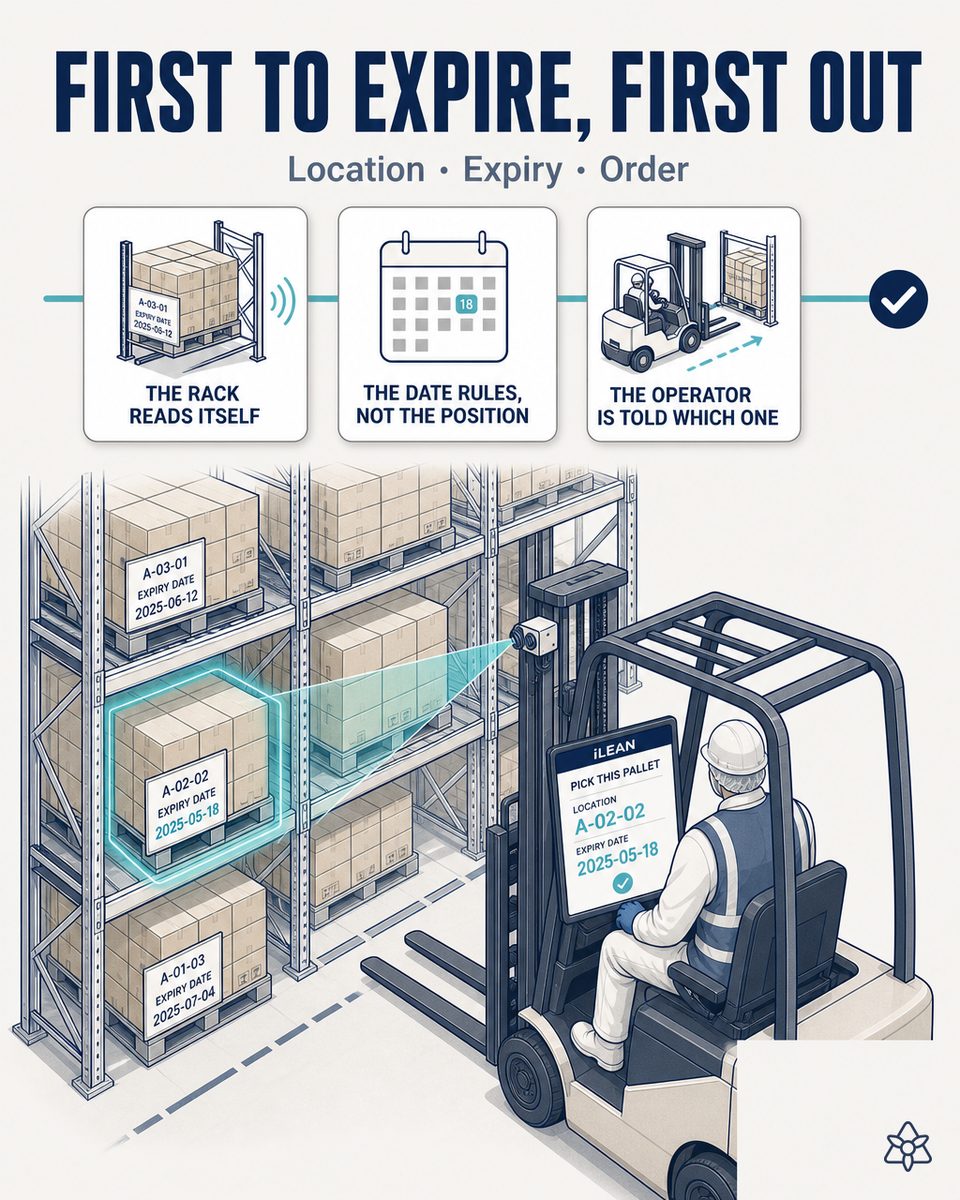
FIFO works on the whiteboard. Out in the aisle, FEFO depends on whoever gets to the pallet first.
Classic FIFO/FEFO has four cracks, and they only show on the day of the recall, never before:
- The expiry date is not where the decision is made — the operator has an RF terminal telling them which pallet to pull; the date is on the pallet label, several meters higher up. When there is time pressure, they take whichever one is at hand.
- Batches of the same SKU with different expiry dates — purchases from several suppliers, production spread over several weeks, a promotion that repositions stock. The WMS treats them as the same SKU; in reality they are different selling windows.
- Cross-dock and outsourced co-packing — product comes in without passing through your warehouse, with labels that are not yours, and the batch gets mixed in a slot with older material. Nobody counts it until it is discovered.
- Retailers keep getting stricter — Mercadona, Carrefour, Lidl and Tesco reject product with fewer than 30/45/60 days of shelf life left. What was an acceptable pick yesterday is reverse logistics on your account today.
The warehouse manager knows it is happening. The sales director gets the call from the retailer. The CFO watches the "expiry loss" line grow quarter after quarter. The classic system works 95-97% of the time. That 3-5% is the loss line.
iLEAN does not replace your WMS — it sits on top and tells it which pallet to pull before it turns into a loss.
The FEFO problem is not a capability gap in the WMS: it is a gap in integrating the expiry data with real rotation, warehouse geometry and retailer rules. iLEAN acts as the putty that fills those cracks — between the batch data, the physical position of the pallet, the shipping plan and the commercial rule.
iLEAN Tracer holds batch + expiry date. Edge sees the pallet. The agent cross-references the WMS, the retailer rule and real rotation. The picking order comes out already optimized by FEFO. The person signs whenever there is an exception.
The three iLEAN pieces applied to food FIFO/FEFO:
- iLEAN Tracer — granular batch traceability: it enters at receiving and stays anchored to a slot, an expiry date and the applicable commercial rules. It is not an extra ERP module; it is the layer that binds the physical batch to the logical data, whether it comes from your printer, from the supplier's SSCC or from OCR on the delivery note.
- iLEAN Agents (on Central) — for every shipping order, the agents propose to the WMS exactly which pallet to pull: the one expiring soonest that also satisfies the retailer rules. When there is a conflict (optimal FEFO but the pallet sits deep in a hard-to-reach slot), they propose a reasoned alternative. The WMS issues the order and the operator executes it as always.
- iLEAN Brain (Central) — the brain that learns real rotation, not the theoretical one. It spots that SKU X turns faster on Mondays, that retailer Y started applying a 45-day rule instead of 30, that the last promotion pulled stock forward that now competes with the fresher material. And it proposes next week's FEFO rules before anyone asks for them.
Manual FEFO vs. FEFO driven by iLEAN
| Aspect | Manual FEFO + RF + good intentions | With iLEAN Tracer + Agent + Brain |
|---|---|---|
| Picking criterion | The WMS's FIFO + an operator who checks the label when they can | FEFO calculated from the real batch, the retailer rule and rotation |
| Same SKU, different expiry dates | Treated alike; the most accessible one goes out | The one expiring soonest goes out; the most accessible one breaks a tie |
| Cross-dock and co-packing | The supplier's label + assumption | OCR on the delivery note + batch anchored to the slot from receiving |
| Retailer rule (45/60 days) | In the sales rep's head; you hear about it when they reject | Active rule per customer; blocks picking before shipping |
| Visibility of approaching dates | A weekly or monthly report | Live dashboard + proactive alert from the Brain |
| Expiry loss | A cost line you learn to live with | Measurable improvement from the first quarter |
Impact estimate for your plant — to be validated with your numbers.
The block below is an estimate to be validated with the specific data of your warehouse. We put it forward so the committee has an order of magnitude; we refine it during the diagnostic.
- A food warehouse of several thousand pallets, an active multi-SKU catalog, multiple retailers with different expiry rules (45-60-90 days remaining depending on the contract).
- Rollout of iLEAN Tracer on top of the existing WMS + Agents proposing FEFO picking. First value expected within a few weeks: the operator already receives the optimized order for the critical SKUs.
- Indicative payback between 4 and 9 months, depending on the current cost of expired product and of retailer rejections. The hard lever is one commercial breakdown avoided with a key customer.
- Expired product cut by ≥ 30% in the first quarter; rejections for a near date cut by even more (because it is a blocking rule at picking, not a check after the fact).
And the warehouse manager's reasonable doubt
"My operators already have a system; is this going to change the way they work?" — no. The picking order still arrives on the RF terminal they already use, with the same flow. The only thing that changes is that the pallet proposed is already the right one under FEFO. The system assists and simplifies; it does not automate or replace. And when there is an exception (blocked slot, equipment under maintenance), the person decides and the order adapts. Connect carries, the Agents propose, the person signs. [1]
[1] Fundación BBVA / Ivie — between 2000 and 2021, the most digitalized sectors raised productivity by up to +40% compared with the least digitalized ones. Digitalization separates those that survive from those that fall.
What people ask about automatic FIFO/FEFO in a food warehouse
What is the difference between FIFO and FEFO?
FIFO (first in, first out) ships first whatever came in first — the criterion is the receiving date. FEFO (first expired, first out) ships first whatever expires soonest — the criterion is the best-before or expiry date. In food both matter, but the one that hurts when it fails is FEFO: two pallets of the same SKU can carry different expiry dates (purchases from different suppliers, batches with different production curves) and a simple FIFO treats them the same. iLEAN applies FEFO by default and falls back to FIFO when the expiry date is identical.
How does it integrate with the WMS?
iLEAN Connect hooks into the WMS (Mecalux, Manhattan, SAP EWM, Reflex, an in-house vertical…) and synchronizes batch + expiry date + location. iLEAN Tracer and the Agents propose the optimal FEFO assignment to picking, and the WMS issues the order to the forklift driver exactly as it does today. The operator does not learn a new system: they see what they always saw, except the picking order already comes optimized by expiry date and by the real geometry of the warehouse.
What about mixed batches in the same slot?
When batches are mixed in a single slot (common in cross-dock and co-packing), iLEAN Vision identifies each pallet individually and the Agent orders them within the slot by expiry date. If the mixing happens at case level inside the pallet (rare, but it does happen in distribution), iLEAN flags the pallet as "mixed expiry" and proposes a different picking rule — the person validates the rule, the system applies it. What matters is that the mix is neither ignored nor assumed away: it is made visible.
Does it work with bulk product?
Yes, with two caveats. For bulk packed in big bags or IBCs with an identified batch, iLEAN treats each unit as a normal FEFO item. For bulk in a silo or hopper (flour, sugar, dairy in a tanker), FEFO becomes production-cohort management + silo rotation rules, which iLEAN models as configurable rules. A silo's expiry date is not a batch's expiry date; it is that of the first batch that went in without the silo having been emptied in between. iLEAN runs that calculation automatically once it receives the silo level signal.
How much does it reduce expiry waste?
It is an estimate to be validated with your warehouse's data, not a closed promise. In plants with manual FEFO and an active multi-SKU catalog, cutting expired product by more than 30% in the first quarter is a conservative target; the real ceiling is set by how often errors happen today and by the product margin. We ask for your numbers (kilos expired per year, average cost, recalls due to a near date) and send you a specific ROI in 48h.
More cases in food
- Blue veining in Stilton PDO — verifying the piercing before the cheese goes into the cave.How iLEAN Vision verifies the manual piercing of Stilton PDO before the final cave, counting holes and…
- Tetilla PDO — shape cannot be fixed in the ripening room: you either catch it at demolding, or it is PDO scrap.iLEAN Vision verifies the characteristic conical shape of Galician Tetilla PDO cheese after demolding…
- Torta del Casar PDO — thistle rennet does not perform the same every day, and the creaminess tells you weeks too late.iLEAN Edge controls the Cynara cardunculus thistle rennet in Torta del Casar PDO: pH curve, creaminess…
- Fish cold room temperature control with AI — the range is not a chart, it is a dossier per batch.How iLEAN cross-checks temperature, door openings, load and the room's curve to keep fresh fish in range…
- Flash juice pasteurization with AI — the HTST window is seconds wide, and the decision cannot take longer.How iLEAN cross-references HTST curve, flow, pH and traceability on flash juice lines with Edge +…
- Flour milling with AI — a low falling number is not an incident, it is a complaint from the baker.How iLEAN cross-references wheat moisture, particle size, ash and falling number to stabilize the flour…
Tell us your case and in 48h we'll send you the estimated ROI of this automatic FEFO project for your food warehouse.
We work on your warehouse's real data, not ours. Diagnostic with no commitment.
Request estimated ROI in 48h See food industry