Flash juice pasteurization with AI — the HTST window is seconds wide, and the decision cannot take longer.
In flash juice pasteurization, the difference between a safe batch and an over-cooked one is two degrees and two seconds. iLEAN cross-references the HTST curve, flow, pH and the color at the sight glass, proposes a hold when the time-temperature pair drifts, and leaves every batch traceable. The person signs.
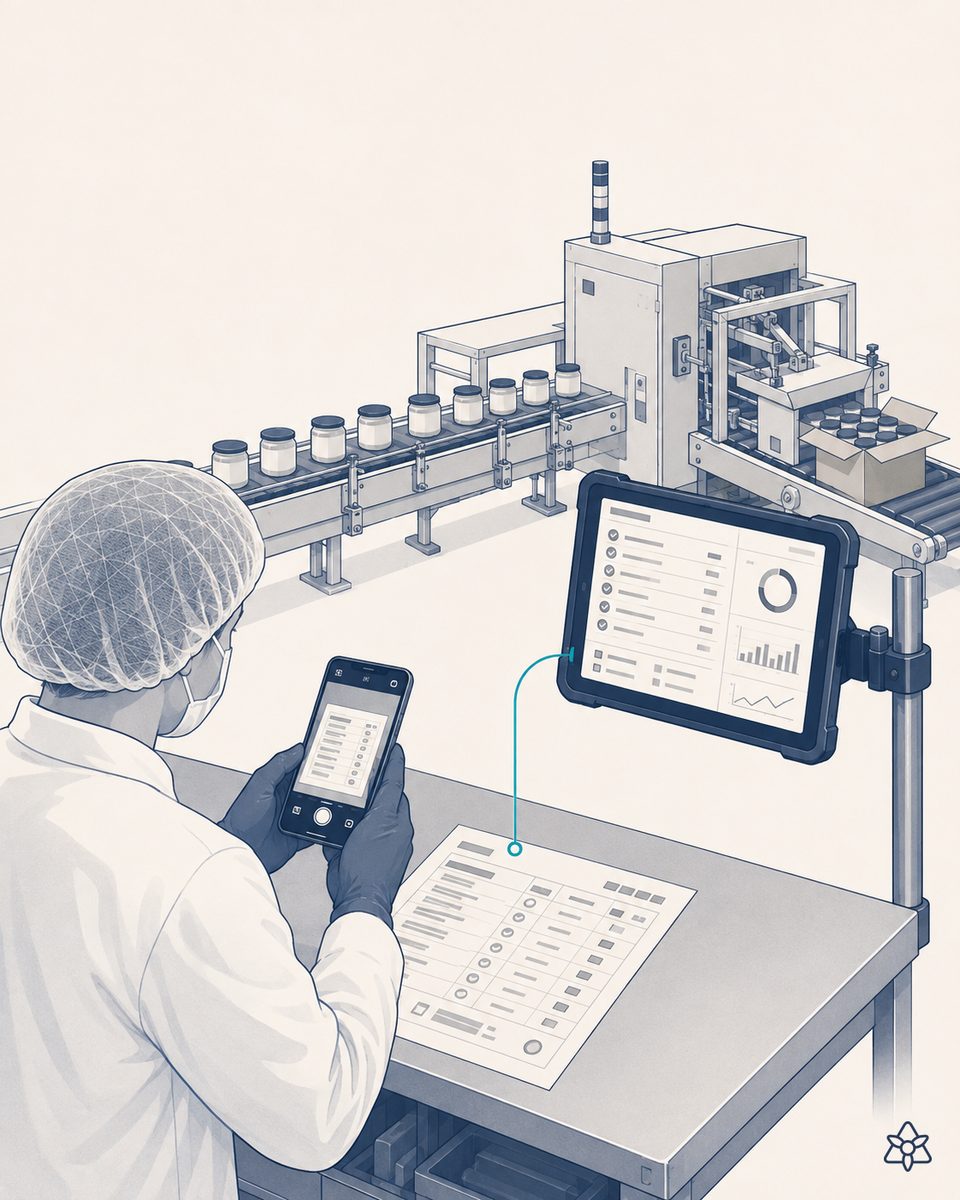
The time-temperature pair is the backbone — and it is managed with two screens and a hunch.
In a flash juice plant, the quality technician cross-references three realities in their head every shift:
- The nominal HTST curve — the one the SKU's HACCP plan dictates (for example, 92 °C × 15 s for orange juice with pH < 4.5).
- The real curve — the one the pasteurizer's SCADA draws, which fouls up with pulp, changes with pump flow and drifts as the heat exchanger ages.
- Sensory quality — color, aroma, residual vitamin C, which is only confirmed in the lab hours later, when the batch is already packed.
The classic system works because there is a procedure. But nobody knows the effective time-temperature pair of batch 412 at 3:23 p.m. with any precision until somebody patiently reconstructs it, and oxidation caused by residual O₂ in an old valve shows up in the color when you are already in distribution. iLEAN does not invent the control; it closes it at a speed one person alone cannot sustain shift after shift.
iLEAN does not replace your pasteurizer or your SCADA — it seals the cracks between the nominal and the real.
The problem in flash juice is not a lack of instrumentation: it is that the real curve, the flow, the pH and the color each sit on a different screen, and they are only cross-referenced at the end, when the batch is already closed. iLEAN acts as the putty that joins those islands and closes the see-decide-act loop before packing.
Edge sees the color at the sight glass. Connect reads the curve, the flow and the recipe. The agent cross-references them with the HACCP time-temperature pair and, if something does not add up, proposes a hold. The person signs — never the other way round.
The three iLEAN pieces applied to flash juice pasteurization:
- Edge — a terminal with vision over the pasteurizer's outlet sight glass and over the packing line (label, date, batch). It detects the color/saturation delta that indicates over-cooking or oxidation, and verifies the printed label. It works with no network: if the plant loses WiFi, Edge keeps classifying and holding.
- Connect — captures the HTST curve from the SCADA, the pump flow, the inlet pH, the batch recipe and the record of the previous CIP, whether they come from a modern SCADA, an old PLC or the process manager's spreadsheet. And it captures what arrives from outside: the supplier's email about a new orange variety, the maintenance manager's WhatsApp about a heat exchanger swap.
- Agent — calculates the effective time-temperature pair batch by batch, compares it with the SKU's HACCP curve and proposes a hold if the pair falls below the CCP. For routine audits, it prepares the complete per-batch dossier (real curve, flow, pH, CIP, color, signature). The Agents have no hands on the critical work order: they propose and the responsible person signs.
Nominal curve + lab afterwards vs. effective time-temperature pair cross-referenced with iLEAN
| Aspect | Nominal curve + lab afterwards | With iLEAN Edge + Connect + Agent |
|---|---|---|
| Effective pair for the batch | Assumed = nominal | Calculated batch by batch, compared with the CCP |
| Detecting oxidation / over-cooking | In the lab, hours later | At the sight glass, in line, before packing |
| Heat exchanger fouling | Scheduled by calendar | Anticipated by the drift in the real curve |
| Verifying the intermediate CIP | Checklist signed per shift | Cross-referenced with the SKU changeover and traced by batch |
| Energy consumed per SKU | Conservative setpoint at all times | Optimal setpoint per SKU without losing the CCP |
| Dossier for the IFS/BRC auditor | Manual reconstruction, days | Automatic per-batch dossier with curve and image |
Impact estimate for your plant — to be validated with your numbers.
The block below is an estimate to be validated with the specific data of your plant. We put it forward so the committee has an order of magnitude; we refine it during the diagnostic.
- Plant with 1-2 flash pasteurization lines (plate or tubular heat exchanger), multi-SKU (orange juice, multifruit, chilled freshly squeezed), variable CIP.
- Edge + Connect pilot (vision on the sight glass and the packing line + integration with the pasteurizer SCADA and the batch recipe). First value expected within a few weeks.
- Indicative payback between 4 and 9 months, depending on how often cycles are repeated because of poorly documented CIP, scrap from oxidation caught late, and the energy saved by the optimal pair per SKU. A reasonable reduction of ≥30%, to be refined.
- Hard lever: one food safety alert avoided (from an undocumented CCP deviation) multiplies the ROI. The recurring saving in energy and cycles is the floor.
And the process manager's reasonable doubt
“What if the agent recommends dropping the setpoint by one degree and I end up with an alert?” — the agent does not sign setpoint changes: it proposes, and the proposal goes through the second validation ring before it reaches the process manager. In anchored tasks (calculating the effective time-temperature pair from a SCADA curve), the best models brought error below 1.5% [1]. And the three safety rings are designed precisely so that critical operations are only executed by a person, where it matters.
[1] OpenAI paper “Why Language Models Hallucinate”, 2025 — on the reliability of AI in anchored tasks.
What people ask about flash juice pasteurization with AI
What is flash pasteurization and why is it the favorite for juice?
Flash pasteurization (HTST: High Temperature, Short Time) heats the juice to 85-95 °C for a few seconds and cools it immediately. It is the favorite for juice because it achieves the enzymatic and microbiological inactivation you need without cooking the product, protecting aroma, color and a good share of the vitamin C. The operational challenge is that the window is extremely narrow: two degrees lower or two seconds longer changes both safety and sensory quality, and the real curve can drift away from the nominal one because of a fouled heat exchanger or a variation in flow.
How do you make sure the time-temperature pair is met batch after batch?
By cross-referencing the continuous curve from the pasteurizer's SCADA with the pump flow and the batch recipe data (variety, °Brix, pH). iLEAN Connect captures all three at second zero and the agent calculates the effective time-temperature pair batch by batch. If the temperature dropped two degrees because of a fouled heat exchanger, or the flow went out of range, the agent cross-references it with the CCP (critical control point) ratio and proposes a hold to the shift lead. The person signs — the batch does not release itself.
How do you detect a sensory deviation (oxidation, color, vitamin C) without waiting for the lab?
With vision on the packing line and cross-referencing with process data. iLEAN Edge can read the color of the juice at the outlet sight glass (saturation delta against the SKU's reference) and raise an alert if the color drifts out of range — an early symptom of over-cooking or of oxidation from contact with O₂. The agent cross-references it with the pasteurization curve and the time spent in the buffer tank, and proposes a root cause to the quality technician. The lab still has the last word; iLEAN shortens the cycle between deviation and reaction.
How is multi-SKU traceability handled (NFC juice, freshly squeezed, from concentrate, blends)?
iLEAN Connect captures the batch recipe from the ERP/MES together with the raw-material batch (variety, origin, incoming °Brix), the previous CIP cleaning cycle and the pasteurizer parameters. The agent generates a per-batch dossier that includes the HTST curve, flow, pH, the previous CIP and the quality manager's signature — ready for an IFS/BRC audit or to answer a RASFF alert. For multi-SKU running on the same line, the system detects the changeover and verifies that the intermediate CIP was correctly documented before the next one starts.
What payback is reasonable in a flash juice pasteurization plant?
An Edge + Connect pilot on one flash pasteurization line (vision on outlet color and the packing line + integration with the pasteurizer SCADA and the batch recipe) is in the order of magnitude of any Edge pilot in a food plant. First value in a few weeks; indicative payback between 4 and 9 months. The hard lever is fewer repeated cycles caused by poorly documented CIP, the energy saved by tuning the HTST pair to the minimum each SKU needs, and avoiding a food safety alert — which, if it happens even once, pays for the pilot and multiplies the ROI. We ask for your data and send you the estimated ROI in 48h.
More cases in food
- Torta del Casar PDO — thistle rennet does not perform the same every day, and the creaminess tells you weeks too late.iLEAN Edge controls the Cynara cardunculus thistle rennet in Torta del Casar PDO: pH curve, creaminess…
- Automatic FIFO/FEFO in a food warehouse — an expired unit on the retailer's shelf is not an incident, it is a phone call from your sales director.iLEAN drives picking by expiry date without relying on the operator. Expired product drops sharply, with…
- Fish cold room temperature control with AI — the range is not a chart, it is a dossier per batch.How iLEAN cross-checks temperature, door openings, load and the room's curve to keep fresh fish in range…
- Flour milling with AI — a low falling number is not an incident, it is a complaint from the baker.How iLEAN cross-references wheat moisture, particle size, ash and falling number to stabilize the flour…
- Blockchain traceability in food — the chain is only worth something if the data at source is true.iLEAN adds blockchain only where it pays off: verified plant data plus an external DLT to certify…
- 24/7 OEE in food manufacturing with AI — the micro-stops nobody writes down are your biggest loss pool.iLEAN measures OEE on your food lines 24/7: every micro-stop logged to the second, and the operator…
Tell us your case and in 48h we'll send you the estimated ROI of this AI project for your flash juice plant.
We work on the real data of your plant, not ours. Diagnostic with no commitment.
Request estimated ROI in 48h See food industry