Dairy cold chain — a break discovered at unloading is milk already lost.
A cold chain break discovered at unloading is milk already lost. iLEAN detects it in transit by cross-referencing temperature, GPS and trip events, and makes it possible to redirect the batch or adjust the tanker before unloading. And it generates the signed per-trip certificate that more and more retailers demand in their specs — without asking you to change your TMS or your fleet.
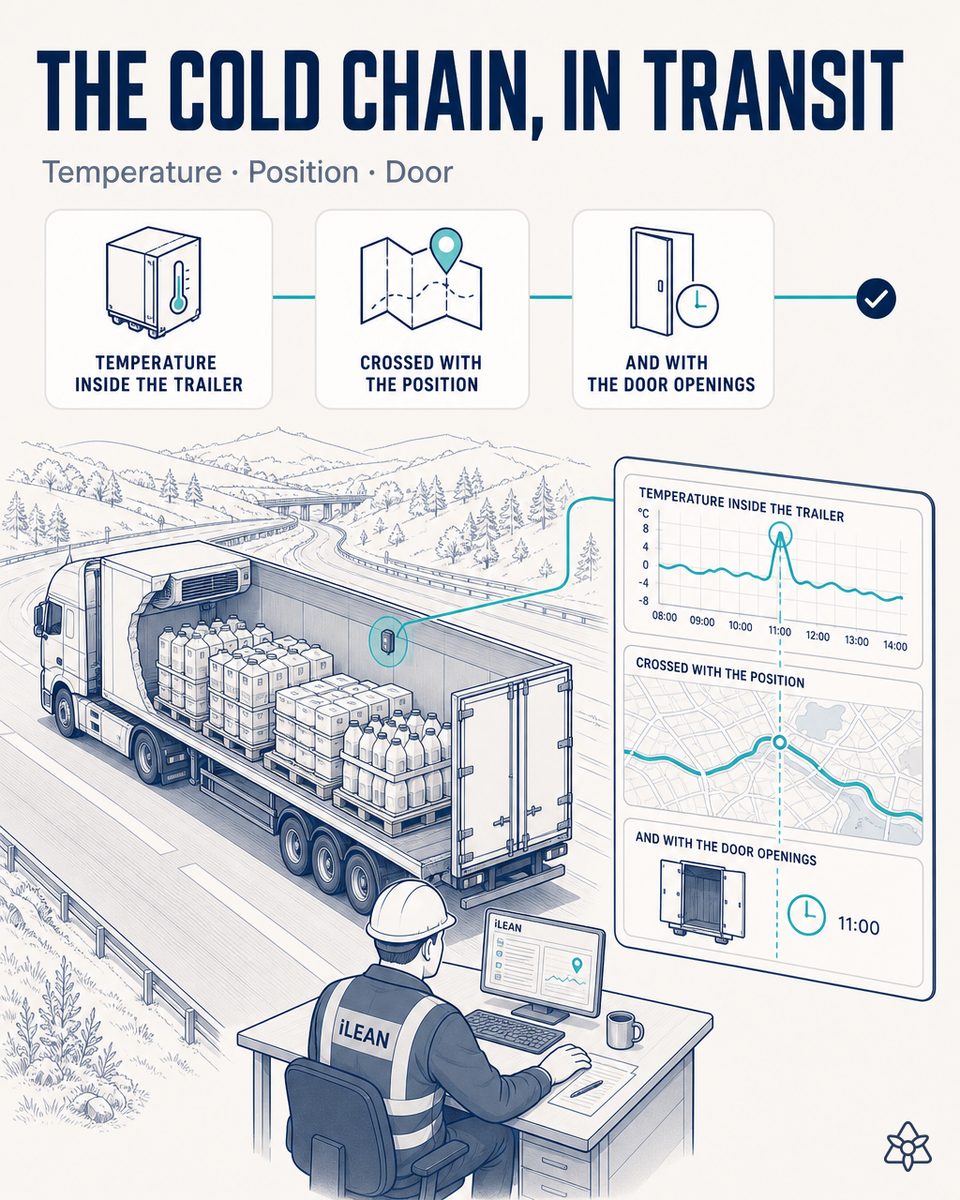
The logger says everything went fine — but the rejection at the dock says otherwise.
A cold chain break in dairy transport is almost never seen in transit. The tanker's logger records, but nobody looks at it until the truck reaches its destination. And at that point, one of three things happens:
- Rejection at the dock — the receiver downloads the logger, sees a spike outside the threshold, and rejects the truck. The transport drives back loaded, the product goes to destruction, the plant is left unsupplied.
- Accepted with an incident — the receiver unloads but penalizes with a discount or a non-conformity. A hard cost and a damaged commercial relationship.
- It slips through unseen — the logger records fine but the incident happened in that stretch without coverage and nobody ever knows. The product reaches the consumer with the chain broken. If it is caught in later lab analysis, there is a recall.
The carrier's dispatcher runs a mixed fleet (own tankers, subcontracted ones, different brands of refrigeration unit), each with its own telemetry portal, and none of those portals talks to the TMS. Watching trip by trip is impossible — and nobody finds out until the unloading dock.
iLEAN does not replace the TMS or the logger — it seals the crack between the mixed fleet and a decision made in time.
The problem is not a lack of sensors: it is data scattered across manufacturer portals that nobody cross-references with the TMS, the GPS and the product inside. iLEAN acts as the putty that fills that gap. It does not ask you to change your fleet, your TMS or your refrigeration equipment.
Connect captures the telemetry wherever it comes from. Edge adds a sensor where there is none. The agent decides what is a break and what is noise — and alerts the dispatcher with time to act.
The iLEAN pieces applied to the cold chain in transport:
- Connect — captures the telemetry data from every brand of refrigeration unit (Thermo King, Carrier, Frigoblock, etc.), the available APIs, the incident emails from the subcontracted carrier, the TMS records and the planned stops. And it captures what arrives from outside: the driver's WhatsApp saying "the unit has dropped into demand mode" enters at second zero.
- Edge — optional, on the tanker or in the cab, when you need your own sensor (a tanker with no usable telemetry) or local processing (long stretches without coverage). It processes locally and reconciles on reconnection. What is critical cannot depend on WiFi.
- Cold chain agent — cross-references temperature, duration of the excursion, GPS position, planned vs. actual stops and the product inside. It tells a real incident (3 °C above range for 30 minutes on the road) from a false positive (1 °C at an authorized 2-minute stop). When it is real, it alerts the dispatcher and proposes actions. The dispatcher signs — the truck does not reroute itself.
Passive logger checks vs. active tracking with iLEAN
| Aspect | Classic logger (downloaded at the dock) | With iLEAN Connect + Edge + Agent |
|---|---|---|
| Moment the break is detected | At unloading, with the truck already at destination | In transit, with time to act |
| Multi-brand fleet | Each brand in its own portal, never unified | Single view, wherever the data comes from |
| Real break vs. false positive | A single threshold line — many false alarms | Temperature × time × GPS × product cross-referenced |
| Communication with dispatcher / customer | Reactive, already at the dock | Proactive, in transit, through the usual channel |
| Cold chain certificate per trip | A spreadsheet after the fact | Automatic signed dossier, ready for the auditor |
| Loss of GPS / telemetry coverage | A gap in the certificate, risk of rejection | Local buffer, reconciliation on reconnection |
Impact estimate for your plant — to be validated with your numbers.
The block below is an estimate to be validated with the specific data of your fleet. We put it forward so the committee has an order of magnitude; we refine it during the diagnostic, reviewing your historical incidents and your retailers' specs.
- Dairy cooperative or dairy processor with 15-50 tankers (a mix of own + subcontracted), 100-400 trips/week, 3-8 brands of refrigeration unit in the fleet, growing retailer spec requirements.
- Connect + cold chain agent deployment (TMS integration + APIs of the majority brands + Edge sensor on tankers with no usable telemetry). First value expected within a few weeks: a unified view of the whole fleet + the first in-transit alert avoiding a rejection at the dock.
- Indicative payback between 4 and 9 months, depending on the number of historical rejection incidents + non-conformity discounts + the cost of the product lost.
- Expected reduction in cold chain rejections ≥ 30% after the first cycle (the in-transit alert lets you adjust, redirect or renegotiate before unloading).
And the logistics director's reasonable doubt
“What if the agent hallucinates and fires a break alarm that isn't one?” — hallucination is a problem of free generation, not of anchored tasks. Cross-referencing real temperature with real GPS and regulated per-product thresholds is exactly the anchored task in which the best models brought error below 1.5% [1]. And even so, the agent does not act alone: it proposes to the dispatcher, who decides. The three safety rings exist precisely for this: no truck redirection goes out without the responsible person's signature.
[1] OpenAI paper “Why Language Models Hallucinate”, 2025 — on the reliability of AI in anchored tasks.
What people ask about the cold chain in dairy transport
What threshold defines a cold chain break in dairy transport?
European regulation (Regulation (EC) 853/2004) and retailer specs set ranges per product: raw milk 0–6 °C in the tanker, yogurt and fresh dairy 0–8 °C, fresh cheese 0–4 °C. A break is not just crossing the threshold for an instant — it is time × temperature delta. A 1 °C spike for 2 minutes during a stop at a port is not a break; 3 °C above range for 30 minutes is. iLEAN does not fire an alarm for every spike — it combines temperature, duration, GPS location and product to tell a real incident from a false positive.
Does iLEAN work with a multi-brand fleet of tankers and semi-trailers?
Yes. The reality of dairy transport is a mixed fleet: own tankers, subcontracted ones, Thermo King, Carrier and Frigoblock units, each with its own telemetry and its own portal. iLEAN Connect captures the data through whatever channel each brand offers (the manufacturer's API where there is one, reading the logger, integration with the carrier's TMS, or a direct read of the logger port). Where there is nothing, Edge adds its own temperature sensor on the tanker with cellular connectivity. The result: a single view of the whole fleet, wherever the data comes from.
Does iLEAN generate a cold chain certificate per trip?
Yes — and it is one of the deliverables retailers increasingly demand in their specs. For every trip, the agent compiles the dossier: the full temperature curve, relevant events (doors opened at authorized stops, spikes tied to partial unloads), synchronized GPS location, and the electronic signature of the origin plant and of the recipient at receiving. An IFS Logistics or BRC Storage and Distribution auditor accepts it because the traceability is continuous and signed — not a spreadsheet rebuilt three days later.
Does iLEAN integrate with the carrier's existing TMS?
Yes. iLEAN does not replace the TMS — it sits on top. It reads the route plan and the expected milestones (loading, stops, unloading) from the TMS and cross-references them with the tanker's actual temperature and GPS position. When the agent detects a deviation that is going to cause a break, it can notify the carrier's dispatcher through their usual channel (WhatsApp, email, the TMS app) and propose a redirection or an adjustment. The dispatcher makes the call — the agent does not reroute trucks on its own.
What if the temperature sensor or the GPS loses signal?
Good question — and a critical one, because in transport connectivity fails constantly (dead zones, tunnels, unloading at a port). The logger on the tanker keeps recording locally, and so does the GPS; when coverage returns, the whole buffer is uploaded. iLEAN Edge, if it sits in the cab or on the trailer, does the same: it processes locally and reconciles when the network comes back. What is critical cannot depend on WiFi. A 40-minute signal loss in a tunnel is not a break — it is a telemetry gap the system closes on reconnection. If the loss is prolonged and unusual, that the system does escalate as an anomaly to review.
More cases from this series
- Dairy batch recall with AI — a recall done right is measured in minutes, not hours.When a food safety alert lands, iLEAN identifies the batch, the affected distribution points and drafts…
- Audit evidence exists before the inspector asks for itEvery critical changeover generates its dossier with before and after photos, log and signature, ordered…
- Digitizing the concentrate evaporator panel without touching the machineA camera reads degrees Brix, temperature and vacuum off the evaporator's isolated panel. No machine…
- Bulk orange and aseptic input intake, without typing into the ERPPhoto the delivery note, the weighbridge ticket and the pallet labels; one-tap validation and straight…
- The shift lead's knowledge stops dying at end of shiftAn earpiece and voice: the shift lead dictates what they see without breaking stride, and gets support…
- Lab analysis reaches the ERP without anyone typing itiLEAN reads the lab sheet when it is saved, structures it and posts it to the ERP after validation. From…
Tell us your case and in 48h we'll send you the estimated ROI of this AI project for your fleet.
We work on your operation's real data, not ours. Diagnostic with no commitment.
Request estimated ROI in 48h ‹ All dairy cases See food industry