Bulk orange and aseptic input intake, without typing into the ERP
In season, bulk orange trucks arrive all day and, in parallel, pallets of aseptic input arrive with their certificate and batch label. Both intakes end at the same bottleneck: one person typing into the ERP while the truck waits. With Connect, a photo of the delivery note, the weighbridge ticket and the labels is enough: iLEAN extracts it, cross-checks it against the purchase order, the supervisor validates with one tap and it all enters the ERP.
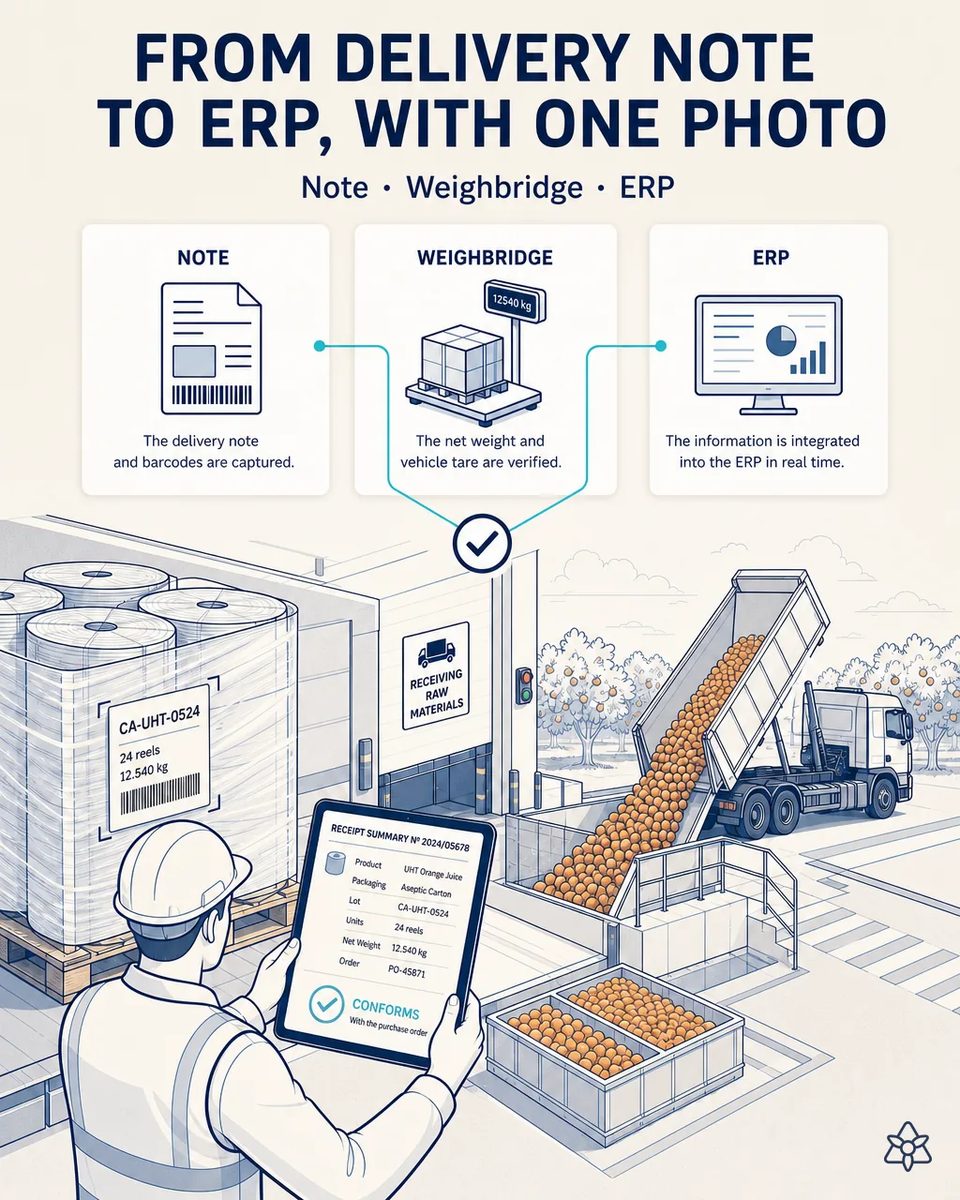
Two kinds of intake, one bottleneck: a person typing while the truck waits.
This plant's goods intake has two very different natures. On one side, agricultural bulk: orange trucks crossing the weighbridge with their weight ticket and delivery note. On the other, industrial pallets: aseptic carton reel, caps, cultures, rennet, sugar or bought-in concentrate, each with its certificate of analysis and its barcoded batch label. Both end the same way. The receiving supervisor has to sign the paper and then log into the ERP to key it in line by line. Either the driver waits twenty to forty-five minutes on demurrage, or it gets typed in a hurry and the batch is badly traced. The second option is not paid for that day. It resurfaces three weeks later, in a traceability query nobody can close because the batch that was typed is not the batch that arrived.
- On one side, agricultural bulk: orange trucks crossing the weighbridge with their weight ticket and delivery note, all day, for weeks.
- On the other, industrial pallets: aseptic carton reel, caps, sugar or bought-in concentrate, each with its certificate of analysis and its barcoded batch label.
- Both end the same way: the receiving supervisor signs the paper and logs into the ERP to key it in line by line. Either the driver waits twenty to forty-five minutes on demurrage, or it gets typed in a hurry and the batch is badly traced.
- The second option is not paid for that day. It resurfaces three weeks later, in a traceability query nobody can close because the batch that was typed is not the batch that arrived.
Connect in photo mode with ERP posting — note, ticket and labels, no supplier changes.
Connect in "photo of the analog" mode with ERP posting. The flow:
The delivery note stops being a filed sheet of paper and becomes an image attached to the goods receipt from minute one, cross-checked against the open purchase order before anyone signs. That is what turns a three-week-old traceability question into a query instead of a reconstruction — and what keeps the bay fluid in the weeks the season saturates it and the weighbridge queue reaches the road.
- Photo of the truck's delivery note, photo of the weighbridge ticket and photo of the pallet labels.
- iLEAN reads standard logistics barcodes carrying batch, expiry and quantity, and reads the note and ticket by OCR.
- It automatically cross-checks against the open purchase order in the ERP and flags immediately if quantity, batch or certificate do not match.
- The receiving supervisor sees the summary on the tablet and validates with one tap, or flags the discrepancy.
- The API writes the goods receipt into the ERP, with the original image of the delivery note attached and queryable forever.
Today's intake versus the captured intake
| Aspect | Today | With iLEAN Connect |
|---|---|---|
| Truck at the bay | 20-45 minutes | Under a minute to validate |
| Delivery note and weighbridge ticket | Typed, then filed | Photographed, read and attached forever |
| Reel and cap batch labels | Keyed by hand | Barcode read: batch, expiry, quantity |
| Mismatch with the purchase order | Found weeks later | Flagged before the signature |
| Hauler demurrage | Invoiced every season | Eliminated |
| Licenses on the goods receipt module | Four | One, the supervisor who validates |
from 20-45 minutes of waiting per truck, to validation at the bay in under a minute. From typed traceability, to photographed traceability. From invoiced carrier demurrage, to a fluid bay in peak season.
Estimated impact — to validate against your actual ERP invoice.
The block below is an estimate to be validated against your plant's actual data. We put it forward so the committee has an order of magnitude; we refine it during the assessment.
- 💰 CFO angle: if four people across receiving and the weighbridge hold an ERP license purely to post goods receipts, with Connect one is enough: from 4 to 1, a 50-70 % reduction on the goods receipt module, recurring.
- Estimated payback 3-7 months in season.
- Demurrage eliminated, truck after truck, in the weeks the bay is saturated.
- And complete batch-to-plant traceability by image — the delivery note, the ticket and the reel label attached to the goods receipt — which is what closes the query that today stays open for three weeks.
direct CFO angle. If four people across receiving and the weighbridge hold an ERP license purely to post goods receipts, with Connect one is enough: from 4 to 1. Typical ratio for this archetype: −50 % to −70 % on goods receipt module licenses, a recurring annual saving, plus eliminated demurrage and complete batch-to-plant traceability by image. Estimated payback 3 to 7 months in season. *Estimate to validate against the actual ERP invoice.*
And the fair question from the production manager
«Does it recognize every supplier's delivery note and every grower's ticket?» — yes, and without asking any of them to change theirs: the model extracts the table structure with no per-supplier template. Labels are read by standard logistics barcode where present and by optical recognition where not. It is an anchored task, where the best models drop below 1.5% error [1], and the supervisor validates before anything is written to the ERP.
[1] OpenAI paper "Why Language Models Hallucinate", 2025 — on the reliability of AI in anchored tasks.
What people ask about digitizing goods receipt
Does it handle bulk oranges and aseptic pallets the same way?
The same flow, different documents. For the truck it is the weighbridge ticket and the delivery note; for the pallet it is the label barcode and the certificate of analysis. The model recognizes each structure without a template, so a new grower or a new reel supplier needs no setup.
What if the delivery note and the labels disagree?
The discrepancy — quantity, batch or missing certificate — is highlighted on the tablet before the supervisor signs, and the supervisor either validates with the correction or flags it back to purchasing. Today nobody makes that cross-check with a driver waiting.
Do we need barcode scanners?
Not necessarily: a photo from the phone or the bay tablet is enough to read a standard logistics barcode carrying batch, expiry and quantity. If the plant already has scanners that work well, they integrate just the same.
Does the certificate of analysis get linked to the batch?
Yes, and it is the part that matters most for aseptic inputs: the certificate is attached to the reel or cap batch from minute one, so proving what went into a carton stops being a search through a filing cabinet and becomes part of the batch record.
Can we start with receiving alone?
Yes, and in season it is a good place to start: the result is visible from the first truck, the demurrage stops the same week, and it does not depend on the other cases being deployed.
More cases from this series
- Audit evidence exists before the inspector asks for itEvery critical changeover generates its dossier with before and after photos, log and signature, ordered…
- Digitizing the concentrate evaporator panel without touching the machineA camera reads degrees Brix, temperature and vacuum off the evaporator's isolated panel. No machine…
- The shift lead's knowledge stops dying at end of shiftAn earpiece and voice: the shift lead dictates what they see without breaking stride, and gets support…
- Lab analysis reaches the ERP without anyone typing itiLEAN reads the lab sheet when it is saved, structures it and posts it to the ERP after validation. From…
- Milk collection alerts, read at second zeroThe carrier's message is cross-checked against the process plan and returns a concrete action, not a…
- The human gate sits before the silo, not after the complaintInhibitors, weighbridge, temperature and freezing point on one bay screen. The human signs and only then…
Tell us how much demurrage you were invoiced last season.
We work on your plant's real data, not ours. Assessment with no commitment.
Request estimated ROI within 48h ‹ See all cases of dairy and citrus See food industry