Lab analysis reaches the ERP without anyone typing it
In a shared folder in the lab lives the spreadsheet technicians fill in shift by shift: intake analysis, alkaline phosphatase, pH, degrees Brix, acidity, somatic cells. It is the freshest data in the plant, and the ERP finds out about it weeks late because it requires someone to transcribe it. With Connect in "listen inward" mode, iLEAN reads the file when it is saved, structures it, lets it be validated and posts it to the ERP.
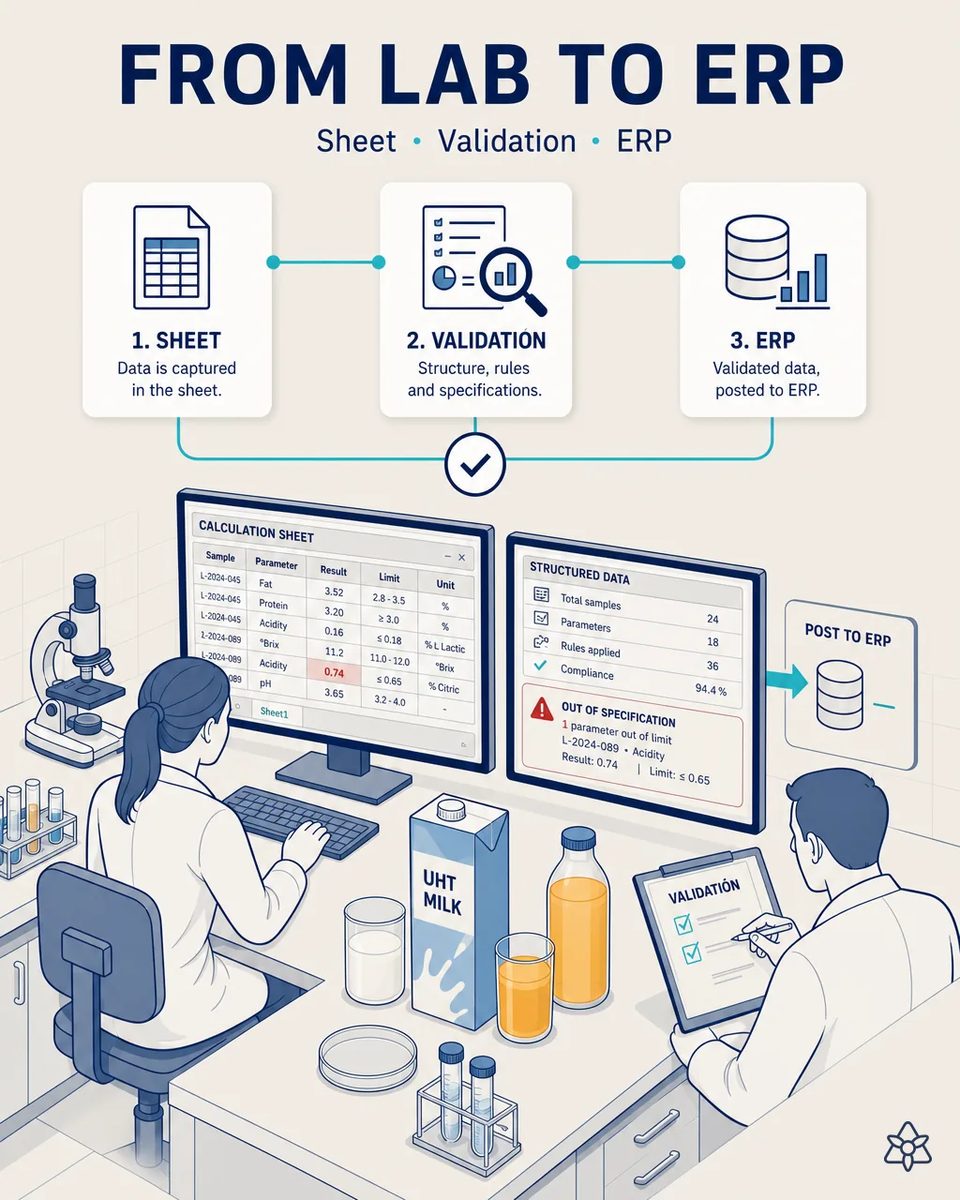
The freshest data in the plant, and the ERP finds out weeks later.
The lab of a plant with raw milk intake, a UHT line, a juice line and a cheese line generates a volume of analysis no shared spreadsheet survives with dignity. There are versions. There are local copies someone took away to work without a lock. There are cells formatted as text where a number should be. And the ERP, where batch release actually lives, requires all of it to be transcribed by hand. Every month several person-days go into typing what was already written. As a result, the ERP data runs systematically weeks behind reality, and out-of-specification results are caught in the monthly review instead of when they happen.
- The lab sheet holds the intake analysis, alkaline phosphatase, pH, degrees Brix, acidity and somatic cells, shift by shift. It is the freshest data in the plant.
- It is a shared spreadsheet with versions, local copies someone took away to work without a lock, and cells formatted as text where a number should be.
- And the ERP, where batch release actually lives, requires all of it to be transcribed by hand. Several person-days a month go into typing what was already written.
- As a result the ERP runs systematically weeks behind reality, and an out-of-specification result is caught in the monthly review instead of when it happens.
Connect in inward listening mode — the file, not the person.
Connect in "listen inward" mode. The flow:
The lab does not change tools or learn a new one. They keep their sheet, with all the formatting quirks accumulated over years, and iLEAN reads it the moment it is saved. What disappears is the transcription — and the licenses that existed only to do it. An out-of-specification acidity or phosphatase result is flagged when the file is saved, before anyone has looked, and the quality manager validates on screen before the API posts anything to the ERP.
- iLEAN observes the shared folder and reads the file when it is saved. This deserves precision: it does not monitor any person, it reads a file.
- A model grounded in that specific sheet's structure extracts the values, even with the formatting quirks accumulated over years.
- Each value is linked to the corresponding batch and line in central memory.
- iLEAN immediately flags anything out of specification, before anyone looks.
- The quality manager validates on screen and, after that validation, the API posts the data into the ERP's quality module.
The lab does not change tools or learn a new one. They keep their sheet. What disappears is the transcription.
Today's lab versus the connected lab
| Aspect | Today | With iLEAN Connect |
|---|---|---|
| Gap between real result and ERP | Weeks | Minutes |
| Manual transcription | Several person-days a month | Zero |
| Out-of-specification result | Caught in the monthly review | Flagged when the file is saved |
| Sheet format | Would have to be standardized | Read as it is, quirks included |
| Who validates before posting | Nobody, it is typed | The quality manager, on screen |
| Licenses on the quality module | Six | One, the person who validates |
from weeks of lag between real data and ERP data, to minutes. From catching out-of-specification results in the monthly review, to catching them when the file is saved. From several person-days a month of transcription, to zero.
Estimated impact — to validate against your actual ERP invoice.
The block below is an estimate to be validated against your plant's actual data. We put it forward so the committee has an order of magnitude; we refine it during the assessment.
- 💰 CFO angle: the ERP bills per named user. If six lab people log in purely to enter results, that is six licenses on the quality module: from 6 to 1, a 50-80 % reduction, recurring every year.
- Estimated payback 3-6 months counting licenses and transcription alone.
- Several person-days a month of lab time recovered.
- And out-of-specification results caught when they happen instead of weeks later, which is what protects the batch release.
direct CFO angle. If six lab people log into the ERP purely to enter results, that is six licenses on the quality module. With Connect only the person who validates logs in: from 6 to 1. At the usual rates of a high-end corporate ERP, that is a recurring five-figure annual saving. Typical ratio for this archetype: −50 % to −80 % on lab/quality module licenses. Estimated payback 3 to 6 months counting licenses and transcription alone. *Estimate to validate against the actual ERP invoice.*
And the fair question from the production manager
«That sheet has been edited by six people for ten years — does it hold up?» — that is the anticipated case: parsing does not depend on fixed cell positions, it interprets columns, units, merged cells and margin notes without asking anyone to standardize anything. It is an anchored task, where the best models drop below 1.5% error [1], and the quality manager validates on screen before anything is posted to the ERP.
[1] OpenAI paper "Why Language Models Hallucinate", 2025 — on the reliability of AI in anchored tasks.
What people ask about connecting the lab sheet
Do we have to standardize the lab sheet?
No, and it is better not to. Asking the lab to change its sheet is the fast route to the system going unused. iLEAN reads the one that exists, in the format it has today, with its text-formatted cells and margin notes, and keeps reading it as it evolves.
Does it watch the folder or the person?
The folder. The file is read when it is saved; there is no tracking of who opens what or how long they spend on it. This deserves precision because it is the first thing the lab will ask, and the honest answer is what makes them keep using their sheet.
What counts as out of specification?
The limits you already use: phosphatase after pasteurization, acidity, pH, somatic cells at intake, Brix for the juice line. iLEAN applies them to each result as it arrives and flags the deviation before anyone opens the sheet, so the batch release is not waiting on the monthly review.
Can licenses really be reduced?
It depends on your contract, which is why it is framed as an estimate to validate against last year's invoice. The logic is that anyone logging into the quality module purely to type stops needing to; only the person who validates keeps a seat.
Which lines does it cover?
All the ones the sheet covers: raw milk intake, the UHT line and the juice line. Each value is linked to its batch and line in central memory, so the ERP receives it already attributed and the quality module stops holding results nobody can tie to a batch.
More cases from this series
- Audit evidence exists before the inspector asks for itEvery critical changeover generates its dossier with before and after photos, log and signature, ordered…
- Digitizing the concentrate evaporator panel without touching the machineA camera reads degrees Brix, temperature and vacuum off the evaporator's isolated panel. No machine…
- Bulk orange and aseptic input intake, without typing into the ERPPhoto the delivery note, the weighbridge ticket and the pallet labels; one-tap validation and straight…
- The shift lead's knowledge stops dying at end of shiftAn earpiece and voice: the shift lead dictates what they see without breaking stride, and gets support…
- Milk collection alerts, read at second zeroThe carrier's message is cross-checked against the process plan and returns a concrete action, not a…
- The human gate sits before the silo, not after the complaintInhibitors, weighbridge, temperature and freezing point on one bay screen. The human signs and only then…
Show us your ERP license invoice and we will tell you how much of it is transcription.
We work on your plant's real data, not ours. Assessment with no commitment.
Request estimated ROI within 48h ‹ See all cases of dairy and citrus See food industry