Milk collection alerts, read at second zero
Raw milk is a raw material on a clock: every alert that arrives late is paid for in a lost window or in product downgraded to a lower-value range. And the alerts that matter most arrive through the most chaotic channels there are. With iLEAN Connect the carrier's message is read at second zero, cross-referenced with the process plan and real silo levels, and returns a concrete action to the process manager: what to bring forward, which silo to use and which export batch stays untouched.
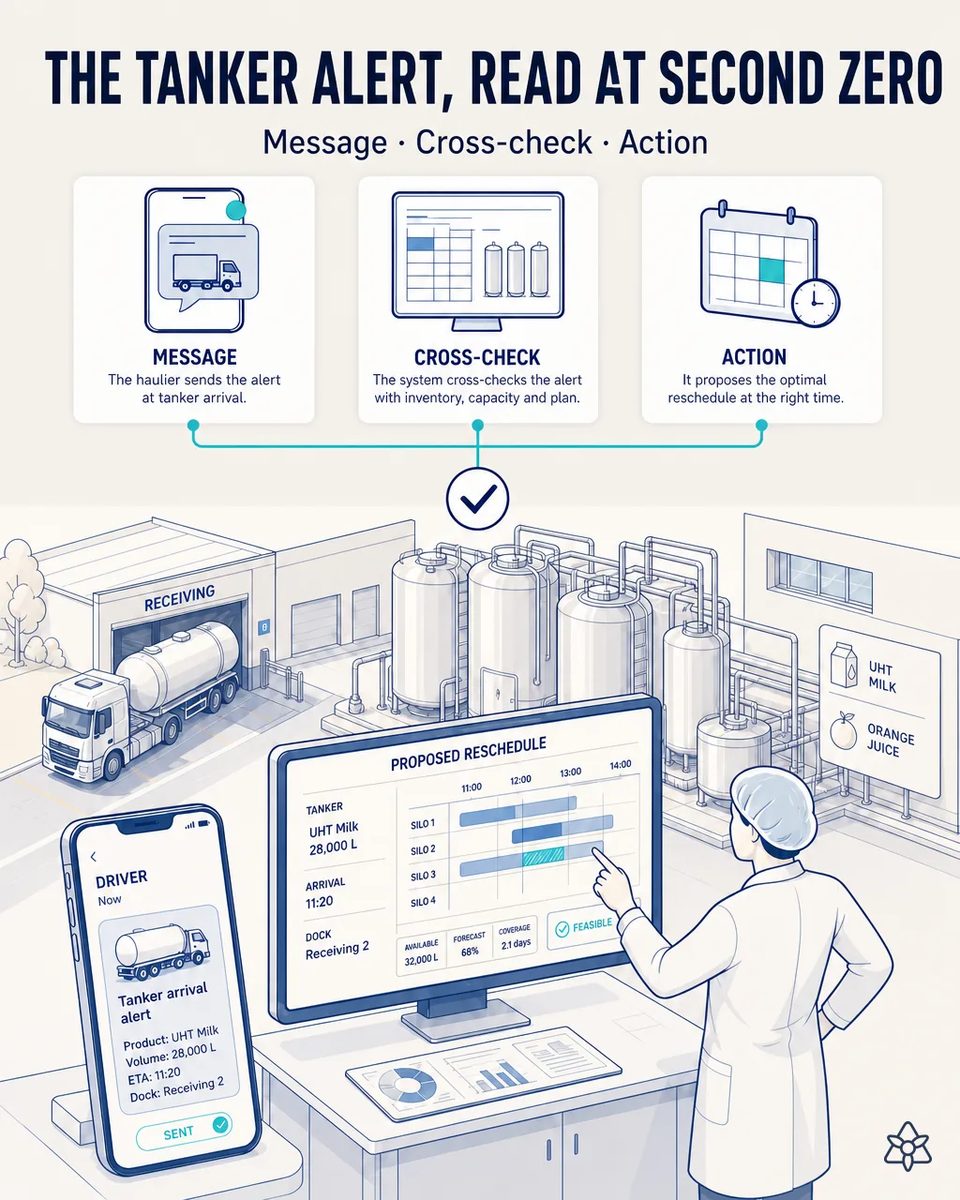
Milk on a clock, and alerts that arrive through the most chaotic channels there are.
A carrier writes at five forty in the morning: the northern route tanker is running two hours late and short on volume because a farmer had a cooling tank failure. The message lands on the receiving manager's phone. They read it at seven fifteen, because at five forty they were asleep and at half six they were on the floor wearing gloves. By then a process schedule has been built on a volume that will not exist: the process room waiting, milk from another silo pushed out of its window, and a product rescheduled on the fly. The same pattern repeats with the export customer's email changing container quantities, with the farmer's phone call reporting an incident and with the packaging supplier's notice. They all reach specific people who cannot watch an inbox while they are on the floor, and they are all read once decisions have been made that now have to be broken.
- At five forty in the morning the hauler writes that the northern route is two hours late and short on volume because a farmer's cooling tank failed. The message lands on the receiving manager's phone, who reads it at seven fifteen.
- By then a process schedule has been built on a volume that will not exist: the process room waiting, milk from another silo pushed out of its window, a product rescheduled on the fly.
- The same pattern repeats with the export customer's email changing container quantities, the farmer's call reporting an incident and the packaging supplier's delay notice. They all reach people who cannot watch an inbox while wearing gloves on the floor.
- Every alert read late is paid for in a lost window or in milk downgraded to a lower-value range.
Connect in chaotic-sources mode — silent copy, twenty-four seven.
Connect in "chaotic sources" mode. The flow:
Finding out sooner is not enough: what changes the morning is the cross-check. The message is read against open orders, the shift's process plan and the real level of each silo, and what comes back is what to bring forward, which silo to use and which export batch stays untouched. The process manager still decides; what changes is the information in front of them — current instead of three hours old, and already reconciled with what the silos actually hold.
- A dedicated mailbox and a messaging number sit on silent copy, twenty-four seven. Nobody changes how they communicate: the carrier keeps writing where they always did.
- When the message arrives, a language model extracts the intent — collection delay, volume shortfall, cooling incident at origin, export order change — and the entities: route, farmer, liters, estimated time, destination.
- That information is cross-referenced with live data: open ERP orders, the shift's process plan and the real level of each silo.
- iLEAN returns a concrete, actionable instruction to the relevant role, not a notification that a message has arrived.
- The process manager decides. The decision remains theirs; what changes is the information they hold.
Today's alert versus the cross-checked alert
| Aspect | Today, on a phone | With iLEAN Connect |
|---|---|---|
| When the hauler's message is read | When its recipient wakes up or takes off the gloves | In seconds, at arrival |
| Human latency | 1.5 to 3 hours | Seconds |
| The process schedule | Built on volume that will not arrive | Reordered before the delay is felt |
| Milk pushed out of its window | Downgraded to a lower range | Brought forward in time |
| What the manager receives | One more notification | Which silo, what to bring forward, what to leave |
| Who decides | The recipient, late | The process manager, on time |
from 1.5 to 3 hours of human latency, to seconds. From rescheduling on three-hour-old information, to deciding on current information. From a process room standing idle, to a proposed reordering before the delay is even felt on the floor.
Estimated impact — to validate with your own numbers.
The block below is an estimate to be validated against your plant's actual data. We put it forward so the committee has an order of magnitude; we refine it during the assessment.
- Estimated payback 3-7 months, depending on the frequency of incidents on the collection routes.
- Process room downtime caused by missing information that you stop paying for.
- Milk that no longer degrades outside its window, and product that no longer gets downgraded to a lower-value range because the schedule was built on stale volume.
- And decisions taken on current information instead of on information three hours old.
estimated payback 3 to 7 months depending on route incident frequency, counting reduced downtime caused by missing information and milk that no longer degrades outside its window. *Estimate to validate.*
And the fair question from the production manager
«Are you going to read my team's messages?» — no. iLEAN sits in copy on a dedicated mailbox and a company messaging number: it only sees what haulers, farmers, customers and suppliers send to those operational channels. On extraction, classifying the intent of a collection delay or a volume shortfall is an anchored task, where the best models drop below 1.5% error [1] — and the reschedule is executed by a person.
[1] OpenAI paper "Why Language Models Hallucinate", 2025 — on the reliability of AI in anchored tasks.
What people ask about reading collection route alerts
Does the hauler have to use an app?
No, and that is the point. The hauler keeps writing where they always did. iLEAN reads the messaging number and the mailbox it is copied on; nobody outside the plant changes anything.
Does it tell a route delay from a cooling incident at the farm?
Yes, and it extracts the entities that matter for each: route, farmer, liters, estimated time, destination. A cooling incident is flagged for quality as well, because it changes what to test at the bay.
What does it cross-check the message against?
Open ERP orders, the shift's process plan and the real level of each silo. Without that cross-check you only find out sooner; with it you know which silo to use and which export batch to leave alone.
Does it also handle the export customer's container changes?
Yes. An email changing quantities per container reaches planning as a concrete change to the dispatch plan, not as a message buried under a hundred others. The packaging supplier's delay notice follows the same path and reaches whoever schedules the filler.
Who ends up deciding?
The process manager, always. iLEAN proposes the reordering with its reasoning attached — which silo, which batch, why — and the decision and the responsibility stay exactly where they are today. What is removed is the hour and a half spent finding out.
More cases from this series
- Audit evidence exists before the inspector asks for itEvery critical changeover generates its dossier with before and after photos, log and signature, ordered…
- Digitizing the concentrate evaporator panel without touching the machineA camera reads degrees Brix, temperature and vacuum off the evaporator's isolated panel. No machine…
- Bulk orange and aseptic input intake, without typing into the ERPPhoto the delivery note, the weighbridge ticket and the pallet labels; one-tap validation and straight…
- The shift lead's knowledge stops dying at end of shiftAn earpiece and voice: the shift lead dictates what they see without breaking stride, and gets support…
- Lab analysis reaches the ERP without anyone typing itiLEAN reads the lab sheet when it is saved, structures it and posts it to the ERP after validation. From…
- The human gate sits before the silo, not after the complaintInhibitors, weighbridge, temperature and freezing point on one bay screen. The human signs and only then…
Tell us how many times a month your process room gets rescheduled because an alert was read late.
We work on your plant's real data, not ours. Assessment with no commitment.
Request estimated ROI within 48h ‹ See all cases of dairy and citrus See food industry