Audit evidence exists before the inspector asks for it
On re-inspection day, someone spends two weeks rebuilding traceability: startup sheets, CIP records, temperature logs, analyzes and signatures scattered across folders, spreadsheets and binders. The inspector asks for proof, the plant produces paper, and the gaps turn into non-conformities. With Agents, every critical changeover generates its dossier at the moment it happens, ordered by certifying standard.
The certification that opens the export market is not passed once. It is maintained.
A grade A milk plant certification under the pasteurised milk ordinance is not passed once: it is maintained, through periodic re-inspection. And for an exporting plant it is the physical key to its most valuable market. Losing it is not a fine: it is closing a channel. On top of that sit the food safety scheme audits, the food safety management system standard audits and the quality audits. Each asks for substantially the same evidence, ordered differently and in different vocabulary. The result is that the organization's most expensive quality people spend weeks a year reconstructing the past instead of improving the present. And the risk is not only the non-conformity: it is that the work of reconstructing competes directly with the work of producing.
- A Grade A milk certification under the Pasteurized Milk Ordinance is maintained through periodic re-inspection, and for an exporting plant it is the physical key to its most valuable market. Losing it is not a fine: it is closing a channel.
- On top of it sit the food safety scheme audits, the food safety management system audits and the quality audits. Each asks for substantially the same evidence, ordered differently and in different vocabulary.
- So someone spends two weeks before each one rebuilding traceability: startup sheets, CIP records, temperature logs, analyses and signatures scattered across folders, spreadsheets and binders.
- The inspector asks for proof, the plant produces paper, and the gaps turn into non-conformities. And the work of reconstructing competes directly with the work of producing.
Connect and Edge capture; Agents organizes by standard.
Agents, the layer that turns memory into a dossier. The flow:
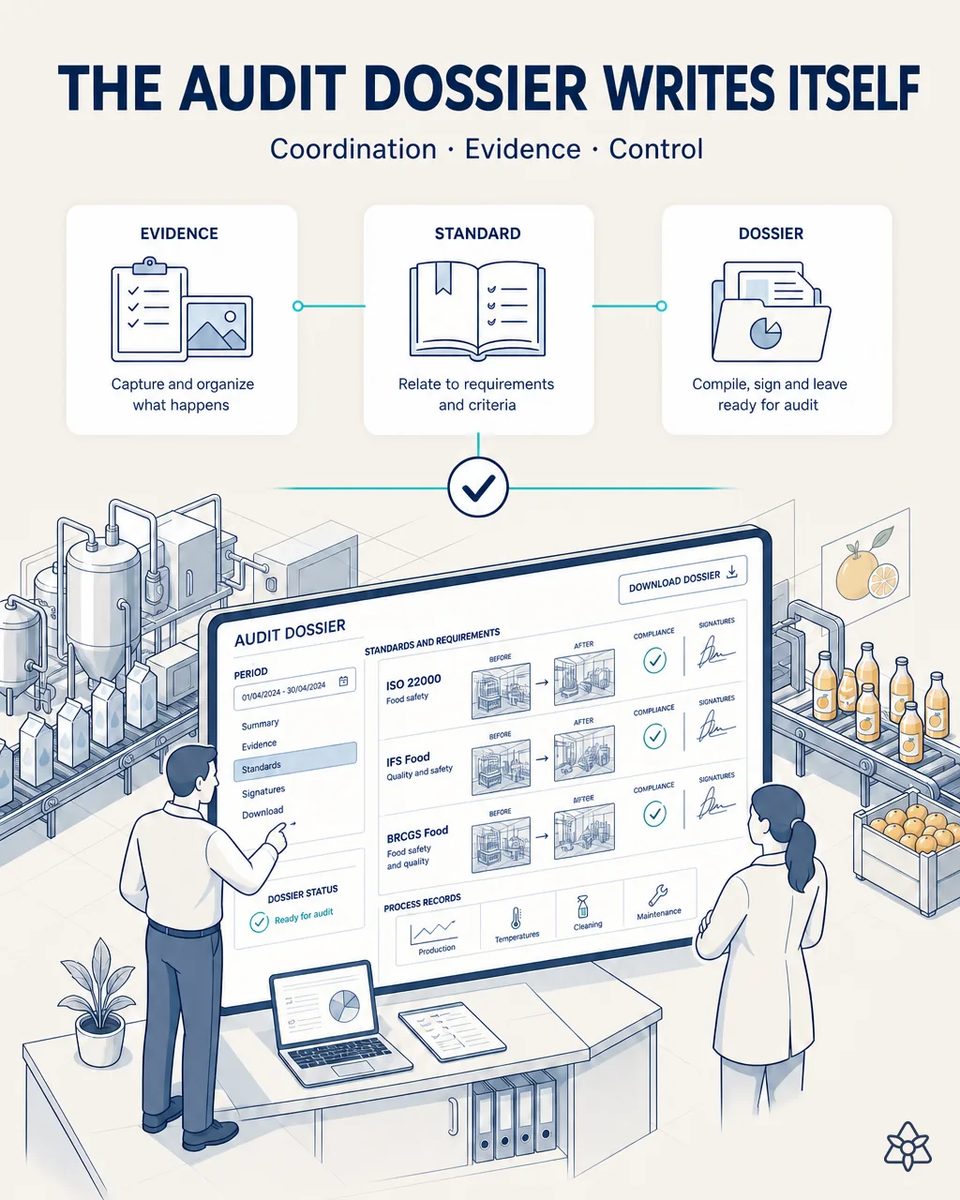
Every critical changeover generates its dossier at the moment it happens: before and after photos of each point, decision log, who signed, with what data in front of them and at what time. The most useful side effect is that documentary gaps stop being discovered on audit day and start being visible — and fixable — the same day they occur.
- Agents takes what Connect captured: startup sheet, tanker release, lab analysis, goods receipt, coding confirmation.
- And what Edge observed: seal evidence per batch, critical changeover validation images.
- It organizes them by the requirements of each certifying standard, so the same fact is presented the way one standard asks for it and the way another one does, without duplicating the work.
- Every critical changeover generates its dossier as it happens: before and after photos of each point, decision log, who signed, with what data in front of them and at what time.
- The auditor opens a web view, picks a period, a batch or a requirement, and downloads the evidence pack.
The most useful side effect: documentary gaps stop being discovered on audit day and start being visible — and fixable — the same day they occur.
Today's preparation versus the permanent dossier
| Aspect | Today | With iLEAN Agents |
|---|---|---|
| Preparation per audit | 1-2 weeks of reconstruction | A dossier available continuously |
| For each certifying standard | The same evidence, rebuilt again | The same fact, presented the way each one asks |
| Where the evidence lives | Folders, spreadsheets, binders | One web view: pick a period, a batch or a requirement |
| A documentary gap | Found in front of the inspector | Visible and fixable the day it occurs |
| The critical changeover | Signed, nothing else | Its own dossier, photos and log included |
| What the auditor does | Waits while someone finds the paperwork | Filters and downloads the evidence pack |
from 1 to 2 weeks of reconstruction per audit, to a dossier available continuously. From "we'll go find the paperwork", to "pick a period". From non-conformities for documentary gaps discovered in front of the inspector, to gaps visible and correctable within the day.
Estimated impact — to validate with your own numbers.
The block below is an estimate to be validated against your plant's actual data. We put it forward so the committee has an order of magnitude; we refine it during the assessment.
- Estimated recovery of 1 to 2 weeks a year of quality people's time per audited standard.
- Estimated payback 5-10 months counting freed hours alone.
- At a plant with a Grade A re-inspection plus several scheme audits a year, the saving multiplies by the number of standards.
- The real value — protecting the continuity of a certification that opens an entire market — does not fit into a payback.
estimated recovery of 1 to 2 weeks a year of quality people's time per audited standard, with payback of 5 to 10 months counting freed hours alone. *Estimate to validate.* The real value — protecting the continuity of a certification that opens an entire market — does not fit into a payback.
And the fair question from the production manager
«Isn't this just another document manager?» — the difference is direction. A document manager stores what somebody decides to upload, after the fact, and inherits the same gaps. Here the dossier closes the instant the tanker is released, the line starts or the changeover is verified, because the evidence was captured at that moment by Connect and Edge. Agents does not create evidence; it organizes, for whichever standard asks, what already exists — and mapping a fact to a requirement is an anchored task, where the best models drop below 1.5% error [1], with the quality manager reviewing the pack before it goes out.
[1] OpenAI paper "Why Language Models Hallucinate", 2025 — on the reliability of AI in anchored tasks.
What people ask about the audit evidence pack
Does one dossier serve the re-inspection and the scheme audits?
Yes, and that is the point: the evidence is the same, what changes is the requirement it is indexed against. That is exactly the work that gets repeated in full for each auditor today.
What does it draw on?
What Connect captured — startup sheet, tanker release, lab analysis, goods receipt, coding confirmation — and what Edge observed: seal evidence per batch and changeover validation images. The more of those cases are deployed, the fuller the dossier.
Does it warn about a missing piece of evidence?
Yes, and it is the function with the most value: it detects that the evidence for a critical event is missing when it should have been generated, not on the inspector's day.
Does the inspector get into our systems?
No. They access a web view scoped to the period and scope of their visit, pick a period, a batch or a requirement, and download the evidence pack.
What about the history from before?
It stays where it is. The dossier builds from day one forward; bringing in the paper history is optional and is usually not worth it. From the first re-inspection after deployment, the period the inspector asks for is already covered.
More cases from this series
- Digitizing the concentrate evaporator panel without touching the machineA camera reads degrees Brix, temperature and vacuum off the evaporator's isolated panel. No machine…
- Bulk orange and aseptic input intake, without typing into the ERPPhoto the delivery note, the weighbridge ticket and the pallet labels; one-tap validation and straight…
- The shift lead's knowledge stops dying at end of shiftAn earpiece and voice: the shift lead dictates what they see without breaking stride, and gets support…
- Lab analysis reaches the ERP without anyone typing itiLEAN reads the lab sheet when it is saved, structures it and posts it to the ERP after validation. From…
- Milk collection alerts, read at second zeroThe carrier's message is cross-checked against the process plan and returns a concrete action, not a…
- The human gate sits before the silo, not after the complaintInhibitors, weighbridge, temperature and freezing point on one bay screen. The human signs and only then…
Tell us how many audits you go through a year and how many weeks each one costs.
We work on your plant's real data, not ours. Assessment with no commitment.
Request estimated ROI within 48h ‹ See all cases of dairy and citrus See food industry