The human gate sits before the silo, not after the complaint
Discharging a tanker of milk containing antibiotic residue does not contaminate one tanker: it contaminates the whole silo and takes half a shift of product with it. It is the highest-leverage decision in the plant and today it is made with a sheet of paper and a stopwatch. With the Connect tablet, the bay supervisor sees everything iLEAN has just captured about that tanker on one screen and releases or rejects with two taps. Only then does the data cross into central memory and the ERP.
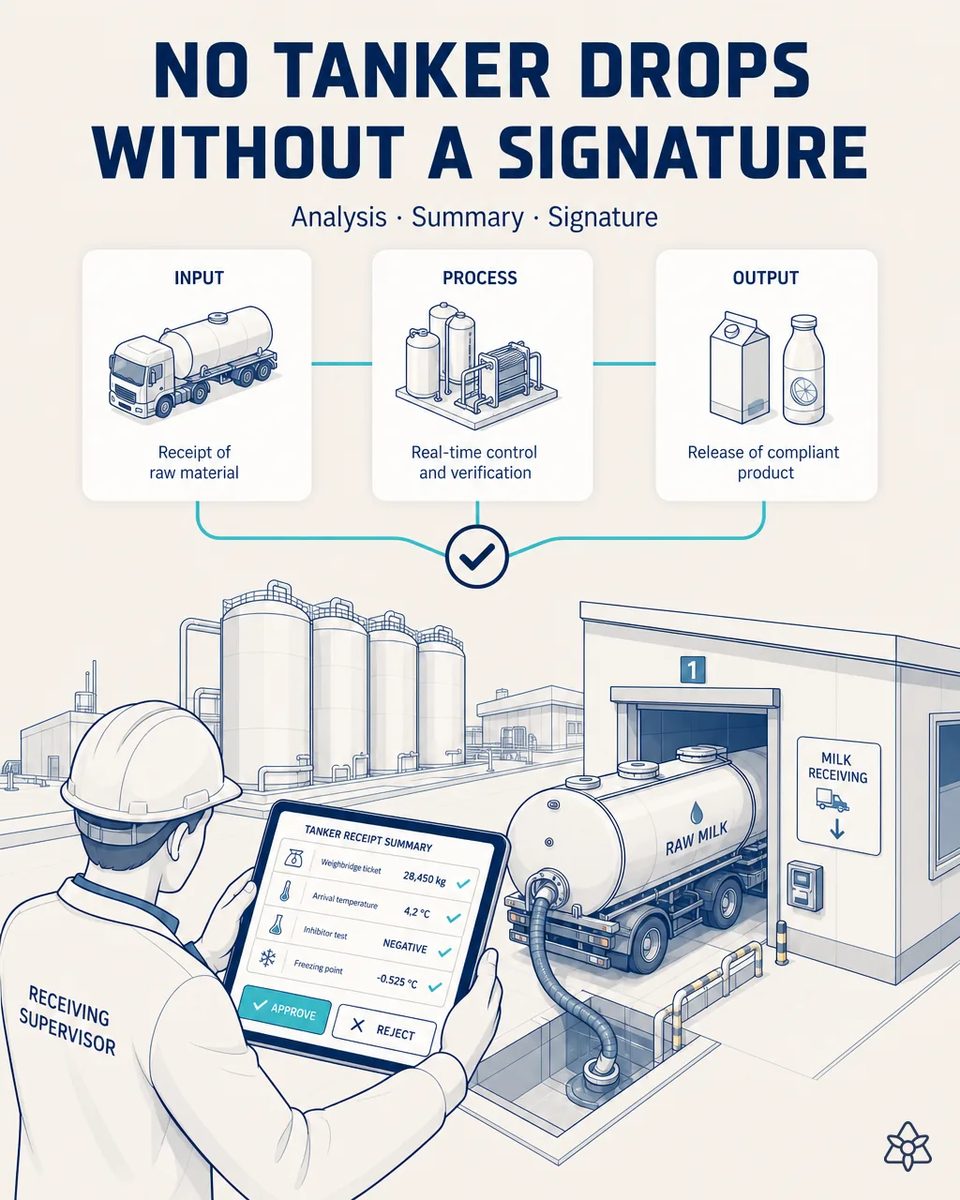
The highest-leverage decision in the plant is made with a sheet of paper and a stopwatch.
Between the inhibitor test, the weighbridge ticket, the arrival temperature and the rapid analysis there are four separate records, and none of them talks to the others. The receiving supervisor combines them mentally, under time pressure, with the driver waiting and another tanker behind. The decision is made well because the supervisor is good, not because the system makes it easy. And on the day it goes wrong, the cost is not one tanker: it is the whole silo plus all the product that already left it before anyone noticed. There is also an uncomfortable asymmetry: when the decision goes right, no record survives of why it was made. Months later, if someone asks why that particular tanker was accepted, the honest answer is that nobody knows.
- Between the inhibitor test, the weighbridge ticket, the arrival temperature and the rapid analysis there are four separate records, and none of them talks to the others. The supervisor combines them mentally, under time pressure, with the driver waiting and another tanker behind.
- The decision goes right because the supervisor is good, not because the system makes it easy.
- On the day it goes wrong, the cost is not one tanker: a tanker with antibiotic residue contaminates the whole silo and takes half a shift of product with it — plus whatever already left the silo before anyone noticed.
- And when it goes right, no record survives of why. Months later, if someone asks why that tanker was accepted, the honest answer is that nobody knows.
Connect with early human verification — two taps at the bay, before the silo.
Connect in "early human verification" mode, the mode that defines the difference between iLEAN and an autonomous AI. The flow:
It is the piece that guarantees the master data is not contaminated and that every tanker has a responsible person by name. The human gate is neither removed nor automated: the friction is removed and context is added. Without it, the other eleven do not get approved, because nobody signs off on AI writing into the ERP a release that decides what goes into a silo.
- Connect captures through all four of its modes at once: photo of the weighbridge ticket and the test strip, reading from the rapid analysis unit, parsing of the lab's email, and the supervisor's own voice.
- Everything consolidates onto a single decision screen on the bay's industrial tablet: origin, route, liters, arrival temperature, inhibitors, freezing point, fat and protein, and that farmer's history.
- The supervisor validates with one tap, or flags a rejection with its reason.
- Only after that signature does the data cross into central memory and generate the ERP entry. No signature, no discharge, no data.
- Who signed, when, and with what data in front of them is recorded.
The human gate is neither removed nor automated: the friction is removed and context is added. Humans in command, literally.
Today's release versus the signed release
| Aspect | Today | With iLEAN |
|---|---|---|
| Records per tanker | Four, disconnected | One screen |
| Inhibitors, freezing point, fat and protein | Combined in the supervisor's head | Consolidated with that farmer's history |
| The release decision | Made from memory, under pressure | Two taps on the bay tablet |
| What crosses into the ERP | Whatever gets typed later | Only what was signed, after the signature |
| Why that tanker was accepted | Nobody knows | Who, when, and with what data in front of them |
| Driver waiting | Demurrage | Minutes |
from four disconnected records and a decision made from memory, to one screen, one signature and full traceability of the reasoning. From "we don't know why that tanker was accepted", to a log with who, when and on what basis.
Estimated impact — to validate with your own numbers.
The block below is an estimate to be validated against your plant's actual data. We put it forward so the committee has an order of magnitude; we refine it during the assessment.
- Estimated payback 3-6 months, counting only bay time and reduced hauler demurrage.
- The dominant value is not productivity, it is risk: every release is signed with its evidence attached.
- The argument is asymmetric: a single contaminated silo avoided pays for the entire rollout several times over.
- And the record of the reasoning exists for the tankers that were accepted as well as the ones that were rejected, which is what an inspector asks for.
estimated payback 3 to 6 months counting only bay time and reduced carrier demurrage. *Estimate to validate.* The real argument is asymmetric: a single contaminated silo avoided pays for the entire rollout several times over.
And the fair question from the production manager
«If a person signs in the end, what is the AI saving?» — the work is not in deciding, it is in assembling. Today the supervisor gathers the weighbridge ticket, the test strip, the rapid analysis and the lab's email in their head with a driver waiting. Reading a test strip or a weighbridge ticket is an anchored task, where the best models drop below 1.5% error [1], and the summary reaches the tablet assembled: the supervisor confirms or corrects, and every correction is stored with its author.
[1] OpenAI paper "Why Language Models Hallucinate", 2025 — on the reliability of AI in anchored tasks.
What people ask about the signed tanker release
How does iLEAN capture four different records at once?
Through all four Connect modes at the same time: photo of the weighbridge ticket and the test strip, reading from the rapid analysis unit, parsing of the lab's email and the supervisor's own voice. Everything lands on the same decision screen.
Can the AI release a tanker on its own?
No, and it is not a setting: it is the architecture. No signature, no discharge, no data. Nothing crosses into central memory or the ERP until the supervisor has signed.
What if the supervisor rejects the tanker?
They flag the rejection with its reason in the same two taps. The rejection, the data it was based on and the farmer it came from are stored, which is what makes the farmer's history useful next time.
Does it slow down the bay when two tankers are queued?
It speeds it up. The supervisor no longer walks between the weighbridge office, the lab and the bay to gather the records: they arrive assembled and the release takes seconds.
Is this mandatory before deploying the other cases?
In practice, yes. It is the case that makes the rest approvable, because it guarantees that nothing enters the ERP without a named person having seen it and signed. It is also the one the board understands fastest, because everyone knows what a contaminated silo costs.
More cases from this series
- Audit evidence exists before the inspector asks for itEvery critical changeover generates its dossier with before and after photos, log and signature, ordered…
- Digitizing the concentrate evaporator panel without touching the machineA camera reads degrees Brix, temperature and vacuum off the evaporator's isolated panel. No machine…
- Bulk orange and aseptic input intake, without typing into the ERPPhoto the delivery note, the weighbridge ticket and the pallet labels; one-tap validation and straight…
- The shift lead's knowledge stops dying at end of shiftAn earpiece and voice: the shift lead dictates what they see without breaking stride, and gets support…
- Lab analysis reaches the ERP without anyone typing itiLEAN reads the lab sheet when it is saved, structures it and posts it to the ERP after validation. From…
- Milk collection alerts, read at second zeroThe carrier's message is cross-checked against the process plan and returns a concrete action, not a…
Tell us what a contaminated silo costs in your plant — that is the floor of the ROI.
We work on your plant's real data, not ours. Assessment with no commitment.
Request estimated ROI within 48h ‹ See all cases of dairy and citrus See food industry