Dairy batch recall with AI — a recall done right is measured in minutes, not hours.
A dairy batch recall done right is measured in minutes: locate the batch, identify where it is, notify the authority. iLEAN covers all three steps by cross-referencing your MES, your delivery notes, your distributors' EDI messages and retailer data. And it drafts the AESAN/RASFF form with the fields already filled in. The quality manager signs — the agent sends nothing without a human signature.
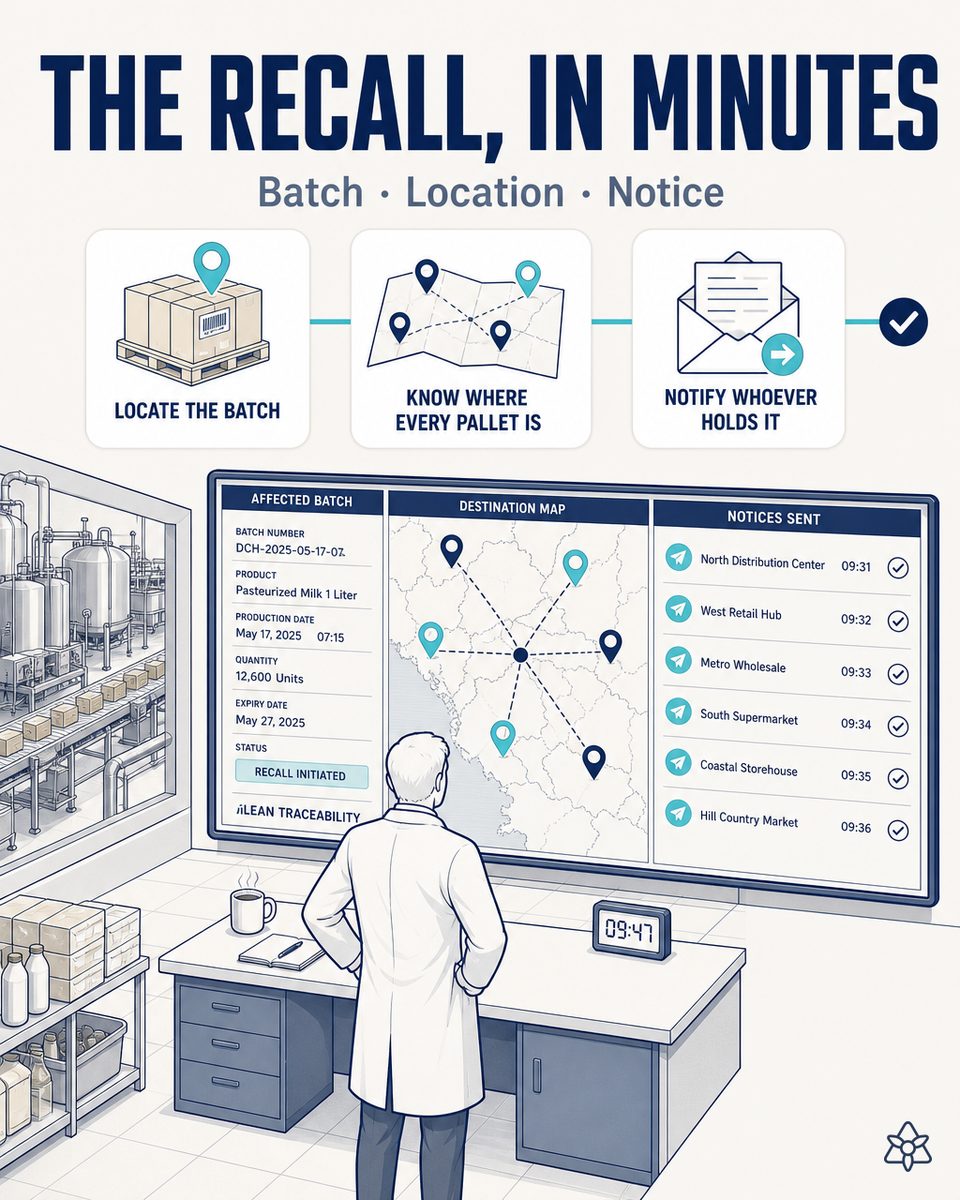
The clock starts with the phone call — and the data sits in six places.
A recall starts with a call from a distributor, an email from the food safety authority, or an internal lab result that comes back out of specification. From that minute on, the quality manager has to reconstruct three answers from data that is almost never in the same place:
- Which batch exactly? — the MES gives you the batch, but the recipe may have changed mid-run, and that lives in a spreadsheet kept by the shift lead.
- Where is it? — the shipping delivery notes are in the ERP, the distributors' EDI messages are in the logistics system, and store-level traceability is only held by the chains that send reporting (not all of them do).
- Which authority, and how do we notify? — AESAN if it is domestic, RASFF if it is an EU export, FDA if it is going to the US. Each with its own form and its own deadlines.
Meanwhile, the clock runs. Every hour the batch stays on the market is product that gets sold, reaches the consumer, and multiplies both the cost and the brand damage. The classic approach — spreadsheets, phone calls, copy-pasting between five screens — works, but it takes hours. And in a recall, hours mean stores.
iLEAN does not replace your ERP or your MES — it seals the crack between them and the official form.
The problem is not a lack of data: it is data in islands that nobody cross-references in time at the moment of truth. iLEAN acts as the putty that fills those gaps, without asking you to change your ERP, your MES, or the way you work with distributors and retailers.
Tracer (inside Connect) follows the batch from one system to the next. The agent cross-references it with the distribution map and prepares the dossier. The person signs — a recall never goes out on its own.
The iLEAN pieces applied to a dairy batch recall:
- Connect — captures the data scattered across the plant: the recipe from the MES, delivery notes from the ERP, distributor EDI messages, customer incident emails, transcribed calls from the authority. And it also captures what arrives from outside: the distributor's email at 10 p.m. with the alert enters at second zero, not at 9 a.m. the next day when somebody forwards it.
- Recall agent — receives the alert (through whatever channel it comes in), locates the batch, identifies the affected distribution points, prepares the dossier by destination and fills in the draft of the AESAN form or the RASFF submission. If exports are involved, it also drafts the communication to the destination country's authority. The agent proposes — the quality manager validates and signs.
- Tracer — downstream batch traceability, maintained continuously. When the alert lands, the data is already built; it is not reconstructed after the fact.
Manual recall vs. recall with iLEAN
| Aspect | Manual recall (spreadsheets + phone calls) | With iLEAN Connect + Agent + Tracer |
|---|---|---|
| Time from alert to batch identified | Hours — piecing it together across ERP, MES and spreadsheets | Minutes — the data is already cross-referenced continuously |
| Identifying distribution points | Call logistics, wait for an answer | Pallet-to-store map prepared in advance |
| Official AESAN/RASFF form | Filled in by hand, copy and paste | Automatic draft, the quality manager signs |
| Communication to retailers | Email by email, one chain at a time | Sent in parallel through each chain's preferred channel |
| Extra product recalled out of caution | High — “just in case” | Low — the batch and its reach are tightly bounded |
| Dossier for the IFS/BRC auditor | Rebuilt by hand weeks later | Generated on the spot, with the full timeline |
Impact estimate for your plant — to be validated with your numbers.
The block below is an estimate to be validated with the specific data of your operation. We put it forward so the committee has an order of magnitude; we refine it during the diagnostic, going through your historical recalls and your distribution map.
- Mid-sized dairy plant (cheese, yogurt or liquid milk) with 50-200 SKUs, 3-8 retail chains, a mix of domestic and EU export, 1-3 documented recalls a year.
- Connect + recall agent deployment (integration with ERP/MES + reading distributor EDI + AESAN/RASFF template). First value expected within a few weeks: the first recall drill with the agent live drops from hours to minutes.
- Indicative payback between 4 and 9 months, depending on the historical frequency of recalls, the number of chains you distribute to and how much product gets pulled out of caution.
- Expected reduction in recall handling time of ≥ 30% after deployment, plus a reduction in product recalled out of an abundance of caution thanks to fine-grained batch traceability.
And the quality director's reasonable doubt
“What if the agent hallucinates and sends the authority a form with the wrong data?” — hallucination is a problem of free generation, not of anchored tasks. Filling in a form with data that is already in your MES and ERP is exactly the anchored task in which the best models brought error below 1.5% [1]. And even so, the agent never sends on its own: it prepares the draft, the quality manager reviews and signs. The three safety rings exist precisely for this: communicating with an authority is a critical operation, and only a person executes it.
[1] OpenAI paper “Why Language Models Hallucinate”, 2025 — on the reliability of AI in anchored tasks.
What people ask about dairy batch recalls with AI
What does the food safety authority require in a dairy product recall?
When a food business detects or is alerted that a batch already on the market may compromise food safety, Regulation (EC) 178/2002 and the rules of the national food safety authority (AESAN in Spain) require three immediate actions: (1) identify the affected batch and every distribution point it reached, (2) withdraw it from the market or, if it already reached the consumer, recall it, and (3) notify the competent authority (AESAN in Spain; for exports, the authority of the destination country via RASFF). The obligation is immediate — and being able to prove downstream traceability from batch to point of sale is what separates a clean recall from a crisis.
How far downstream can iLEAN trace a dairy batch?
As far as your data goes — and that is the point. iLEAN cross-references the plant's MES/ERP (which batch was made when, with which raw milk, with which culture), the shipping records (which truck left with which pallet for which customer), your distributors' EDI messages (which order reached which logistics center) and, where available, retailer data (which store received which pallet and what was sold). If one of those layers lives in a forgotten spreadsheet or in an email from the carrier, Connect captures it just the same. The result: within minutes you know which specific stores hold the batch and in what quantity.
Does iLEAN generate the official notification form automatically?
Yes — and it is the piece that saves the most time. The recall agent prepares the draft of the AESAN form (or the corresponding RASFF submission) with the fields already filled in from plant data: product identification, batch, production and expiry dates, quantity, distribution, reason. The quality manager reviews and signs — the agent sends nothing without a human signature. But the time between the alert and the submission drops from hours to minutes, which is exactly what the authority measures when it audits the recall.
What about batches already on the supermarket shelf?
That is the most painful part of a recall and the worst-handled without a system: pinpointing exactly which stores received the batch and reaching each chain to pull it off the shelf before it gets to the consumer. iLEAN cross-references your shipping delivery note with the available retailer EDI/data, identifies the affected stores and prepares the mass communication through whichever channel each chain uses (email, reverse EDI, supplier portal). If the chain has a recall scanner, it sends the EAN + batch list. If not, the per-store dossier.
How many recalls a year make this system worth the investment?
The right question is not how many recalls you run, but what the worst one you could face would cost. A single mishandled mass recall (misidentified batch, late communication to retailers, a fine from the authority, brand damage on social media) costs more than years of running the system. As a conservative reference, a dairy plant with 2-3 documented recalls a year usually pays back the investment in under a year purely from the time the quality team saves and from the reduction in product recalled out of an abundance of caution (when you do not know exactly which batch it is, you pull too much).
More cases from this series
- Audit evidence exists before the inspector asks for itEvery critical changeover generates its dossier with before and after photos, log and signature, ordered…
- Digitizing the concentrate evaporator panel without touching the machineA camera reads degrees Brix, temperature and vacuum off the evaporator's isolated panel. No machine…
- Bulk orange and aseptic input intake, without typing into the ERPPhoto the delivery note, the weighbridge ticket and the pallet labels; one-tap validation and straight…
- The shift lead's knowledge stops dying at end of shiftAn earpiece and voice: the shift lead dictates what they see without breaking stride, and gets support…
- Lab analysis reaches the ERP without anyone typing itiLEAN reads the lab sheet when it is saved, structures it and posts it to the ERP after validation. From…
- Milk collection alerts, read at second zeroThe carrier's message is cross-checked against the process plan and returns a concrete action, not a…
Tell us your case and in 48h we'll send you the estimated ROI of this AI project for your recall system.
We work on your plant's real data, not ours. Diagnostic with no commitment.
Request estimated ROI in 48h See food industry