Rice whitening with AI — between leaving grain dark and breaking whole grain there is a very narrow band. That band is money.
A rice mill's yield is played out between two extremes — ask too little of the whitening and leave the dark grain the packer rejects, ask too much and break whole grain down to brokens prices. Today that band is read by the veteran's eye. iLEAN captures that eye, cross-checks it with the whitener console and proposes the fine setting to the shift lead — who signs.
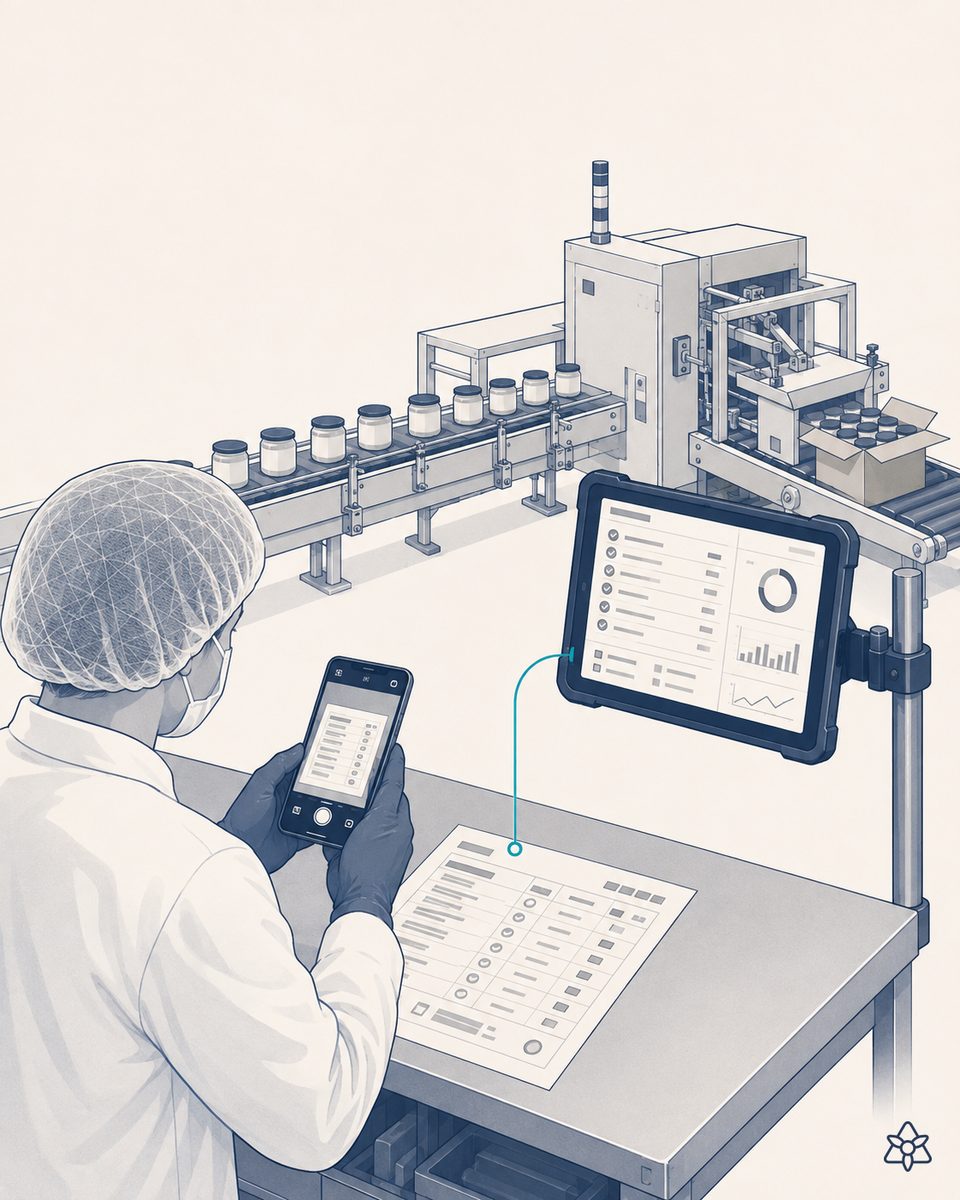
The grain changes and the whitener settings are inherited from the previous shift.
A rice mill's yield is decided in a very fine band: whiten just enough to get the white grain the packer accepts, without going far enough to break the whole grain and downgrade it to brokens. The price gap between whole rice and broken rice is significant, and every season it is measured over hundreds of thousands of kilos.
And it drifts because three things change without anyone cross-checking them in time:
- The grain in the new lot — harvest moisture, variety, age of the stored rice. The operator reads it by eye when the line starts up.
- The whitener and polisher settings — pressure, speed, feed rate, alarms. On the console, a screen the shift lead looks at from time to time.
- The actual whole vs. broken yield — the lab measures it at the end of the shift, when the silo is already loaded and the setting has been held for 8 hours.
The veteran operator covers that coordination with his eye: "this one comes in wet, lower the pressure". But the night shift is shorter on staff, handovers do not pass on the whole read, and the setting gets inherited. By the time brokens climb 3 points, several tons of discounted basmati have already gone through. The classic system works as long as the veteran is there. Without him, it falls over — and retirement is only a matter of time.
iLEAN does not replace the veteran operator — it captures his eye and keeps it in the plant forever.
The problem with whitening control is not a lack of technology: it is knowledge that lives in people and leaves with them. iLEAN acts as the putty that fills the gap between what the SCADA measures and what the veteran knows how to read, without asking you to change the whitener, the polisher or the lab.
Edge watches the grain at the polisher outfeed. Connect reads the console, the incoming lot and the lab at second zero. The agent correlates against the veteran's eye and proposes the adjustment to the operator. The person signs — never the other way around.
The three iLEAN pieces applied to rice whitening control:
- Edge — a terminal with machine vision (CNN) over the belt at the outfeed of the polisher or the optical sorter. It reads whiteness, percentage of brokens and size dispersion in real time, without touching the line. If brokens climb above the threshold declared for the batch or whiteness drops out of the commercial range, it fires an alert to the operator and proposes a pressure adjustment. It works without a network: if the plant loses its WiFi, Edge keeps sorting.
- Connect — captures the adjustments the operator makes on the console, the voice notes he dictates into the earpiece ("this grain looks like the late harvest"), the delivery note of the lot that starts the shift. And it also captures what arrives from outside (a new customer's spec by email, a complaint from the packer by WhatsApp) at second zero.
- Agent — cross-checks the Edge reading, the console settings, the lot's delivery note and the history of previous seasons. It correlates how the veteran adjusted for each type of grain and proposes the fine setting to the operator on duty. The operator validates and signs; the whitener does not adjust itself.
Classic control vs. cross-checked control with iLEAN
| Aspect | Classic control (the veteran's eye) | With iLEAN Edge + Connect + Agent |
|---|---|---|
| Reading the new grain | Veteran's eye at the start of the shift | Captured by Edge + cross-checked with the delivery note |
| Whitener setting | Memory + intuition, varies by shift | Proposed by the agent, validated by the operator |
| Whole / broken yield | Analysis at the end of the shift, too late | Measured in line, alarm as soon as it drops |
| Night shift | Inherits settings without a fresh read | Same assistant as the day shift |
| Veteran's retirement | The eye is lost, yield falls | His judgment stays captured in the plant |
| Season close-out | Plant manager's Excel sheet, weeks | Automatic dossier with yield by lot |
Impact estimate for your plant — to be validated with your numbers.
The block below is an estimate to be validated with the specific data of your plant. We put it forward so the committee has an order of magnitude; we refine it during the diagnostic.
- Mid-sized rice mill with 2 whiteners + polisher + optical sorter, a mix of long and round varieties, export + private label.
- Edge pilot at the polisher outfeed (vision camera + integration with the whitener console and ERP). First value expected within a few weeks.
- Indicative payback between 4 and 9 months, depending on the historical percentage of brokens per season and the €/kg spread between whole and broken rice in your market.
- Hard lever: ≥ 30% reduction in avoidable breakage losses on shifts without the veteran on duty. Each point of head rice yield over the season pays for the pilot.
And the plant manager's reasonable doubt
"What if the agent proposes a pressure that breaks more grain and I ruin the shift?" — hallucination is a problem of free generation, not of anchored tasks. In tasks where the AI correlates what is already measured (the Edge reading, the console setting, the lot history), the best models brought error below 1.5% [1]. And even so, the adjustment is not decided by the AI: the agent proposes, the operator signs. The three safety rings exist precisely for this.
[1] OpenAI paper "Why Language Models Hallucinate", 2025 — on the reliability of AI in source-anchored tasks.
What people ask about whitening control at a rice mill
Which parameters drive yield at a rice mill?
Three dominate: head rice yield (the share of brown rice that comes out as commercial whole grain versus broken grains — the €/kg price gap is large), degree of whiteness (measured by colorimeter or by vision, with targets by market: white rice, parboiled, semi-brown) and residual bran content after whitening and polishing. The veteran operator moves between two extremes: whiten too little and leave dark grain the packer rejects, whiten too much and break whole grain down to brokens prices. That band is what you want to capture.
Why does yield drift between shifts at a rice mill?
Because the whitener and the polisher work on grain that changes lot by lot: harvest moisture, variety, age of the rice, pre-existing breakage. The pressure, throughput speed and fine settings are set by the veteran operator "by eye" from the grain he sees coming out. On the night shift, with fewer people, the settings are inherited from the previous shift, and when the grain changes, head rice yield drops without anyone seeing it until the lab the next morning.
Can iLEAN Edge measure whiteness and breakage in line without stopping the line?
Yes. Edge is a terminal with machine vision (CNN) mounted over the outfeed belt of the polisher or the sorter. It reads grain whiteness, percentage of brokens and size dispersion in real time, without touching the line. It cross-checks with the whitener and polisher console via Connect, and if head rice yield drops or whiteness drifts out of the commercial range, it proposes the pressure / speed adjustment to the operator before the batch fills the silo.
How do you capture the eye of the veteran operator who is about to retire?
This is one of iLEAN's strongest levers at a rice mill: the veteran operator knows how to read the grain ("this one comes from a wet field, lower the pressure"). Connect captures his decisions — the adjustments he makes on the console, the voice notes he dictates into the earpiece, the read of the grain he sees with his own eyes — and the agent correlates those adjustments with the subsequent yield. The knowledge that was going to retire with him becomes a permanent capability of the plant. Assist and simplify, not replace.
How much does a rice whitening control pilot cost?
The order of magnitude of an Edge pilot on a polisher or sorter outfeed falls in the usual range of any Edge pilot in a grain plant: an initial investment covering terminal + camera + integration with the whitener console and the ERP, plus an annual license. A reasonable payback sits between 4 and 9 months, conservatively — the hard lever is gaining 2-3 points of head rice yield over a season's volume, which in rice is hundreds of thousands of euros. We ask for your season's data and send you the estimated ROI in 48h with your numbers.
Flour mill control with AI → · Sunflower oil refining with AI →
More cases in food
- Real AI cases in the food industryReal AI cases in the food industry: dairy, meat, beverages, frozen foods and ingredients, plus labeling,…
- AI recipe and dosing control — the out-of-tolerance weighing is caught at second zero, not at month-end.iLEAN checks every weighing against the work order's active recipe at second zero: operator alert,…
- Returns and reverse logistics with AI — every rejected pallet should close a root cause, not open a limbo.iLEAN reads the buyer's email, the credit note and the pallet photos, links them to the batch and the…
- Coffee roasting control with AI — so Friday's batch comes out like Monday's.iLEAN captures the roast curve, bean color and development so the master roaster no longer depends on…
- Sausage drying room control with AI — a piece that drifts is not recovered, it is anticipated.iLEAN cross-checks curing-chamber humidity, temperature and piece weight with the panel and the master…
- Shellfish cold chain control with AI — from boat to shelf, no jumps in the curve.How iLEAN cross-checks dock, transport and cold room with vision and agents to keep the shellfish cold…
Tell us your case and in 48h we'll send you the estimated ROI of this AI project for your rice mill.
We work on your plant's real data, not ours. Diagnostic with no commitment.
Request estimated ROI in 48h See food industry