Coffee roasting control with AI — so Friday's batch comes out like Monday's.
Coffee roasting is a curve — temperature, time, first crack, color — that today lives in the master roaster's head and in fragile Excel sheets. iLEAN Edge reads it in line and links it to the batch, without replacing the roaster: it amplifies them, and leaves consistency available for the second shift.
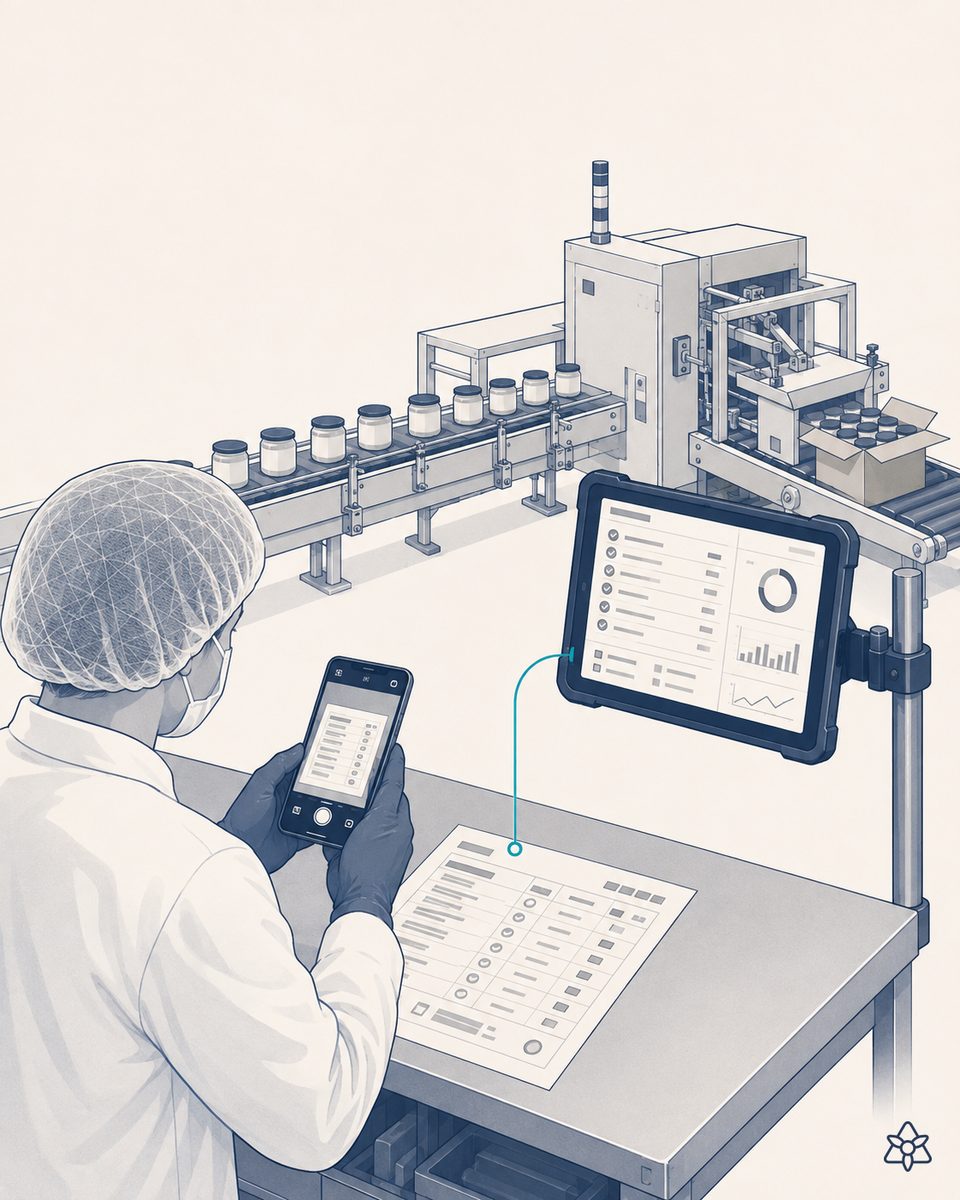
The roast profile lives in the master's head and in an Excel sheet.
An industrial coffee roaster has four simultaneous sources of truth that the master roaster watches at once:
- The temperature curve — bean and air thermocouples, usually in Cropster, Artisan or the manufacturer's local recorder.
- First crack — a sound and a texture the master recognizes, and a margin of seconds to decide the discharge.
- Bean color — measured with Agtron/SCA scale at the end, sometimes only by eye.
- The target profile — written in the master's Excel, on a recipe sheet, or only in their head.
When the master is there, everything runs fine. When they are away for a week, or the second roaster steps in, or the origin of a bag changes — batch-to-batch dispersion goes up. The approval cupping notices before the customer does, and every bag that ships off-profile is a scratch on the brand. The classic system (judgment + Excel + eye) works 95% of the time; that 5% is the barista who comes back and says “this one doesn't taste the same”.
iLEAN does not replace the master — it captures their judgment and keeps it available 24/7.
Roast control is not a problem of missing data: the curve is in the thermocouple, the color is measured at the end, the master hears the first crack. It is a problem of data living on four separate islands that only cross paths inside one person's head. iLEAN acts as the putty that joins the curve, the color, the sound and the recipe — and makes them available to any roaster on the shift, not just the master.
Edge watches the color in the cooler. Connect reads the curve whether it comes from Cropster or a legacy thermocouple. The agent checks against the target profile and warns if the discharge is drifting too far. The master signs — always the master signs.
The three iLEAN pieces applied to roasting:
- Edge — a camera with a CNN trained for bean color against the Agtron/SCA scale. It reads the batch in the cooler or at discharge and flags the batch's drift in the moment, not after the fact. Works without a network.
- Connect — captures the temperature curve whether it comes from a modern Cropster or an old thermocouple, reads the roaster's panel with OCR if there is no interface, and lets the master speak into the earpiece when marking first crack. Everything goes into the batch.
- Agent — cross-checks curve, color, first crack and target recipe; keeps the per-batch dossier with every event timestamped and tells the second roaster “the master usually discharges here when it comes in with this dispersion”. It does not decide the discharge: it proposes it to the human.
Roasting by judgment vs. roasting with iLEAN at your side
| Aspect | Master + Cropster + Excel | With iLEAN Edge + Connect + Agent |
|---|---|---|
| Temperature curve | Cropster/Artisan, one screen | Captured and linked to the batch by default |
| Final bean color | Agtron at the end, manual | Edge in line, batch by batch, with dispersion |
| First crack | The master's ear + stopwatch | Voice into the earpiece + cross-checked sensor, timestamp |
| When the master is away | Dispersion rises, cupping complains | Second roaster sees “how the master would do it” |
| Traceability by origin/harvest | Manual batch Excel | Automatic dossier with curve + color + recipe |
| Waste from over-roasting | Accepted as a fixed cost | Warning before discharge, measurable reduction |
Impact estimate for your plant — to be validated with your numbers.
The block below is an estimate to be validated with the specific data of your plant. We put it forward so the committee has an order of magnitude; we refine it during the diagnostic.
- 30-150 kg roaster, 4-8 active profiles, mix of single origin and blends, output at medium/dark roast.
- Edge pilot in the cooler + Connect on the curve + consistency agent. First value expected within a few weeks.
- Indicative payback between 4 and 9 months, depending on the current frequency of off-profile batches and the cost of re-roasting/waste.
- Hard levers: scrap from over-roasting cut ≥ 30%, batch-to-batch dispersion tightened, the ability to run two shifts without losing the profile when the master is away.
And the master roaster's reasonable doubt
“What if the AI starts telling me when to discharge and gets it wrong?” — it does not. The agent proposes, it does not decide. The discharge is always signed by the roaster. And the reliability of AI in anchored tasks (reading a color, comparing against a scale, marking an event) is below 1.5% error [1]. The three safety rings are there precisely so that critical operations are signed by a person.
[1] OpenAI paper “Why Language Models Hallucinate”, 2025 — on the reliability of AI in anchored tasks.
What people ask about coffee roasting control with AI
How does Edge read bean color in real time?
With a camera and a CNN trained to classify bean tone against an Agtron/SCA-type scale. The Edge terminal watches the beans inside the cooler or on the roaster's discharge belt, returns the batch's average color and the head-to-head dispersion. If the batch is drifting darker than planned, it warns before discharge — not three minutes later when there is no way back. It works without a network: if the plant loses WiFi, Edge keeps reading and saving locally.
What does it do with the first crack data?
First crack is the sacred point of the roast — between too light and too dark there are seconds. iLEAN cross-checks the temperature data, the ROR (rate of rise) curve and the sound picked up by the operator's earpiece to mark first crack as a batch event, with a timestamp. The master roaster decides when to discharge; the system just spares them from watching two screens and a stopwatch at the same time.
Does it replace the master roaster?
No. The master roaster is the piece nobody wants to lose — their judgment on when to charge, when to lower the gas, when to discharge is what makes Monday's batch come out like Friday's. iLEAN captures that judgment and makes it available as an objective reference: when the master is there, everything runs finer; when they are away for a week, the second roaster steps up to a panel that tells them “this profile is usually discharged here, this other one here”, with the master's own data. Assist and simplify, not replace.
Does it integrate with an old roaster without OPC-UA?
Yes. iLEAN Connect has three capture modes. (1) If the roaster is a Loring, Probat, Giesen or Diedrich with a modern interface, direct integration. (2) If it has an old isolated PLC, Connect hooks in through the thermocouple/recorder and extracts the data. (3) If it has nothing — the classic 1980s Probat — the operator photographs the panel every X minutes with a phone, or the earpiece takes the values by voice; the system digitizes them. The important part: it does not force you to change the machine.
Does it work for specialty coffee and for commercial coffee?
Yes, and the pain is different in each. In specialty, the pain is batch-to-batch consistency and fine traceability by origin so the approval cupping matches what goes into the bag. In commercial, the pain is roaster productivity and reducing waste from over-roasting in large batches. iLEAN covers both with the same architecture — the dominant piece changes: Edge + Agent in specialty (consistency and dossier), Connect + Agent in commercial (legacy integration and OEE).
More cases in food
- AI recipe and dosing control — the out-of-tolerance weighing is caught at second zero, not at month-end.iLEAN checks every weighing against the work order's active recipe at second zero: operator alert,…
- Returns and reverse logistics with AI — every rejected pallet should close a root cause, not open a limbo.iLEAN reads the buyer's email, the credit note and the pallet photos, links them to the batch and the…
- Rice whitening with AI — between leaving grain dark and breaking whole grain there is a very narrow band. That band is money.iLEAN cross-checks multispectral grain vision, whitener settings and live batches to optimize head rice…
- Sausage drying room control with AI — a piece that drifts is not recovered, it is anticipated.iLEAN cross-checks curing-chamber humidity, temperature and piece weight with the panel and the master…
- Shellfish cold chain control with AI — from boat to shelf, no jumps in the curve.How iLEAN cross-checks dock, transport and cold room with vision and agents to keep the shellfish cold…
- AI control of snack extrusion — the shape at the die rules, not the recipe in the spreadsheet.How iLEAN sees the snack's shape at the die exit and corrects the recipe before the oven — less scrap,…
Tell us your case and in 48h we'll send you the estimated ROI of this AI project for your roaster.
We work on your plant's real data, not ours. Diagnostic with no commitment.
Request estimated ROI in 48h See food industry