AI recipe and dosing control — the out-of-tolerance weighing is caught at second zero, not at month-end.
The recipe lives on paper or in Excel, and the weighing error surfaces months later, in accounting or in a complaint. iLEAN captures every weighing where it already happens and cross-checks it at second zero with the work order's active recipe: if it goes out of tolerance, the operator gets an alert and the dosing is held until a human signature. A per-batch dosing file, ready for IFS/BRC.
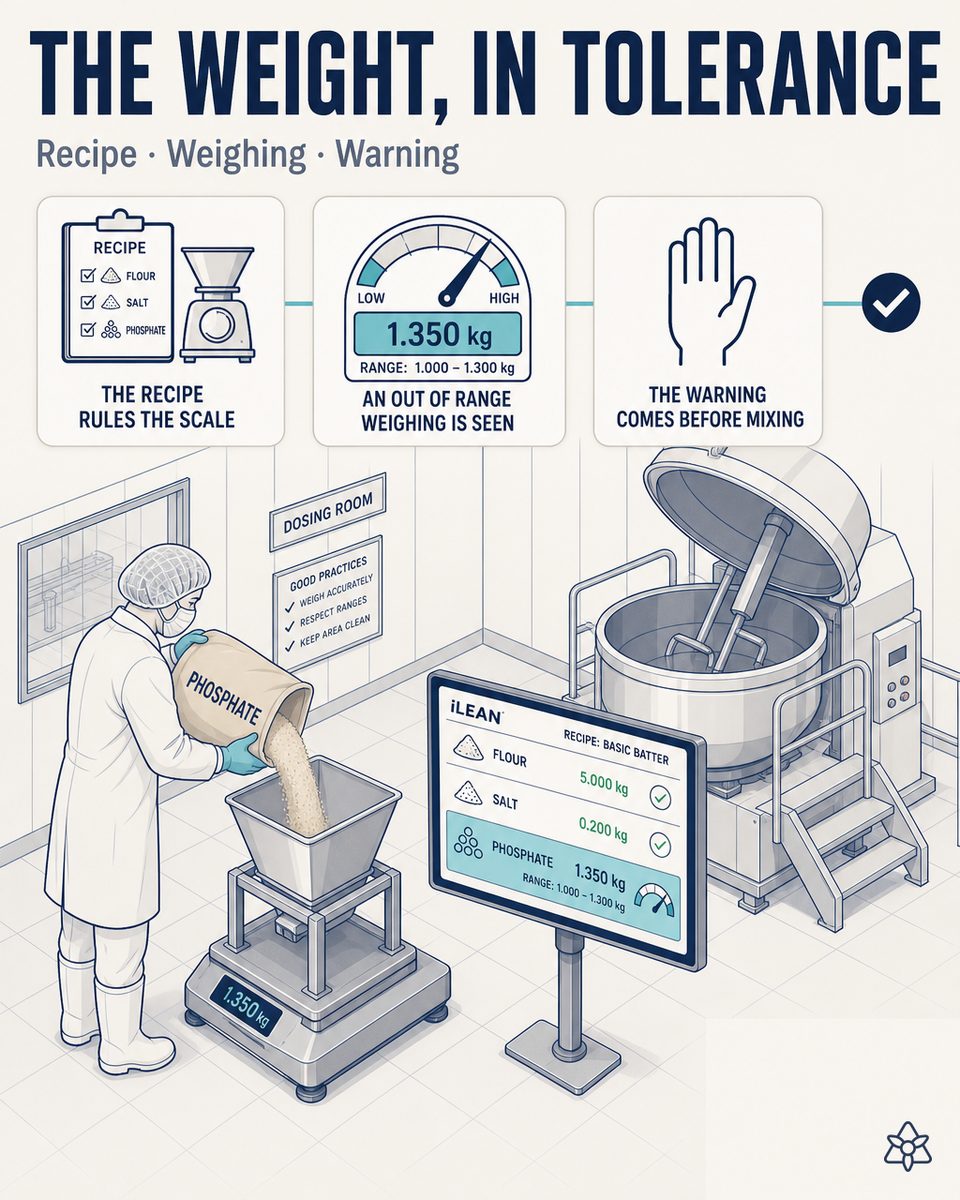
The weighing error is not seen when it happens — it is seen in the P&L or in the complaint.
In the dosing room the scene is almost always the same: the operator weighs major and minor ingredients against a printed recipe sheet — or against an Excel someone exported from the ERP three recipe versions ago. The scales do their job well; the problem is everything happening around the scale:
- The reference recipe is not the current one — R&D adjusted an ingredient's percentage last week, but the old sheet keeps circulating around the plant. Nobody does it wrong on purpose: there are simply two truths, and paper does not tell you which one has expired.
- Overdosing the expensive ingredient is invisible — weighing "a little over, just in case" is human and happens every day. Tenths of a percentage point per weighing that, multiplied across batches and months, are tons of protein concentrate, flavoring or any other high-priced ingredient given away to the product.
- The serious error is the wrong recipe — dosing against the neighboring work order, or against an old version of the recipe, can put an undeclared allergen into a batch whose label does not carry it. That is no longer an overrun: it is recall risk, a health alert and a very uncomfortable conversation with the retailer.
- The deviation is discovered late and far away — theoretical vs. actual consumption is reconciled at month-end in accounting. By then the batch has been sold, the shift does not remember and the root cause is unrecoverable. The complaint, if it comes, comes even later.
- Rebuilding the file for the auditor is archaeology — when the IFS/BRC audit asks for the dosing traceability of a batch, someone spends hours gathering pen-signed weighing sheets, delivery notes and loose records, hoping none is missing.
The classic system works the vast majority of the time. The remaining minority is what pays the silent overrun all year — and what, one day, becomes the batch with the undeclared allergen.
iLEAN does not change your scales or your ERP — it seals the gap between the weighing and the recipe.
The bottleneck is not weighing (the scales do that well); it is that the weighing lives in one island, the current recipe lives in another (the ERP) and the batch file lives in a third (folders, signed sheets, the supervisor's memory). None of them talks to the next at the moment it matters. iLEAN is the putty that joins all three — without asking you to change your ERP, MES, scales or the way the dosing room works.
Connect captures every weighing where it already happens. The Tracer agent cross-checks it at second zero with the work order's active recipe; if it goes out of tolerance, the operator gets an alert and the dosing is held until a human signature. The Writer agent archives the batch's dosing file. No signature, no mixing.
The iLEAN pieces applied to recipe and dosing control:
- Connect — captures the weighing wherever it comes from: direct integration with the modern scale that has a digital output, a photo of the display of the old scale that does not (machine vision that reads and validates the value), or the operator's voice in purely manual dosing. Critical plant information almost never arrives through an API; Connect brings it in at second zero, without anyone transcribing anything at the end of the shift.
- Tracer agent — cross-checks every weighing with the work order's active recipe in the ERP: correct ingredient, quantity within the tolerance quality defined, expected sequence. If the ingredient does not belong to the recipe or the quantity goes out of band, it fires the alert at the station and the JIDOKA hold: dosing stays stopped until a manager signs the exception or it is corrected. The wrong allergen is stopped before the mixer, not in the market.
- Writer agent — writes and archives the per-batch dosing file: each weighing with its evidence (scale data, photo or voice record), deviations, holds and signatures, chained to the work order and the batch. When the IFS/BRC audit arrives, the file opens as-is — nobody rebuilds anything.
The brain (Brain) that orchestrates the agents lives in Central; the critical data stays in the plant's ring 1, not in just any cloud (see the IRIS architecture and the three safety rings).
Dosing against paper/Excel vs. dosing with iLEAN
| Aspect | Manual weighing against paper/Excel | With iLEAN Connect + Tracer + Writer |
|---|---|---|
| Checking the weighing | At month-end, reconciling theoretical vs. actual consumption | At second zero, right at the weighing station |
| Reference recipe | Printed sheet or Excel — several versions circulating | The work order's active recipe in the ERP, always current |
| Out-of-tolerance weighing | Enters the mixer and is discovered late, if at all | Immediate alert + hold until a human signature (JIDOKA) |
| Overdosing the expensive ingredient | Invisible weighing by weighing; surfaces as accounting waste | Measured on every weighing and bounded by quality's tolerance |
| Ingredient from another recipe (allergen risk) | Depends on someone noticing in time | Detected and held before entering the mixer |
| Dosing file for IFS/BRC | Rebuilt from weighing sheets and delivery notes | Archived per batch with evidence and signatures, ready for the auditor |
Impact estimate for your plant — to be validated with your numbers.
The block below is an estimate to be validated with the specific data of your dosing room. It gives the committee an order of magnitude; we refine it during the diagnostic.
- Plant with 30-200 active recipes, dosing of majors and minors at several stations, scales from different generations (some with a digital output, some without) and the reference recipe on paper or in Excel.
- Deployment of Connect + Tracer/Writer agents integrated with your ERP/MES and your current scales — no hardware change. First value expected within a few weeks on a pilot station (for example, the minors room, where the allergens concentrate).
- Measurable reduction of overdosing of expensive ingredients from the first month of the pilot (estimate to be validated with your real consumption: the improvement band depends on your current average weighing deviation). Food safety design goal: zero batches with an undeclared allergen due to a recipe error, because the weighing that does not belong to the recipe is held before mixing.
- A per-batch dosing file ready for the auditor with no rebuilding — hours of documentary archaeology that disappear from every IFS/BRC audit and every complaint.
- Indicative payback between 4 and 9 months (estimate to be validated), depending on the cost of your major ingredients, the frequency of deviations and what a complaint or a recall costs you today.
And quality's reasonable doubt
"What if the AI misreads the scale display?" — hallucination is a problem of free generation, not of anchored tasks. Reading a value on a display and checking it against the work order's active recipe is exactly an anchored task: the AI recontextualizes one piece of data (kilos on the screen) using another (the recipe's quantity and tolerance) and applies deterministic rules. In this kind of task, the best models brought error below 1.5% [1]. And even so, the decision that matters stays with the person: the doubtful weighing is held and without a human signature nothing is mixed. The three safety rings are there for this.
[1] OpenAI paper "Why Language Models Hallucinate," 2025 — on AI reliability in anchored tasks.
What people ask about AI recipe and dosing control
Does it work with the scales we already have, or do we need to replace them?
No need to replace scales. Connect captures the weighing through three routes, depending on what each station has: direct integration with the modern scale that already has a digital output, a photo of the display of the old scale that does not (machine vision reads the value and validates it), or the operator's voice when dosing is manual and there is no connectable scale. All three routes feed the same record: ingredient, quantity, work order, batch and time are cross-checked with the recipe at the moment of weighing, not at the end of the shift.
How does it prevent an allergen from being dosed through a recipe error?
The agent checks every weighing, at second zero, against the work order's active recipe in the ERP. If the operator is weighing an ingredient that does not belong to that recipe — or was handed a paper copy of an old version still circulating around the plant — the system catches it before the ingredient enters the mixer: an immediate alert at the station and a JIDOKA hold until a manager signs the exception or the dosing is corrected. The batch with an undeclared allergen stops depending on someone noticing in time.
Who defines the weighing tolerances and how are they applied?
Your quality team defines them, ingredient by ingredient and recipe by recipe: in absolute value or as a percentage, with different bands for major ingredients (where cost rules) and for minors and allergens (where food safety rules). The system always applies the tolerance in force at the moment of weighing; if quality adjusts a band, the new rule takes effect on the next work order without reprinting route sheets or retraining the operator.
Is the dosing file valid for an IFS/BRC audit?
Yes — it is one of its design goals. Every batch keeps its dosing file: each weighing with its evidence (scale data, display photo or voice record), the deviations detected, what was held, who signed each exception and when. When the auditor asks for the traceability of a specific batch, the file opens as-is — no rebuilding the story from delivery notes, weighing sheets and the supervisor's memory. What was signed is exactly what is shown.
What payback can I expect from a project like this?
As an estimate to be validated with your numbers: between 4 and 9 months, depending on the cost of your major ingredients, your current average weighing deviation and what an allergen complaint or a recall costs you today. The fastest lever is usually overdosing of the expensive ingredient — tenths of a percentage point that add up to tons by year-end —; the hard lever is a single avoided recall. During the diagnostic we calculate it with your real consumption, not with industry averages.
More cases in food
- Raw milk traceability from farm to plant — one record for every liter received, not five islands nobody cross-checks.iLEAN ties tanker, route, time and intake analysis into a single record for every liter of raw milk that…
- AI control of chilled ready meals — short shelf life, multi-SKU, zero margin for error.How iLEAN cross-checks cold chain, MAP, allergens and expiry dates in chilled ready meals with Edge +…
- Real AI cases in the food industryReal AI cases in the food industry: dairy, meat, beverages, frozen foods and ingredients, plus labeling,…
- Returns and reverse logistics with AI — every rejected pallet should close a root cause, not open a limbo.iLEAN reads the buyer's email, the credit note and the pallet photos, links them to the batch and the…
- Rice whitening with AI — between leaving grain dark and breaking whole grain there is a very narrow band. That band is money.iLEAN cross-checks multispectral grain vision, whitener settings and live batches to optimize head rice…
- Coffee roasting control with AI — so Friday's batch comes out like Monday's.iLEAN captures the roast curve, bean color and development so the master roaster no longer depends on…
Tell us your case and in 48h we'll send you the estimated ROI of this AI project for your dosing room.
We work on your plant's and your recipes' real data, not ours. Diagnostic with no commitment.
Request estimated ROI in 48h See food industry