AI control of chilled ready meals — short shelf life, multi-SKU, zero margin for error.
A chilled ready meal bets the batch on four variables at once: cold chain, MAP, allergens and expiry date. iLEAN joins what today lives in islands — cold room sensor, packing machine, recipe and label — and holds the batch before shipping when something does not add up. The person signs.
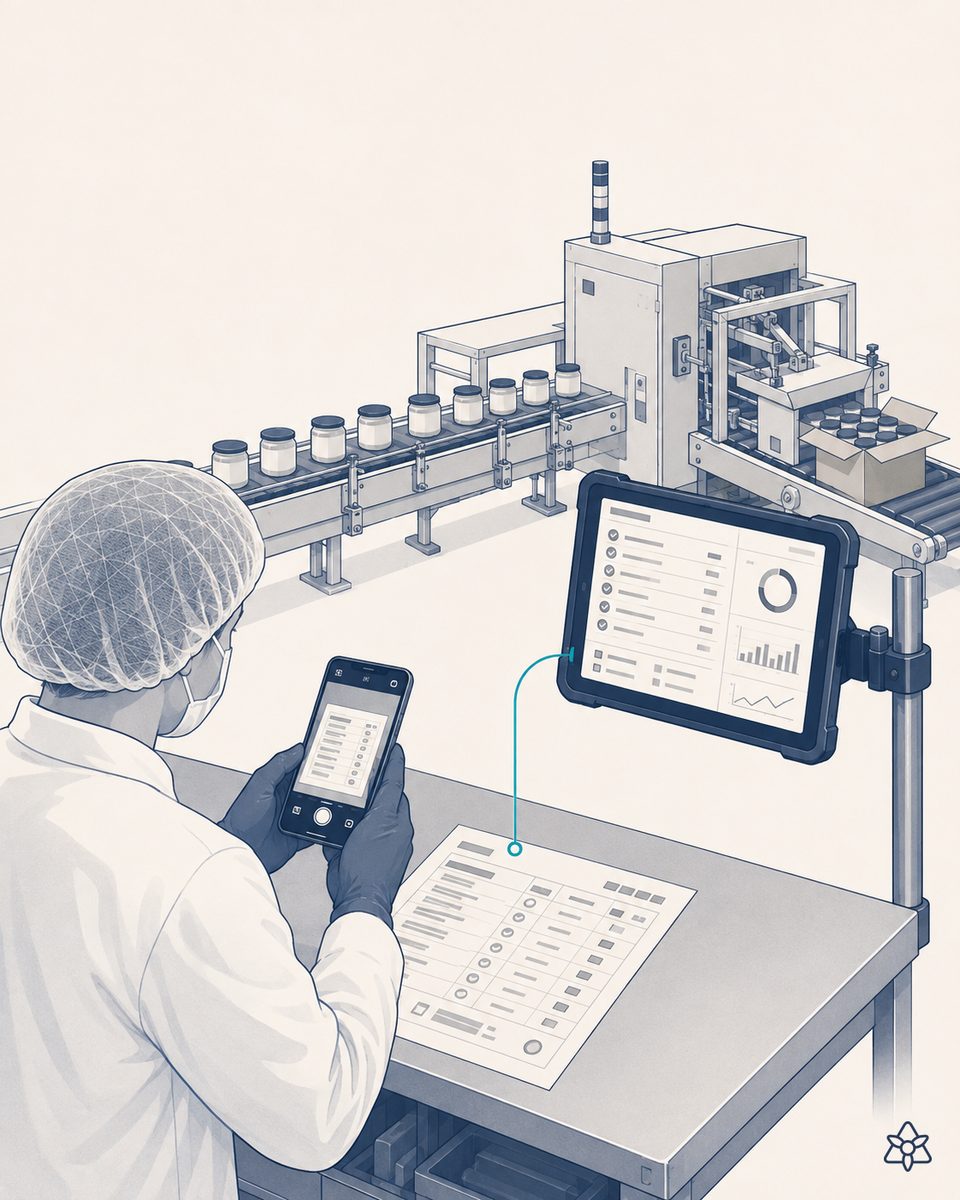
Four variables at once, and no single system joining them.
The quality manager of a chilled ready meal plant looks at four dashboards on four different screens every shift:
- Cold room and tunnel temperatures — in the SCADA, with records signed every morning on paper.
- The packing machine's MAP parameters — gas mix, pressure, seal integrity, in a vertical PLC that almost nobody cross-checks with anything else.
- Batch recipe and allergens — in the ERP, in the MES, or in an Excel sheet from the R&D department, updated each morning in a shared folder.
- The printed expiry date — on the label, changed manually with every SKU launch and entrusted to one operator plus a checklist.
The classic system works 99% of the time. That 1% is what ends up in RASFF — and in chilled ready meals, where shelf life is measured in days, an alert is not managed with slack: it is managed by pulling the batch off the shelf and restocking within 24h, with all the reverse-logistics, destruction and brand-damage cost that implies.
iLEAN does not add a fifth system — it seals the cracks between the four you already have.
The chilled ready meal problem is not a lack of information: it is information living in islands that, at the critical moment (the SKU changeover, the overnight cold room spike, the gas change on the packing machine), does not reach the decision-maker in time. iLEAN acts as the putty that fills those gaps, without asking you to change the SCADA, the MAP system, the ERP or the packing line.
Edge sees the label and the seal before shipping. Connect reads the cold room, the MAP, the recipe and the carrier's emails. The agent cross-checks and, if something does not add up, holds the batch. The person signs — never the other way around.
The three iLEAN pieces applied to chilled ready meals:
- Edge — a machine-vision (CNN) terminal over the tray sealer. It reads the printed label (date, batch, allergens), verifies the integrity of the MAP seal and triggers the actuator (light signal, ejector) if it does not match the expected recipe. It works without a network. If the plant loses WiFi, Edge keeps reading and holding.
- Connect — captures the batch recipe and the cold room temperatures whether they come from a modern ERP, the SCADA, a vertical MES or a forgotten Excel file. And it captures what arrives from outside: the carrier's 6:00 am email "the truck broke the cold chain for 90 min on the highway," the shift lead's WhatsApp "recipe change, SKU 412 goes vegan," at second zero, without anyone forwarding anything.
- Agent — cross-checks cold room temperature, MAP parameters, batch recipe, line history (what ran before, with what cleaning) and the image of the final package. If there is a deviation, it does not send an email at 10 pm: it holds the batch at shipping and alerts the quality manager through whatever channel they use. The person validates and signs; the shipment does not leave on its own.
Manual control + checklist vs. cross-checked control with iLEAN
| Aspect | Manual control + checklist | With iLEAN Edge + Connect + Agent |
|---|---|---|
| Overnight cold chain | Spike unseen, signed off next morning | Agent detects the spike and cross-checks affected batches |
| SKU changeover (allergens) | Paper checklist, shift sign-off | Edge verifies the label + agent verifies the cleaning |
| Batch MAP parameters | Trend in the PLC, never cross-checked with quality | Joined with recipe and label at second zero |
| Printed expiry date | Operator plus checklist | Edge vision reads it and compares with the batch recipe |
| Carrier's email | Mail folder, seen when someone looks | Connect escalates it before the next load |
| File for the IFS/BRC auditor | Rebuilt by hand, days | Automatic per-batch dossier, with photo and traces |
Impact estimate for your plant — to be validated with your numbers.
The block below is an estimate to be validated with the specific data of your plant. We put it forward so the committee has an order of magnitude; we refine it during the diagnostic.
- Chilled ready meal plant, 2-3 MAP lines, multi-SKU with daily recipe changes (vegan, gluten-free, lactose-free) and 7-14 day shelf life.
- Edge + Connect pilot on one line (camera over label and seal + integration with cold room, MAP and the batch recipe). First value expected within a few weeks.
- Indicative payback between 4 and 9 months, depending on the frequency of documented incidents, the average recall cost at your retailer and the improvement in scrap from bad seals or misprinted expiry dates (reasonable estimates starting at ≥30% reduction).
- The hard lever is a single avoided recall plus the reduction of recurring scrap from bad MAP seals and undetected cold chain breaks.
And the operations director's reasonable doubt
"What if the agent stops a shipment by mistake and I run out of restock on the shelf?" — the agents have no hands on critical OT: they propose, the person decides and signs. And in anchored tasks (cross-checking a cold room reading with a recipe, comparing a temperature with a threshold), the best models brought error below 1.5% [1]. The third safety ring exists precisely for this: the hold is a proposal signed by the quality manager, not an autonomous decision.
[1] OpenAI paper "Why Language Models Hallucinate," 2025 — on AI reliability in anchored tasks.
What people ask about AI control of chilled ready meals
What are chilled ready meals (5th range) and why is their control more demanding than frozen food?
5th-range products are chilled ready meals, ready to eat or heat, with a short shelf life (7-21 days) and storage between 0 and 4 °C. Their control is more demanding than a frozen product's because there is no thermal margin for error: a cold chain break of just a few hours is invisible, but it compromises the batch. Add multi-SKU with changing recipes (vegan, gluten-free, lactose-free), MAP packaging and expiry dates trimmed to the day — and any of those four variables, out of line, means a recall.
How do you control the cold chain of a ready meal from packing to shipping?
By cross-checking three sources that are almost never joined: the cold room temperature sensor (SCADA), the image of the product leaving the tunnel/packing machine that iLEAN Edge reads in line, and the truck loading record that arrives by email from the carrier. If the cold room had a +2 °C spike for three hours overnight and nobody saw it, the agent cross-checks it with which batches passed through and holds the shipment until the quality manager signs. The line does not resume on its own.
How are allergens managed in a multi-SKU chilled ready meal plant?
It is precisely the most vulnerable scenario. A line that runs, in the same shift, a salad with nuts, a vegan salad without nuts and a sandwich with egg concentrates every possible cross-contact vector. iLEAN cross-checks the batch recipe, the production order, the documented intermediate cleaning and the image of the package with the printed allergen list. If the label declares "nut-free" but the previous batch contained walnut and the cleaning was not fully logged, the system holds the batch before close-out and alerts through the quality manager's channel.
Can iLEAN integrate with existing MAP systems and packing machines without changing the line?
Yes. iLEAN Connect reads the MAP parameters (N₂/CO₂/O₂ mix, pressure, sealing) whether the packing machine has a modern interface or only exposes an old panel or a local screen. If there is only an analog panel, a person photographs it with the app and the data comes in all the same. iLEAN Edge adds vision on the line itself to verify the seal and the label. It does not force you to change the packing machine — the putty fills the cracks; it does not demolish.
How much does an iLEAN pilot cost in a chilled ready meal plant and how long until it delivers value?
An Edge + Connect pilot on a ready meal line (camera over label and seal + integration with cold rooms, MAP and the batch recipe) is in the order of magnitude of any Edge pilot in a food plant. First value in a few weeks; indicative payback between 4 and 9 months depending on the frequency of documented incidents, the average cost of a recall and the cost of scrap from cold chain breaks. The hard lever is a single avoided recall plus the reduction of scrap from contamination or badly managed expiry dates. We send you the estimated ROI with your numbers in 48h.
More cases in food
- Real AI cases in processed cheese12 real AI cases for plants that cut, slice and pack cheese: zero labeling recalls, paperless batch…
- RASFF and AESAN alerts with AI — a 10 pm alert should not wait until the next morning.iLEAN monitors RASFF/AESAN, cross-references alerts with your batches and drafts the official…
- Raw milk traceability from farm to plant — one record for every liter received, not five islands nobody cross-checks.iLEAN ties tanker, route, time and intake analysis into a single record for every liter of raw milk that…
- Real AI cases in the food industryReal AI cases in the food industry: dairy, meat, beverages, frozen foods and ingredients, plus labeling,…
- AI recipe and dosing control — the out-of-tolerance weighing is caught at second zero, not at month-end.iLEAN checks every weighing against the work order's active recipe at second zero: operator alert,…
- Returns and reverse logistics with AI — every rejected pallet should close a root cause, not open a limbo.iLEAN reads the buyer's email, the credit note and the pallet photos, links them to the batch and the…
Tell us your case and in 48h we'll send you the estimated ROI of this AI project for your ready meal plant.
We work on your plant's real data, not ours. Diagnostic with no commitment.
Request estimated ROI in 48h See food industry