Returns and reverse logistics with AI — every rejected pallet should close a root cause, not open a limbo.
Returns arrive in pieces: an email from the buyer, a paper credit note, photos by instant messaging. iLEAN consolidates them, cross-checks them against the batch, line and shift that produced them and proposes the product disposition in hours. The person confirms; the defect doesn't come back.
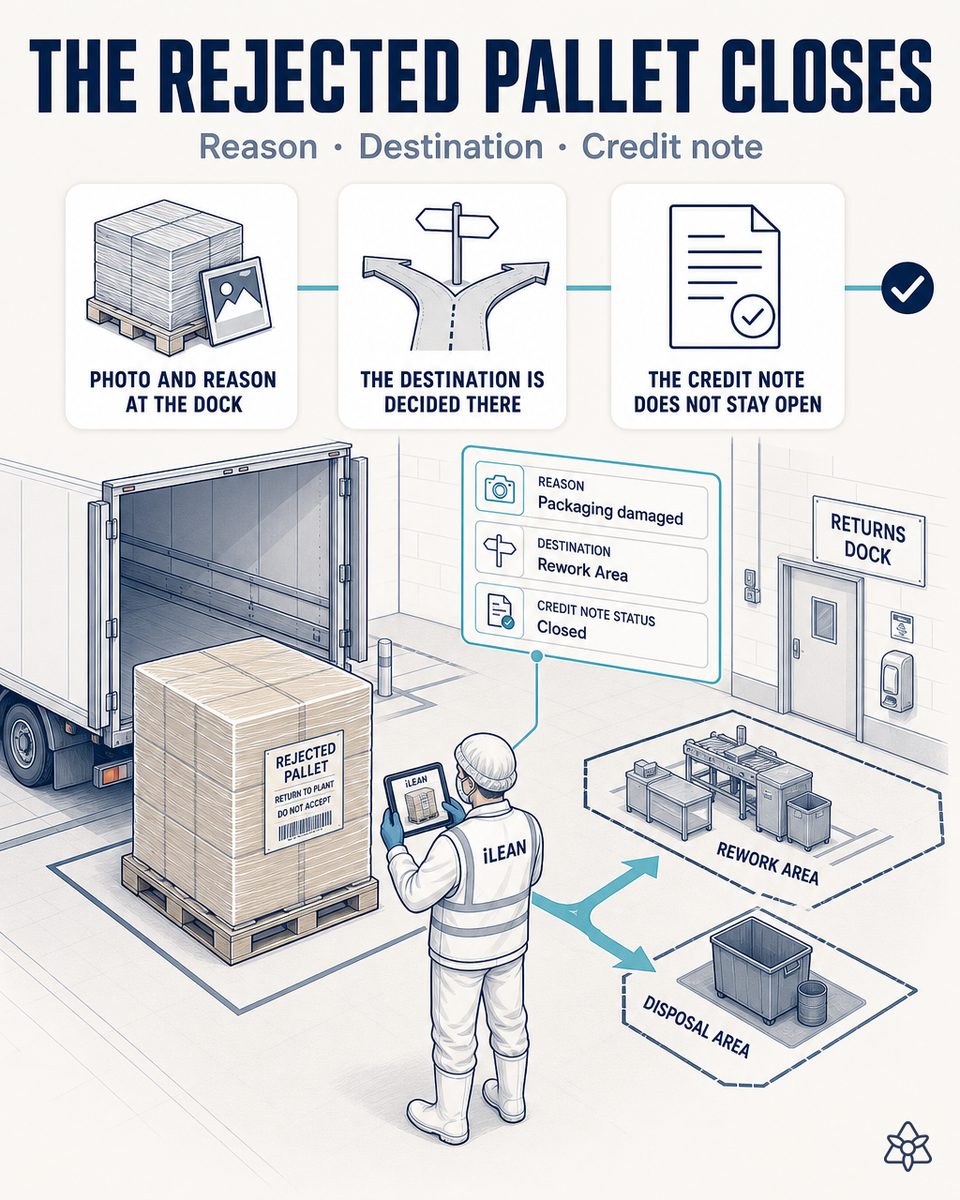
The retailer rejects a pallet and the information scatters across three places that never come together.
The retailer's buyer sends an email to the sales rep: “we've rejected two pallets from Tuesday's order”. The carrier brings the goods back with a paper credit note that someone drops in the admin tray. And the pallet photos — the crushed box, the illegible label, the torn film — arrive by instant messaging on the shipping lead's phone. Three pieces of the same event, in three different inboxes, hours or days apart. From there:
- Nobody links the return to the batch that produced it — the email says SKU and order, the credit note says quantities, the photo has the batch… but nobody puts them together. Without the batch there's no line, no shift, no work order: the root cause stays open forever.
- The same defect comes back — since the non-conformity never reaches the action plan with its context, the sealing that fails on the night shift keeps failing. Next quarter, another pallet rejected for the same reason, and another credit note.
- The returned product enters a limbo — it's unloaded in a corner of the warehouse “until quality takes a look”. Every day that passes it loses shelf life and options: what was reworkable on Monday is destruction-only by Friday.
- The credit note goes out late and without evidence — admin rebuilds it from memory weeks later, the retailer disputes it, and the dispute eats the margin and the commercial relationship.
- The big picture doesn't exist — how much does each customer return, and for what cause? The answer lives in an Excel sheet someone fills in at month-end, if they have time, from what they remember.
Each isolated return looks like a minor cost. The real cost is the loop that never closes: the same cause generating returns quarter after quarter, and the value of the returned product evaporating while nobody decides.
iLEAN doesn't add one more portal — it joins the three pieces of the return and closes the loop with production.
The bottleneck isn't registering returns (any ERP has that screen); it's that the information arrives broken into chaotic fragments — an email, a paper, some photos — and that linking it to batch traceability demands detective work nobody has time to do. iLEAN is the putty that joins the dock, quality and admin — without asking you to change your ERP, your MES or each retailer's portal.
Connect captures the email, the credit note and the photos and builds a single file. The Tracer agent cross-checks it against the batch, the line and the shift. The Writer agent proposes the disposition, prepares the credit note with evidence and feeds the action plan. The person confirms — nothing moves in the ERP without a signature.
The iLEAN pieces applied to returns and reverse logistics:
- Connect — in chaotic sources mode, it reads the buyer's email, the scanned or photographed credit note and the photos of the rejected pallet, and extracts SKU, batch, customer, quantities and reason. Critical information almost never arrives through an API; it arrives by email, messaging or paper. Connect integrates it at second zero and consolidates the three pieces into a single return file.
- Tracer agent — takes the batch from the file and cross-checks it against the traceability your ERP/MES already records: which line produced it, on which shift, under which work order and which checks it passed. With that context, the non-conformity enters the quality action plan pointing at the exact spot in the process — not into thin air.
- Writer agent — aggregates returns by cause and by customer, proposes the disposition of the returned product (rework, secondary channel, donation or destruction) based on remaining shelf life, cold chain and reason, and prepares the credit note with all the evidence attached. The quality lead confirms every proposal; without confirmation no stock moves and no credit note is issued.
The brain (Brain) that orchestrates the agents lives in Central; critical data stays in the plant's ring 1, not in just any cloud (see the IRIS architecture and the three safety rings).
Returns managed by hand vs. managed with iLEAN
| Aspect | Email + paper + Excel | With iLEAN Connect + Tracer + Writer |
|---|---|---|
| Consolidating the return information | Days chasing emails, papers and photos | A single file at second zero |
| Link to batch, line and shift | Almost never done — the cause stays open | Automatic from the label photo and the credit note |
| Decision on the returned product | Weeks in a limbo, losing shelf life | Proposal in hours — the person confirms |
| Credit note to the retailer | From memory, no evidence, frequent disputes | With photos, batch and verified quantities |
| Recurring returns from the same cause | The same defect back quarter after quarter | Loop closed in the quality action plan |
| View by cause and by customer | Excel sheet rebuilt at month-end | Live aggregation, ready for the quality review |
Impact estimate for your plant — to be validated with your numbers.
The block below is an estimate to be validated with the specific data of your returns. It gives the committee an order of magnitude; we refine it during the diagnostic.
- Food manufacturer serving several retailers, with dozens of returns a month across dock rejections, quality credit notes and reverse logistics from promotions. Today the work is split between sales, shipping, quality and admin — with no shared file.
- Deployment of Connect in chaotic-sources mode + Tracer/Writer agents integrated with your ERP/MES traceability. First value expected within a few weeks on a pilot customer (for example, the retailer that returns the most).
- Expected reduction of recurring returns from the same cause ≥30% by closing the loop with the quality action plan (estimate to be validated; it's the defensible floor, not the ceiling). Credit notes issued with evidence and without dispute, and value recovered from the returned product by deciding its disposition in hours, not weeks.
- Indicative payback between 4 and 9 months (estimate to be validated), depending on return volume, average value of recoverable product and the cost credit-note disputes generate for you today.
And quality's reasonable doubt
“What if the AI makes up the return reason?” — hallucination is a problem of free generation, not of anchored tasks. Extracting SKU, batch and reason from an email and from the photo of a delivery note is exactly an anchored task: the AI recontextualizes data that exists in the documents, it doesn't write anything from scratch, and the cross-check against traceability is deterministic. In this kind of task, the best models brought error below 1.5% [1]. And even so, the person confirms every disposition and every credit note — without a signature nothing moves in the ERP. The three safety rings are there for this.
[1] OpenAI paper “Why Language Models Hallucinate”, 2025 — on the reliability of AI in anchored tasks.
What people ask about returns and reverse logistics with AI
What sources can Connect read in a return?
The ones you already use today, without changing them: the retailer buyer's email, the paper credit note (scanned or photographed), the photos of the rejected pallet that the carrier sends by instant messaging and, if it exists, the EDI notice from the customer's portal. Connect works in chaotic sources mode: it extracts SKU, batch, customer, quantity and reason from each piece, even if they arrive in three different formats hours apart, and consolidates them into a single return file.
How does it link the return to the batch and line that produced it?
The key piece of data is the batch, and it's almost always in the photo of the pallet label or on the credit note. The Tracer agent extracts it, cross-checks it against the traceability your ERP/MES already records and rebuilds the full context: the line, shift and work order that produced that batch, plus the quality checks it passed. The complaint stops being “the customer returned something” and becomes “the defect came out of line 2, night shift, work order 4811” — which is where it can be fixed.
Who decides what happens to the returned product?
A person, always. The agent proposes the disposition — rework, resale in a secondary channel, donation or destruction — based on the return reason, the remaining shelf life, the state of the cold chain and that SKU's history. The quality lead confirms or corrects the proposal, and only then is the movement recorded in the ERP. Human confirmation before anything moves: it's the rule in every iLEAN deployment.
How does it prevent disputes over retailer credit notes?
Because every credit note goes out with its evidence attached: the pallet photos, the reason extracted from the buyer's email, the affected batch and the quantities verified against the delivery note. Today the dispute is born from the credit note being issued weeks later, from memory and without proof; with the complete file, buyer and supplier see the same data. The amount is validated by a person before it's issued — the system prepares, it doesn't sign.
Does it help with IFS/BRC audits and the quality action plan?
Yes. Every closed return leaves a complete record: root cause identified, batch and line linked, disposition decided, corrective action opened in the quality action plan and documentary evidence. The agents also aggregate returns by cause and by customer, so the monthly quality review starts from live data, not a sheet rebuilt by hand. For the auditor, the question “how do you manage customer non-conformities?” has a traceable answer end to end.
More cases in food
- AI control of chilled ready meals — short shelf life, multi-SKU, zero margin for error.How iLEAN cross-checks cold chain, MAP, allergens and expiry dates in chilled ready meals with Edge +…
- Real AI cases in the food industryReal AI cases in the food industry: dairy, meat, beverages, frozen foods and ingredients, plus labeling,…
- AI recipe and dosing control — the out-of-tolerance weighing is caught at second zero, not at month-end.iLEAN checks every weighing against the work order's active recipe at second zero: operator alert,…
- Rice whitening with AI — between leaving grain dark and breaking whole grain there is a very narrow band. That band is money.iLEAN cross-checks multispectral grain vision, whitener settings and live batches to optimize head rice…
- Coffee roasting control with AI — so Friday's batch comes out like Monday's.iLEAN captures the roast curve, bean color and development so the master roaster no longer depends on…
- Sausage drying room control with AI — a piece that drifts is not recovered, it is anticipated.iLEAN cross-checks curing-chamber humidity, temperature and piece weight with the panel and the master…
Tell us your case and in 48h we'll send you the estimated ROI of this AI project for your returns.
We work on the real data of your plant and your credit notes, not ours. Diagnostic with no commitment.
Request estimated ROI in 48h See food industry