Sausage drying room control with AI — a piece that drifts is not recovered, it is anticipated.
A drying room lives on two curves that have to match — humidity/temperature and the piece's weight loss. When they drift, you notice too late: case hardening, white spot, shrink off target. iLEAN cross-checks the chamber's datalogger, the photo of the panel and the master curer's history to warn before the piece loses value. The person signs the adjustment.
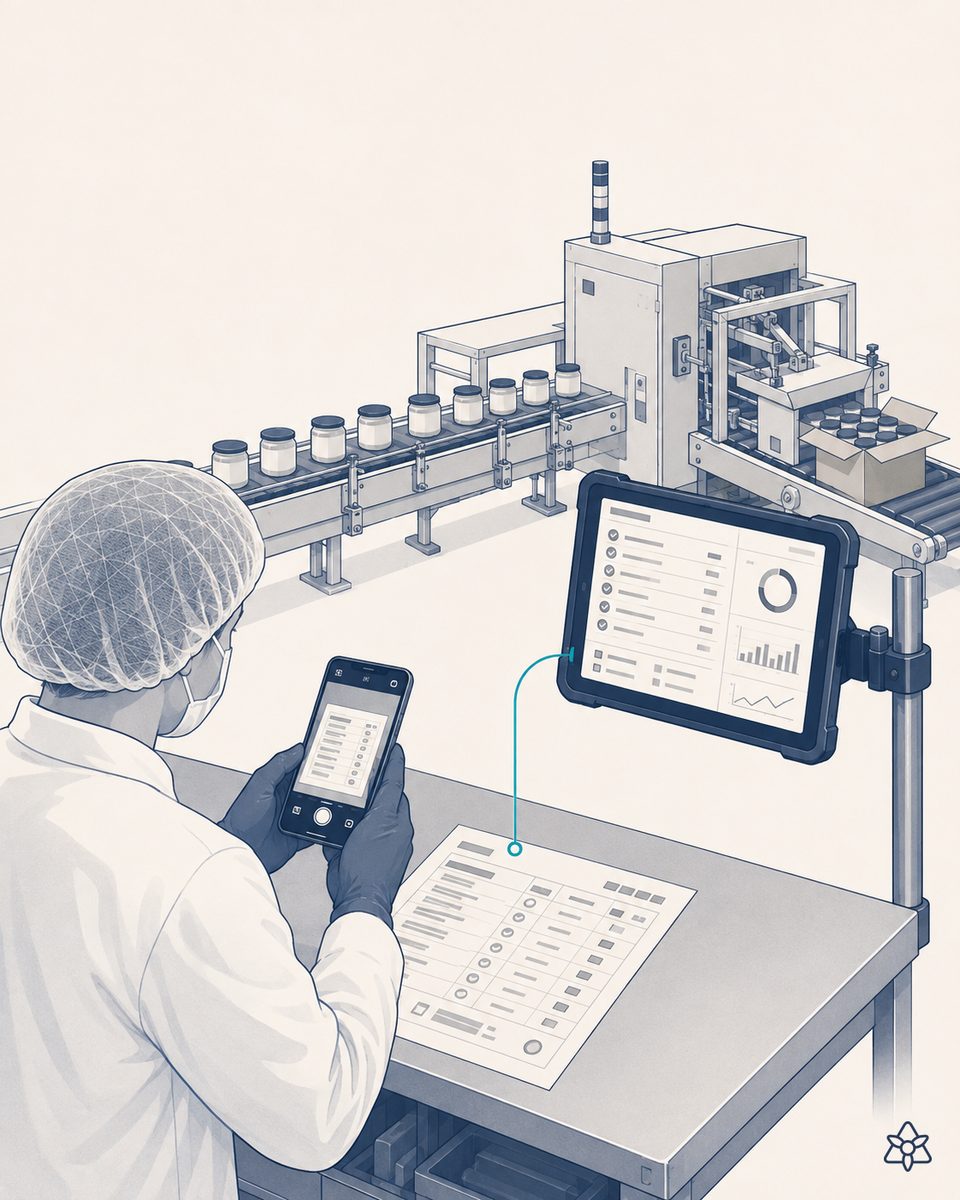
The master reads the chamber in his head, the datalogger records to a memory card, the ERP never finds out.
In a sausage drying room, what decides whether the batch comes out right is accumulated intuition: the master curer walks in in the morning, checks the thermo-hygrometer, touches the casing of three pieces, remembers what happened on Wednesday night, and lowers the humidity half a point or raises the temperature one degree. That knowledge is the most valuable asset in the plant — and the worst protected.
The classic system has three built-in gaps:
- The datalogger records, but does not warn. The usual Tewes, OMNIA or CFS units store the curve, but nobody looks at the curve until there is already a complaint. Slow drift never fires as an alarm.
- Pieces are not weighed piece by piece. Weight loss (the ultimate truth of curing) is usually measured by sampling, and by the time anyone detects that a whole room is running off target, the room has been running that way for weeks.
- The master's judgment is not inherited. That "if this goes up, I bring that down" lives in his head. The day he retires, the plant enters a learning cycle paid for in lost batches.
The result: when white spot, case hardening or out-of-range shrink appears, the problem is not today's — it started three days ago and nobody connected the dots in time. The classic system works 99% of the time. That 1% is where the year's margin goes.
iLEAN does not touch the chamber — it seals the cracks between the datalogger, the panel and the master's head.
The drying room's problem is not a lack of sensors: it is information living in islands that, at the critical moment — Wednesday night, the recipe change from salchichón to fuet, an incoming batch of meat with more fat — does not reach the decision-maker in time. iLEAN acts as the putty that fills those gaps without asking you to change the chamber, the datalogger or the ERP.
Connect reads what the datalogger records and what the panel says. The agent cross-checks the curve against the piece's weight history. If the accumulated drift puts the batch at risk, it warns the master. The person signs the adjustment — never the other way around.
The two iLEAN pieces applied to a sausage drying room:
- Connect — captures the data whether it comes from a modern datalogger with an output, from an old, isolated local computer, or from a photo of the analog panel taken by a person with a phone. It also captures what comes in from outside: the casing supplier's email with a change in caliber, the veterinarian's WhatsApp with a note about the incoming batch. Everything at second zero, no forwarding.
- Agent — cross-checks the datalogger's humidity/temperature curve, the piece's weight history, the batch recipe and the product's master curve. If the accumulated drift puts the batch at risk (case hardening, white spot, shrink off target), it warns the master or the shift lead on whatever channel they use, with the proposed adjustment. The person validates and signs; the chamber does not reprogram itself.
Edge comes in here later — vision over the pieces at the chamber exit to validate casing uniformity — but it is not the first step. The first value comes from the data you already have and nobody reads.
A drying room run on craft vs. a drying room with the curves cross-checked
| Aspect | Today in most drying rooms | With iLEAN Connect + Agent |
|---|---|---|
| Datalogger reading | On demand, once there is already a complaint | Continuous, cross-checked with weight and recipe |
| Slow drift detection | When the defect shows up on the piece | Early warning, with days of margin |
| Recipe or caliber change | The master recalibrates from memory | Agent suggests an adjustment based on history |
| White spot / case hardening | Discovered when the piece comes out | Anticipated from humidity/weight deviation |
| Master curer's handover | Learning curve paid in lost batches | The veteran's judgment captured as data |
| Traceability for the IFS/BRC auditor | Rebuilt by hand, weeks | Per-batch dossier with the full curve |
Impact estimate for your plant — to be validated with your numbers.
The block below is an estimate to be validated with your plant's data. We put it forward so the committee has an order of magnitude; we refine it during the diagnostic.
- Mid-sized plant making cured ham or long cured sausages, 4-8 drying chambers, a heterogeneous datalogger fleet (a mix of modern and old equipment), a master curer with 20+ years of craft.
- Connect + Agents pilot in 2 representative chambers (the oldest and the newest), without touching the chambers' programming. First value expected within a few weeks: early drift warnings on batches in progress.
- Indicative payback between 4 and 9 months, depending on volume, unit value of the piece and current level of waste + grade downgrades. A reduction in waste and B-grade pieces on the order of 30% or more is defensible as a floor.
- The hard lever is not just waste: it is preserving the master's judgment when the handover comes, without the plant losing a year re-learning it.
And the technical director's reasonable doubt
"What if the AI recommends badly and the batch is lost by following it?" — hallucination is a problem of free generation, not of anchored tasks. In tasks where the AI merely cross-checks a measured value against a historical pattern (datalogger curve vs. master curve), the best models brought error below 1.5% [1]. And even so, what is critical is never decided alone: iLEAN proposes, the master or the shift lead signs. The three safety rings exist precisely for this.
[1] OpenAI paper “Why Language Models Hallucinate”, 2025 — on the reliability of AI in anchored tasks.
What people ask about sausage drying room control
Which critical deviations in a drying room can AI detect earlier?
The three classics: case hardening (the piece loses surface water too fast because relative humidity fell below target in phase 1), white spot and surface blooms (humidity too high in phases 2-3 favors off-recipe surface mold) and shrink off target (weight loss deviating from the master profile). iLEAN does not invent a new recipe — it takes the master curer's curve, cross-checks it against what it sees in the datalogger, and warns when the accumulated drift puts the batch at risk.
Do I need to replace the curing chamber to integrate iLEAN?
No. Connect adapts to whatever state your chamber is in: if the datalogger has a modern output, direct integration; if it is an old, isolated local computer, Connect connects and extracts the data; if all there is is an analog panel, a person photographs it with a phone and it comes in as usable data. The chamber — Tewes, OMNIA, CFS, whichever it is — keeps working exactly as it does today. iLEAN sits on top; it replaces nothing.
What happens when the master curer retires?
It is one of the pains we see most. The master carries the curve in his head — he knows that in week 5 humidity should come down half a point if the temperature rose on Wednesday night, and that is in no system. iLEAN captures that pattern by cross-referencing historical curves with the batch's final result (weight, defects), and the agent ends up proposing the adjustment the veteran used to propose. It does not take the craft away from the master — it captures his judgment before he leaves, so his successor does not walk into the new job in the dark.
Does it work if the plant loses Internet or the SCADA goes down?
Yes. The drying room's critical points — the datalogger's local recording, the panel reading, the chamber's physical alarms — keep operating as always, because iLEAN does not get inside the climate control loop. What it adds is a layer of intelligence upstream: when there is connectivity, the agents cross-check data and anticipate; when there is not, the drying room follows its program and the agents pick up the thread when the line comes back. What is critical does not depend on WiFi.
What payback should a cured-sausage plant expect?
It depends a great deal on your volume, the value of the piece (cured ham, salchichón, chorizo, fuet) and your current level of waste. As an order of magnitude to present to the committee — and always as an estimate to be validated with your data — a Connect + Agents pilot in one drying room delivers first value within a few weeks and a reasonable payback between 4 and 9 months, with the hard lever in avoided waste and batches saved from grade downgrades. We send you the estimated ROI in 48h with your numbers, not ours.
More cases in food
- Returns and reverse logistics with AI — every rejected pallet should close a root cause, not open a limbo.iLEAN reads the buyer's email, the credit note and the pallet photos, links them to the batch and the…
- Rice whitening with AI — between leaving grain dark and breaking whole grain there is a very narrow band. That band is money.iLEAN cross-checks multispectral grain vision, whitener settings and live batches to optimize head rice…
- Coffee roasting control with AI — so Friday's batch comes out like Monday's.iLEAN captures the roast curve, bean color and development so the master roaster no longer depends on…
- Shellfish cold chain control with AI — from boat to shelf, no jumps in the curve.How iLEAN cross-checks dock, transport and cold room with vision and agents to keep the shellfish cold…
- AI control of snack extrusion — the shape at the die rules, not the recipe in the spreadsheet.How iLEAN sees the snack's shape at the die exit and corrects the recipe before the oven — less scrap,…
- Snack seasoning control with AI — the right dose in every bag, not just in the recipe.How iLEAN cross-checks the SKU recipe, the seasoning dispenser and visible coverage so every bag of…
Tell us your case and in 48h we'll send you the estimated ROI of this AI project for your drying room.
We work on your plant's real data, not ours. Diagnostic with no commitment.
Request estimated ROI in 48h See food industry