AI control of snack extrusion — the shape at the die rules, not the recipe in the spreadsheet.
Snack extrusion lives on three levers: flour moisture, screw temperature/pressure and cutter speed. When one of them moves, the snack loses expansion or shape five minutes before the operator sees it. iLEAN Edge watches the die exit in milliseconds, Connect reads the old extruder and the agent corrects the recipe before the batch reaches the oven. The person signs.
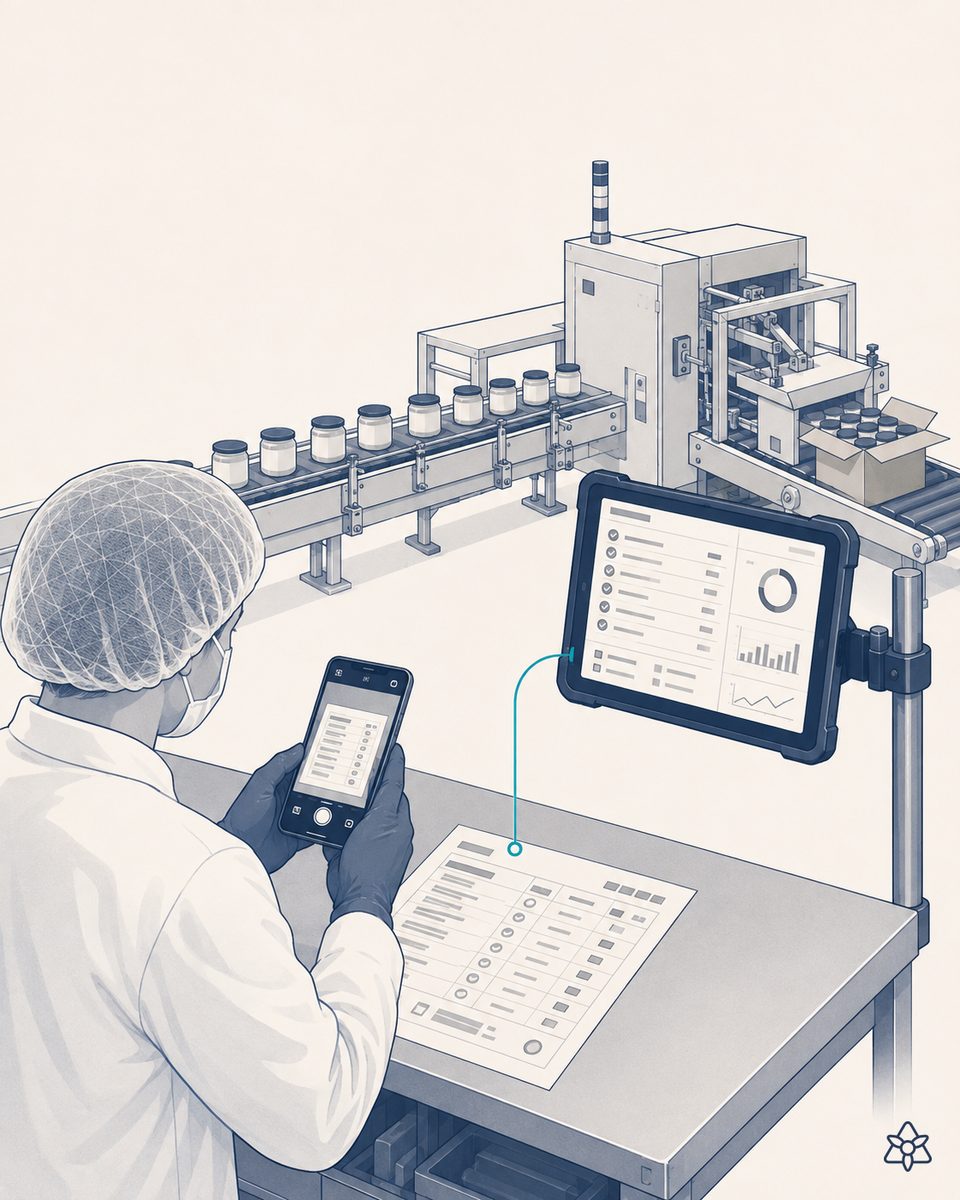
The extruder is not the one failing — the flour changes, the die fouls up, and nobody sees it in time.
A properly tuned extruder is a wonderfully stable machine. The problem is not the machine: it is the conditions it receives and the speed at which they change:
- A new flour silo — slightly different moisture and particle size; the recipe in the spreadsheet no longer applies.
- A fouled or worn die — the hole geometry shifts by tenths, and expansion collapses.
- A fast SKU changeover — the operator has to adjust temperature, pressure and speed with no stable baseline, and over-corrects.
- A slow temperature drift — five imperceptible minutes, but the oven batch is already coming out off size.
The consequence does not arrive as an extruder alarm; it arrives as a pallet of returned bags three days later, or as an oven that has burned energy cooking scrap. The operator knows it, but he cannot spend his life staring at the belt. The classic system (eye + experience) works 90% of the shift. The other 10% is what the quality committee pays for.
iLEAN does not change your extruder — it puts eyes where you could not reach and connects what you had lying loose.
Extrusion is a textbook case for IRIS: there is a point on the line (the die exit) where the defect becomes visible long before it does in the oven or at packing, and there are islands of data (flour silo, extruder PLC, cutter panel, recipe spreadsheet) that nobody joins at the critical moment. iLEAN acts as the putty between those gaps.
Edge sees the snack's shape at the die exit. Connect reads the old extruder and the silo. The agent correlates and proposes the adjustment. The person signs.
The iLEAN pieces applied to extrusion control:
- Edge — a vision terminal (CNN) over the belt at the die exit. It measures shape, length, expansion ratio and color of every snack in milliseconds, and keeps a live histogram. When the distribution drifts, it triggers a stack light and proposes a cause. It works with no network. If the plant loses WiFi, Edge keeps watching and alerting, because what is critical cannot depend on connectivity.
- Connect — captures the moisture and particle size of the flour silo (modern sensor, a read of the local PC or a photo of the panel), the extruder PLC values (temperature, pressure, speed), the cutter speed and the recipe in the process manager's spreadsheet. All of it at second zero, with nobody having to forward anything.
- Agents — correlate the visual drift with the captured variables: "expansion dropped when silo 3 was opened, moisture +0.8%, raise screw speed by 4% and lower zone 3 temperature". It proposes this to the operator through the earpiece. The person validates and applies it; the line never adjusts itself.
Classic extrusion vs. extrusion assisted by iLEAN
| Aspect | Operator + recipe + eye | With iLEAN Edge + Connect + Agent |
|---|---|---|
| Drift detection | 5-10 min, by eye on the belt | Seconds, with a live histogram at the exit |
| Flour silo changeover | Same recipe, no moisture compensation | The agent compensates temperature/speed at the changeover |
| SKU changeover | Typical over-correction, initial scrap | Recipe loaded + guided fine tuning |
| Fouled or worn die | Detected via a complaint from packing | Shape distribution shifts → maintenance alert |
| Operation with no network | n/a | Edge keeps watching on panel power |
| The veteran's knowledge | Lives in his head, leaves with him | Patterns captured, replicable on another line |
Impact estimate for your plant — to be validated with your numbers.
The block below is an estimate to be validated with the specific data of your line. We put it forward so the committee has an order of magnitude; we refine it during the diagnostic.
- Snack plant with 1-2 twin-screw extruders, multi-SKU (corn curls, sticks, shapes), a tunnel oven and a seasoning + packing line.
- Edge pilot on one line (camera over the belt at the die exit + integration with the PLC and the silo + correlation with the recipe). First value expected within a few weeks.
- Indicative payback between 4 and 9 months. Cooking scrap down ≥30% on problem SKUs; unplanned stoppages from die changes down ≥20%.
- Serial quality in food: demanding standards; in automotive the benchmark is in the order of 25 PPM of out-of-spec parts [2]. Moving extrusion toward that PPM logic is the direction of travel.
And the process manager's reasonable doubt
“What if the AI proposes some weird adjustment that ruins the batch?” — the Agents propose, the person decides. That is the principle of the three rings: on a critical work order, the hands are the person's. Hallucination is a problem of free generation; in anchored tasks (measuring shape, reading pressure, correlating), the best models brought error below 1.5% [1]. The extruder is still yours — iLEAN just takes the "I'm about to screw this up" out of the operator's shift.
[1] OpenAI paper “Why Language Models Hallucinate”, 2025 — on the reliability of AI in anchored tasks.
[2] Symestic — PPM standards in automotive serial quality.
Related cluster: pet food extrusion, snack seasoning.
What people ask about snack extrusion control
Which variables have to be controlled in snack extrusion?
The hard levers of a snack extruder are the moisture and particle size of the incoming flour (corn, rice, blends), the temperature and pressure of the screw zones, the screw and cutter speed, and the die geometry. The result shows up in the snack itself: expansion (specific volume), shape, color and texture. When one of those variables drifts, the operator notices it five or ten minutes later on the belt — and by then there is already scrap in the oven and out-of-spec product heading to packing.
How does iLEAN detect an expansion or shape drift before it reaches packing?
With machine vision on the belt right at the die exit. iLEAN Edge measures geometry (length, diameter, expansion ratio), color and uniformity of every snack in real time, and builds a live histogram. When the distribution drifts away from the setpoint — even before the operator can see it by eye — the agent correlates it with the flour moisture of the last silo opened, the screw pressure and the cutter speed, and proposes the specific adjustment. The person validates and applies it.
Does iLEAN work if the extruder is old and only has a PLC with its own touch panel?
Yes — that is exactly the typical case. iLEAN Connect captures extruder data at three levels: direct integration if it has modern OPC-UA, a read of the local PC if it is an isolated proprietary panel, or a photo of the panel from the app if all there is is an analog display. It does not force you to change the extruder, the die or the cutter. What it adds is vision at the exit and correlation with the data the extruder already generates but does not share.
Does it reduce cooking scrap and energy consumption?
Yes, in two ways: (1) reacting to a drift in seconds instead of minutes means the out-of-spec batch is caught on the belt and never reaches the oven, saving energy and raw material; (2) cutting abrupt recipe changes (operator over-corrections) lowers variability and, with it, consumption per kilo expanded. Conservative estimates to be validated on site: cooking scrap down ≥30% on problem SKUs.
How much does it cost to implement AI control on a snack extrusion line?
The order of magnitude of an Edge pilot on an extrusion line is comparable to other food-industry Edge pilots: a camera over the belt + an actuator (stack light or diverter) + integration with the extruder PLC and with the ERP/MES, plus an annual license. A reasonable payback is several months. The hard levers are scrap reduction, energy saved in the oven and fewer stoppages on problem SKUs. We ask for your line's data and send you the estimated ROI in 48h.
More cases in food
- Coffee roasting control with AI — so Friday's batch comes out like Monday's.iLEAN captures the roast curve, bean color and development so the master roaster no longer depends on…
- Sausage drying room control with AI — a piece that drifts is not recovered, it is anticipated.iLEAN cross-checks curing-chamber humidity, temperature and piece weight with the panel and the master…
- Shellfish cold chain control with AI — from boat to shelf, no jumps in the curve.How iLEAN cross-checks dock, transport and cold room with vision and agents to keep the shellfish cold…
- Snack seasoning control with AI — the right dose in every bag, not just in the recipe.How iLEAN cross-checks the SKU recipe, the seasoning dispenser and visible coverage so every bag of…
- AI applied to spice, paprika and seasoning factoriesReal AI (IRIS) use cases for spice, paprika and seasoning factories: traceability, quality and less…
- Sugar refinery with AI — the commercial grade is not decided in the lab, it is decided in the vacuum pan.How iLEAN cross-checks ICUMSA color, polarization and pan-boiling parameters to stabilize refined sugar…
Tell us your case and in 48h we'll send you the estimated ROI of this AI project for your extrusion line.
We work on your plant's real data, not ours. Diagnostic with no commitment.
Request estimated ROI in 48h See food industry