Pet food extrusion with AI — the SKU changeover is the most expensive moment of the day. And it hinges on an Excel file the operator never read.
Pet food extrusion lives in a narrow band — moisture, density, kibble shape and coating all have to line up at once for the batch to come out to spec. iLEAN cross-checks in-line vision, preconditioner control and the recipe from the formulator's Excel, and proposes the adjustment to the operator before the line drifts. The person signs.
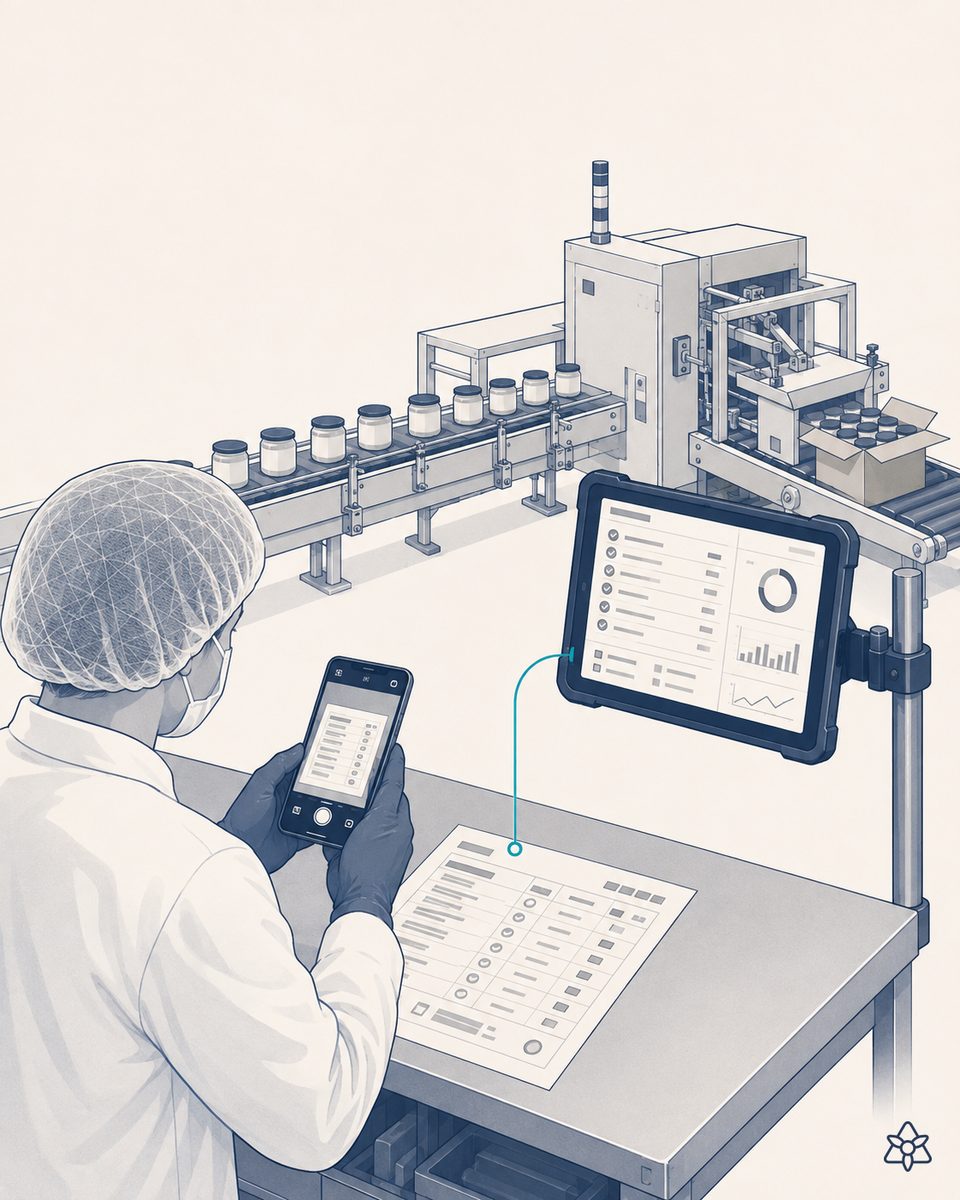
Recipe change, SKU change, and the fine-tuning lives in the head of the operator whose shift just ended.
A premium pet food plant can run 30, 40 or 50 different SKUs in a week: kibble for adult dogs, kittens, seniors, special diets, different shapes (bone, star, cylinder), different sizes. Every SKU changeover means changing the recipe, adjusting steam flow at the preconditioner, extruder screw speed, die diameter, drying profile. That coordination is where the day falls apart.
It happens because the information lives in different places and different timeframes:
- The formulator's recipe — in an Excel file owned by the R&D manager, updated when needed and sent by email or WhatsApp to the shift lead.
- The preconditioner and extruder parameters — on the console, a screen with a history only the initiated can pull up.
- The kibble reading — the operator eyeballs it at the dryer exit, decides whether it looks right, and often scraps the first minutes until the line stabilizes.
- The retailer's specification — in another sheet, another system, sometimes only in the sales rep's head.
The SKU changeover is the most vulnerable moment of the day: many parameters to touch at once, little margin to validate, and if something is left badly adjusted, the first batch of the new SKU comes out off-shape — and that is tons going to rework or to bulk sale at a lower margin. The system works when the veteran shift lead is in. When they are not, it does not.
iLEAN does not add one more system — it seals the cracks between the four you already have.
The extrusion control problem is not a lack of information: it is information living in islands that, at the critical moment (the SKU changeover, the new recipe that came in without going through the shift lead), does not reach the decision-maker in time. iLEAN acts as the putty that fills those gaps, without asking you to change the extruder, the dryer or the formulator's Excel.
Edge sees the kibble at the dryer exit. Connect reads the recipe, the extruder console and the retailer's specification at second zero. The agent correlates and proposes the adjustment to the operator. The person signs — never the other way around.
The three iLEAN pieces applied to pet food extrusion:
- Edge — a machine-vision (CNN) terminal over the belt at the dryer exit or before the coater. It reads kibble shape, size, color and spread in real time, without touching the line. If the batch drifts from the shape declared for the SKU, it fires an alert and proposes an adjustment to screw speed or steam flow. It also detects the end of the transient (when the line has stabilized) so good batch counting can start. It works without a network.
- Connect — captures the formulator's recipe whether it comes from an Excel file in a shared folder, a vertical MES or the ERP. It reads the extruder console and the preconditioner parameters at second zero, without waiting for the end-of-shift close. And it also captures what arrives from outside (the retailer's specification changed by email, the packing operator's complaint over WhatsApp) without anyone forwarding anything.
- Agent — cross-checks the recipe of the running SKU, the extruder parameters, Edge's reading and the history of previous SKU changeovers. If it detects that the adjustment will not stabilize before a threshold of lost tons, it does not send an email: it alerts the operator through whatever channel they use, with the concrete proposal. The operator validates and signs; the line does not adjust itself.
Classic control vs. cross-checked control with iLEAN
| Aspect | Classic control (operator + shift lead) | With iLEAN Edge + Connect + Agent |
|---|---|---|
| Recipe for the new SKU | Formulator's Excel, arrives by email/WhatsApp | Captured at second zero + cross-checked with the console |
| Kibble shape and size | Operator's eyeball, judgment call | Continuous in-line reading, on every batch |
| SKU changeover transient | First minutes by eye, sometimes minutes too many | End of transient detected as soon as it stabilizes |
| Final moisture | Sample taken at packing, already late | Anticipated by preconditioner + Edge correlation |
| Off-shape batch | Confirmed at packing, goes to rework | Redirected to bulk or adjusted before packing |
| Batch file for the retailer | Rebuilt by hand, weeks | Automatic per-batch dossier, with Edge photo |
Impact estimate for your plant — to be validated with your numbers.
The block below is an estimate to be validated with the specific data of your plant. We put it forward so the committee has an order of magnitude; we refine it during the diagnostic.
- Premium pet food plant with 2 extruders, 40-60 active SKUs, a single dryer and a fat/palatant coater.
- Edge pilot on the belt at the dryer exit (vision camera + integration with the extruder console and the formulator's Excel). First value expected within a few weeks.
- Indicative payback between 4 and 9 months, depending on the number of SKU changeovers per week and the tons lost to badly adjusted transients.
- Hard lever: ≥ 30% reduction of the transient batch that goes to rework or to bulk. Every well-adjusted SKU changeover is tons that come in at full margin instead of reduced margin.
And the production manager's reasonable doubt
"What if the agent proposes the wrong screw adjustment and I jam the extruder?" — hallucination is a problem of free generation, not of anchored tasks. In tasks where the AI correlates what is already measured (recipe, extruder parameters, Edge reading, SKU history), the best models brought error below 1.5% [1]. And even so, the AI does not decide the adjustment: the agent proposes, the operator signs. The three safety rings are there precisely for this.
[1] OpenAI paper "Why Language Models Hallucinate," 2025 — on AI reliability in source-anchored tasks.
What people ask about pet food extrusion control
Which parameters define kibble quality in pet food extrusion?
Four groups: kibble shape and size (cylinder, bone, star — any deformation gets it rejected by the packing operator or the retailer), final moisture after drying (target 8-10% depending on product and declared shelf life), density / expansion (floating vs sinking kibble for wet feeding, controls how the product sits in the tray) and uniformity of fat and palatant coating after the coater. On top of that come color (key in premium pet food that mimics the look of a cut of meat) and hardness. The usable band is narrow and everything shifts with every recipe change between SKUs.
Why does extrusion drift between SKU changeovers?
Because every recipe has a different profile of starch, protein, fiber and mix moisture, and the preconditioner + extruder have to adjust steam flow, water, screw speed and die diameter against that recipe. If the formulator updated the recipe in an Excel file and the operator never got the note at the start of the new SKU, the kibble comes out off-shape or with moisture out of calibration — and the whole batch is diverted to rework or to bulk sale at a lower margin. The SKU changeover is precisely the line's most vulnerable moment.
Can iLEAN Edge measure kibble shape and color on the discharge belt?
Yes. Edge is a machine-vision (CNN) terminal mounted over the belt at the dryer exit or before the coater. It reads kibble shape, size, color and spread in real time, without touching the line. It cross-checks with the preconditioner and extruder consoles through Connect, and if the batch drifts from the shape declared for the SKU (cylindrical kibble coming out flattened, color too dark), it fires an alert and proposes an adjustment to screw speed, steam flow or a die change. It works without a network: Edge keeps classifying even if the plant loses WiFi.
How does this integrate with a formulator who updates the recipe in Excel?
iLEAN does not ask the formulator to change their workflow. Connect captures the recipe wherever it lives: an Excel file in a shared folder, a vertical pet food MES, or the ERP. It reads it at second zero and cross-checks it with the extruder console and with Edge's in-line reading. The agent correlates which recipe deviation is producing which kibble deviation, and proposes the adjustment to the operator before the batch is completed. The Excel sheet remains the formulator's Excel sheet — but it stops being the bottleneck.
How much does a pet food extrusion control pilot cost?
The order of magnitude of an Edge pilot on a dryer or coater discharge belt falls in the usual range of any Edge pilot in a food plant: an initial investment covering terminal + camera + integration with the extruder console and the formulator's recipe, plus an annual license. A reasonable payback is between 4 and 9 months, conservative — the hard lever is eliminating the rework batch caused by a badly adjusted SKU changeover (in premium pet food, a single badly extruded 5-ton batch is several thousand euros + a line stop). We ask for your plant's data and send you the estimated ROI in 48h with your numbers.
More cases in food
- Predictive maintenance of HTST pasteurizers — the unplanned stop costs entire shifts.iLEAN combines vibration, differential pressure and temperature to predict HTST heat-exchanger failures…
- AI control of pâté and meat emulsions — a break is not discovered at packing, it is prevented at the cutter.How iLEAN cross-references cutter vision, bowl temperature and recipe to catch a broken pâté emulsion…
- PDO wine labeling with AI — a misplaced control seal is not a fine, it is a disqualified vintage.How iLEAN cross-checks the regulatory council seal, the bottled batch and the sulfite declaration to…
- Industrial artificial intelligence in rawhide chew treat factoriesTwelve real industrial AI cases in rawhide chew treat plants: paperless capture, in-line vision and an…
- Plant-based beverage control with AI — a cross-contact allergen gives no warning; it shows up in RASFF.How iLEAN keeps oat, soy and almond allergens apart, controls fortification and interim cleaning, and…
- Industrial AI in precooked frozen food factoriesTwelve real industrial AI cases in precooked frozen food factories: paperless capture, in-line vision…
Tell us your case and in 48h we'll send you the estimated ROI of this AI project for your pet food plant.
We work on your plant's real data, not ours. Diagnostic with no commitment.
Request estimated ROI in 48h See food industry