PDO wine labeling with AI — a misplaced control seal is not a fine, it is a disqualified vintage.
Labeling a Protected Designation of Origin wine means cross-checking three realities — the regulatory council's control seal, the actual bottling report and the vintage/strength/sulfite declaration. iLEAN automates that cross-check with in-line vision + integration with your winery ERP, and holds the pallet before palletizing when something does not add up. The person signs.
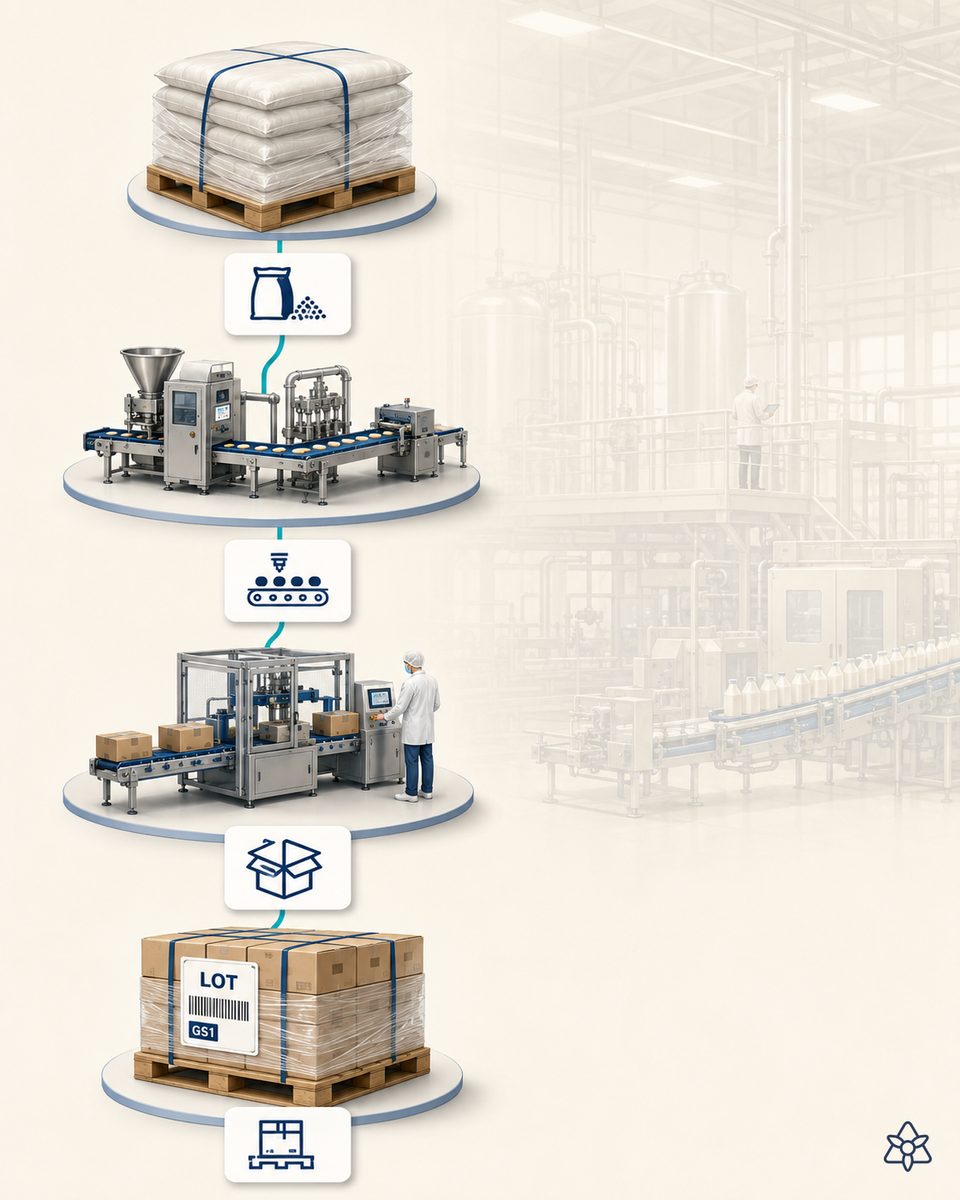
The control seal is not just another sticker — it is what makes your wine a PDO.
The regulatory council's seal or control number is not a decorative detail: it is the signature certifying that this specific wine, in this specific batch, meets the PDO specification. If the classic system (the council's Excel + a paper bottling report + the line lead's eye) fails, the consequences are harsh:
- A seal assigned to one batch and applied to another — the shipment goes out with a seal that does not belong to those bottles. If the council audits, it disqualifies the shipment.
- An unauthorized blend of vintages or tanks — an order changed at the last minute connects a tank that was not in the declaration. The label stops being true.
- Sulfite declaration or alcoholic strength out of range — the analyzer measured one value and the label states another, because someone reused the previous batch's template.
- Seal range exhausted mid-shift — bottling stops with no warning, or worse, numbers already used get reused.
The cellar manager knows all this, but cannot be on the council's portal, on the bottling report and at every pallet at the same time. The classic system works 99% of the time. That 1% is what costs you a vintage — and a disqualified vintage cannot be recovered.
iLEAN does not ask you to change your ERP or your council — it seals the cracks between the three worlds you already have.
PDO labeling does not fail for lack of information; it fails because the information lives on islands: the council's assignment on a portal, the bottling report in the MES or in Excel, the declared recipe in the ERP. At the second of the batch change, no system sees the full picture. iLEAN acts as the putty between those islands, without touching the wall.
Edge sees the back label before palletizing. Connect reads the council's assignment and the bottling report wherever they live. The agent cross-checks against the PDO specification and, if something does not add up, holds the pallet. The person signs — never the other way around.
The three iLEAN pieces applied to PDO wine labeling:
- Edge — a computer-vision (CNN) terminal over the bottling or labeling line. It reads the control seal, the vintage, the alcoholic strength and the sulfite declaration in milliseconds, and triggers the light stack or the rejector if anything fails to match the declaration. It works without a network. If the winery loses WiFi, Edge keeps reading and holding.
- Connect — captures the seal assignment whether it comes from the council's portal, from an email from the council's technician or from an Excel sheet the winemaker updates every morning. And it also captures the actual bottling report (connected tanks, flow rates, unscheduled stops) at second zero, without anyone forwarding anything.
- Agent — cross-references the council's assignment, the bottling report, the back-label image and the PDO specification. If the seal read is not in the assignment, if the connected tank is not authorized in the declaration, or if the seal range is running out ahead of time, it holds the pallet and alerts the manager. The person validates and signs; bottling does not restart on its own.
Classic labeling vs. cross-checked labeling with iLEAN
| Aspect | Classic bottling + checklist | With iLEAN Edge + Connect + Agent |
|---|---|---|
| Control seal assignment | Council Excel, copied by hand into the report | Assignment captured and cross-checked in line |
| Tank change mid-batch | Winemaker's verbal notice, handwritten note | Connect picks it up, the agent revalidates the declaration |
| Seal reading | Visual at the end, sampling | Edge reads 100% before palletizing |
| Sulfite declaration | Previous batch's template — copy-paste risk | Cross-checked against the batch's actual lab result |
| Operation without a network | n/a | Edge keeps running on the panel's own power |
| File for the council's audit | Rebuilt by hand, weeks | Per-pallet dossier, automatic, with photo and history |
Impact estimate for your plant — to be validated with your numbers.
The block below is an estimate to be validated with the specific data of your winery. We put it forward so the committee has an order of magnitude; we refine it during the diagnostic.
- Mid-sized winery under a PDO, 1-2 bottling/labeling lines, several active vintages and exports to several markets.
- Edge pilot on one line (camera over the back label + actuator + integration with the ERP/MES and the council's portal). First value expected within a few weeks.
- Indicative payback between 4 and 9 months, depending on the documented frequency of seal/declaration incidents and the average shipment volume.
- The hard lever is a single avoided PDO disqualification on an export shipment: blocked product, reverse transport, reputational damage with the importer. One incident pays for the pilot.
And the winemaker's reasonable doubt
“What if the AI misreads the control seal and lets a mislabeled pallet through?” — hallucination is a problem of free generation, not of anchored tasks. In tasks where the AI merely recontextualizes a piece of data from one system to another (reading the control seal and comparing it with the council's assignment), the best models brought error below 1.5% [1]. And even so, what is critical is never decided alone: iLEAN holds the pallet and the person signs. The three safety rings exist precisely for this.
[1] OpenAI paper “Why Language Models Hallucinate”, 2025 — on the reliability of AI in anchored tasks.
If you are interested in the rest of the wine cluster, also see grape must traceability and wine vintage traceability.
What people ask about PDO wine labeling
What does EU regulation require on PDO wine labeling?
The labeling of a Protected Designation of Origin (PDO) wine is governed by Regulation EU 1308/2013 and Delegated Regulation 2019/33, plus each regulatory council's product specification. It must carry the PDO name, the vintage, the council's control seal or control number, the actual alcoholic strength, the volume, the batch, the sulfite declaration (“contains sulfites” from 10 mg/l) and, depending on the destination market, specific warnings (US, United Kingdom, Canada). If the control seal does not match the batch actually bottled, the wine loses the PDO on that shipment.
How do you make sure the council's control seal matches the bottled batch?
By cross-checking three sources that today live on islands: the regulatory council's seal assignment (Excel, portal or delivery note), the bottling report (which tank, which vintage, what actual quantity) and the image of the back label that iLEAN Edge reads on the line itself. If the seal read does not appear in the council's assignment for that batch, or if the assigned range is running out ahead of time, the system holds the pallet before palletizing and alerts the cellar manager. The person signs — bottling does not restart on its own.
What happens when tanks from different vintages or PDOs get blended during bottling?
It is one of the critical points. The bottling report may say “tank 12, last year's vintage, PDO X”, but if a production order changed at the last minute also connects tank 14 (another vintage, same color), the declared label stops being true. iLEAN Connect captures the cellar crew's orders (including last-minute changes by voice or through the app), cross-references them with the tanks' flow rates and the declared recipe — and the agent blocks the shipment if the blend is not authorized by the council's specification.
Can iLEAN Edge read the back labels and the council's seals in line?
Yes. Edge is a computer-vision (CNN) terminal over the bottling or labeling line — it reads the seal/control number, the printed vintage, the alcoholic strength and the sulfite declaration, and cross-references them with the bottling report and the council's assignment. If something does not add up, it triggers the light stack or the rejector before palletizing. It works without a network: if the winery loses WiFi, Edge keeps reading and holding, because what is critical cannot depend on connectivity.
How much does AI labeling cost in a mid-sized PDO winery?
The order of magnitude of an Edge pilot on a winery bottling/labeling line is close to that of any Edge pilot in a food plant: an initial investment covering terminals + cameras + actuator + integration with the winery's ERP/MES and the council's portal, plus an annual license. The reasonable payback to present to the committee is several months — the hard lever is a single avoided PDO disqualification on a large shipment, which pays for the pilot by itself. We ask for your winery's data and send you the estimated ROI in 48h, with your numbers.
More cases in food
- Olive oil mill traceability with AI — segregating PDO and organic without slowing the yard down at the height of the harvest.iLEAN captures every weighbridge intake by photo, follows the batch to the tank and generates the…
- Predictive maintenance of HTST pasteurizers — the unplanned stop costs entire shifts.iLEAN combines vibration, differential pressure and temperature to predict HTST heat-exchanger failures…
- AI control of pâté and meat emulsions — a break is not discovered at packing, it is prevented at the cutter.How iLEAN cross-references cutter vision, bowl temperature and recipe to catch a broken pâté emulsion…
- Pet food extrusion with AI — the SKU changeover is the most expensive moment of the day. And it hinges on an Excel file the operator never read.iLEAN cross-checks kibble vision, moisture, density and recipe to stabilize pet food extrusion — less…
- Industrial artificial intelligence in rawhide chew treat factoriesTwelve real industrial AI cases in rawhide chew treat plants: paperless capture, in-line vision and an…
- Plant-based beverage control with AI — a cross-contact allergen gives no warning; it shows up in RASFF.How iLEAN keeps oat, soy and almond allergens apart, controls fortification and interim cleaning, and…
Tell us your case and in 48h we'll send you the estimated ROI of this AI project for your winery.
We work on your plant's real data, not ours. Diagnostic with no commitment.
Request estimated ROI in 48h See food industry