AI control of pâté and meat emulsions — a break is not discovered at packing, it is prevented at the cutter.
A broken emulsion means a lost batch: grainy texture, free fat, weeping inside the casing. iLEAN cross-references Edge vision over the cutter with temperature, speed and batch characteristics, and alerts the master charcutier with enough margin to correct before the bowl is closed. The person signs.
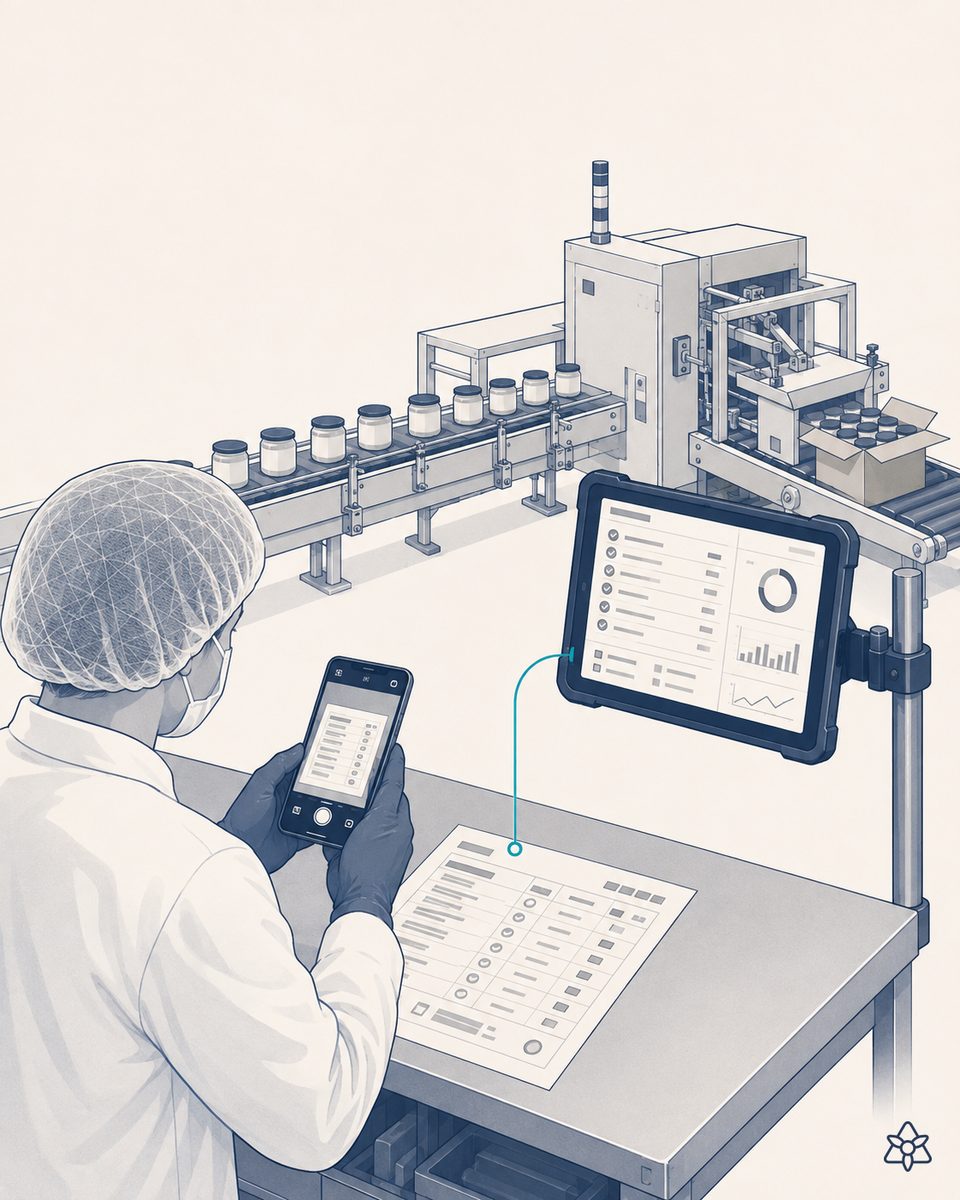
The recipe is the same. The batch is not.
A pâté is not made with a scale: it is made with the hands of the master charcutier, who looks into the bowl and decides whether to stop or carry on. Those hands capture what no system captures — the visual signature of an emulsion that binds versus one that does not. But the master's hands have three serious limitations in a modern plant:
- They have to be there — across three cutters at once, over three shifts, they cannot be.
- They leave with him — the day he retires, the pâté is signed off by someone who never read the bowl with the same eyes.
- They leave no traceability — the master's "that batch felt off to me" never enters any system, and is never cross-referenced with the final temperature or the fat percentage of the batch.
The classic setup is the master's eye, a final temperature probe and a tasting panel the next day. It works 99% of the time. That 1% is a batch sent to rework or, worse, a packed batch that weeps fat inside the casing and comes back from the retailer as a complaint. The expensive part is not the bowl: it is everything that gets packed, labeled, palletized and shipped before the break becomes obvious.
iLEAN does not replace the master — it captures his eye and puts it to work 24/7.
The emulsion problem is not a lack of recipe: it is that the knowledge that separates an emulsion that binds from one that does not lives in people, and the plant only has it when those people are there. iLEAN acts as the putty that fills the gaps between the cutter, the thermometer, the batch record in the ERP and the master's eye — without asking you to change the cutter or move the master between shifts.
Edge sees the texture in the cutter the way a master charcutier would. Connect reads temperature, speed and batch composition. The agent cross-references and alerts before the break is irreversible. The signature still belongs to the person.
The three iLEAN pieces applied to pâté and emulsion control:
- Edge — a terminal with machine vision (CNN) over the cutter or emulsifier. It reads texture, sheen, the presence of free fat and the pattern of the mass on every revolution. Trained per SKU with the master's eye during the immersion. It works without a network: if the plant loses WiFi, Edge keeps reading, because what is critical cannot depend on connectivity.
- Connect — captures bowl temperature (final value and ramp), knife speed, ice weight, batch fat percentage and order of addition. If the cutter is old, it reads a photographed analog panel or a handheld probe value dictated by voice into the earpiece. And it also captures what arrives from outside: the supplier certificate with the real fat percentage of the liver, the shift lead's WhatsApp message with the recipe change.
- Agent — cross-references vision, temperature, speed, batch and recipe. When the visible signature and the temperature point to an imminent break, it alerts the master with enough margin to correct — add ice, drop the speed, adjust the order. The person validates and signs; the bowl is never changed on its own.
Control by the master's eye vs. cross-referenced control with iLEAN
| Aspect | Master's eye + thermometer | With iLEAN Edge + Connect + Agent |
|---|---|---|
| Coverage per shift | 1 master, 1 lead cutter | Continuous across every cutter and shift |
| Traceability of "it felt off" | Verbal, gets lost | Recorded per batch and cross-referenced with data |
| Batch composition | Assumed from the delivery note | Captured from the certificate at second zero |
| Break detection | Sometimes only at packing | Before the bowl is closed |
| The master's successor | "Learn by watching me" | Visible pattern captured as a permanent capability |
| IFS/BRC file per batch | Rebuilt by hand | Dossier with temperature, cutter photo and signature |
Impact estimate for your plant — to be validated with your numbers.
The block below is an estimate to be validated with the specific data of your plant. We put it forward so the committee has an order of magnitude; we refine it during the diagnostic.
- A charcuterie room with 1-3 cutters, several references (country-style pâté, liver mousse, foie, sobrasada) and master charcutiers with deep, unwritten knowledge.
- Edge pilot on one cutter (camera over the bowl + integration with the thermometer + cross-referencing with recipe and batch certificate). First value expected within a few weeks.
- Indicative payback between 4 and 9 months, depending on how often batches go to rework today and on retailer complaints about weeping inside the casing.
- Expected reduction in scrap from broken emulsion of ≥30%. The hard lever is everything that today gets reworked, sold as a lower-margin paste or downgraded.
And the "my master has 30 years of experience, he doesn't need AI"
True — and the AI is not going to replace him either. What it will do is capture his eye as a permanent capability of the plant, so that the day the master retires half the room does not walk out with him. Industrial AI does not invent the tasting: it is trained on the existing tasting so the pattern lives in the system. In anchored tasks like this one (comparing a visible signature against history), the error of the best models drops below 1.5% [1]. But the decision about the bowl is still signed by a person — always.
[1] OpenAI paper "Why Language Models Hallucinate", 2025 — on the reliability of AI in anchored tasks.
What people ask about pâté and emulsion control
Why does a pâté emulsion break even when the recipe is identical?
Because the emulsion depends on the balance between fat, soluble protein, water and temperature — and that balance shifts with every batch. It is affected by the fat percentage of the incoming liver and meat (not the same in a young pig as in an adult one, nor in fresh liver as in frozen-then-thawed liver), by the final cutter temperature (if it heats up too much the fat melts before it binds), by knife speed, by the order of addition and by total time. When two or three variables move at once, the recipe still says the right thing but the emulsion breaks — free fat, grainy texture, weeping inside the casing.
How does iLEAN detect a broken emulsion without opening the batch?
iLEAN Edge installs a camera with a neural network (CNN) over the cutter or emulsifier. It reads visible texture, sheen, the presence of free fat and the pattern of the mass on every revolution. It cross-references that reading with the bowl temperature (final value and ramp-up), knife speed and the fat percentage of the batch. When the visible pattern points to an imminent break, the agent alerts the master charcutier before the bowl is closed — with enough margin to add ice, drop the speed or adjust the order of addition. The person decides the correction; the system only proposes.
Does it also work for foie, mousse, sobrasada or fish emulsions?
Yes. The pattern is the same in any meat or fish emulsion: the fat-protein-water-temperature balance. The recipe, the control points and the temperature windows change, but the logic of cross-referencing cutter vision + bowl readings + batch characteristics carries across. iLEAN is calibrated per SKU during the initial immersion — every product has its own visible signature and its own reference thermal curve.
What if the cutter is old and has no digital output?
That is the norm in charcuterie. iLEAN Connect applies its graduated capture: if the cutter has a PLC, direct integration; if it has a local panel with an analog temperature and speed display, a camera photographs the reading and the system turns it into data; if the thermometer is a handheld probe, the operator dictates the value by voice into the Connect earpiece. It does not force you to replace the cutter — it seals the cracks between what exists and what the agent needs to know.
How long does a pilot take in a cutting and emulsion room?
First value — a camera reading the cutter and an agent cross-referencing temperature and recipe — within a few weeks. The initial immersion lasts 3-5 days: the mixed team (people from your plant + an embedded AI engineer) works alongside the master charcutier, the Pareto of SKUs is identified (which references concentrate the volume) and the baseline is measured. Without a baseline there is no way to prove the improvement — that is why we measure the "before" before touching anything.
More cases in food
- Automated nutrition labeling with AI — changing one ingredient shouldn't mean reviewing hundreds of labels.iLEAN computes the nutrition panel from the recipe, generates the Nutri-Score and mass-updates every…
- Olive oil mill traceability with AI — segregating PDO and organic without slowing the yard down at the height of the harvest.iLEAN captures every weighbridge intake by photo, follows the batch to the tank and generates the…
- Predictive maintenance of HTST pasteurizers — the unplanned stop costs entire shifts.iLEAN combines vibration, differential pressure and temperature to predict HTST heat-exchanger failures…
- PDO wine labeling with AI — a misplaced control seal is not a fine, it is a disqualified vintage.How iLEAN cross-checks the regulatory council seal, the bottled batch and the sulfite declaration to…
- Pet food extrusion with AI — the SKU changeover is the most expensive moment of the day. And it hinges on an Excel file the operator never read.iLEAN cross-checks kibble vision, moisture, density and recipe to stabilize pet food extrusion — less…
- Industrial artificial intelligence in rawhide chew treat factoriesTwelve real industrial AI cases in rawhide chew treat plants: paperless capture, in-line vision and an…
Tell us your case and in 48h we'll send you the estimated ROI of this AI project for your pâté room.
We work on your plant's real data, not ours. Diagnostic with no commitment.
Request estimated ROI in 48h See food industry