Predictive maintenance of HTST pasteurizers — the unplanned stop costs entire shifts.
An unplanned stop of an HTST pasteurizer costs entire plant shifts and milk dumped in the flush. iLEAN combines vibration, differential pressure and temperature in an agent that learns from your own machine's failure history and predicts the failure of the exchanger or the pump days ahead. The intervention is scheduled at shift change — not in the middle of a packing run.
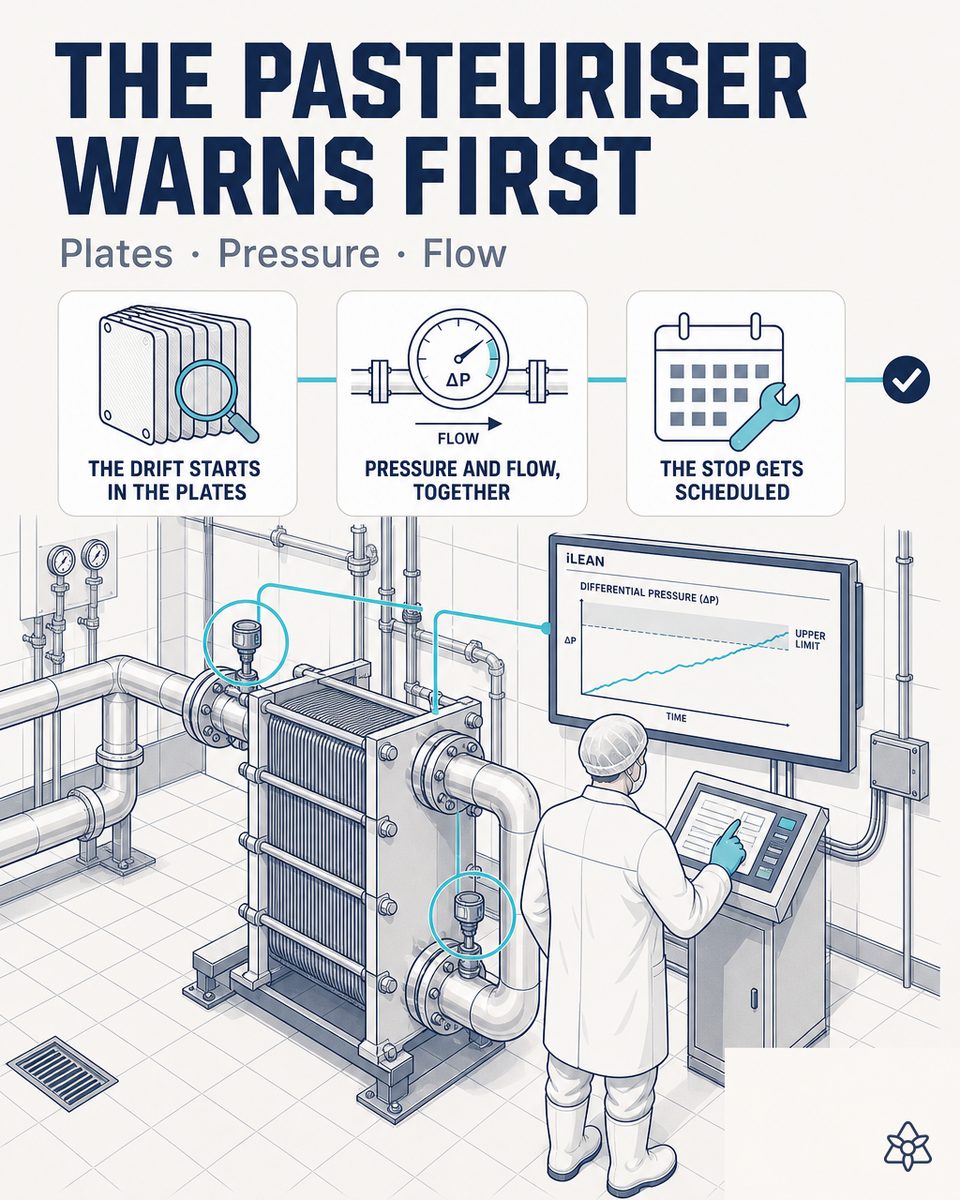
When the HTST stops mid-afternoon, the cost is not the part — it is four hours of shift and the milk in the flush.
An HTST pasteurizer that stops without warning is one of the worst scenarios in a dairy plant: the line downstream runs dry, packing stops, the cleaning crew has to come in early, and the milk in process ends up in the flush or in rework. And the pattern repeats:
- The plate heat exchanger fouls with burnt proteins, differential pressure climbs, thermal performance drops — and one day it stops pasteurizing at the target temperature.
- The centrifugal milk pump starts vibrating abnormally a few days beforehand — the operator “feels” it, but nobody is squaring that vibration with the history, so the warning arrives when the impeller has already broken.
- The SCADA has the data, but it has it raw, locked inside the machine, with nobody cross-referencing it with the maintenance plan or the history of previous failures.
The veteran maintenance lead sees the pattern. But they cannot be in three places at once, nor review four signals per machine every hour — and the day they retire, that eye leaves with them. Having the data joined up without an agent is a library without a librarian.
iLEAN does not replace the SCADA — it seals the crack between your signals and your maintenance plan.
The problem is not a lack of sensors: it is that the signals you already have are never cross-referenced with the history or the intervention plan, and nobody has time to do it by hand. iLEAN acts as the putty that fills that gap, without asking you to change the PLC, the SCADA or the CMMS.
Edge reads vibration and pressure where they live. The agent cross-references them with the failure history and predicts. The person decides when to intervene — the system only proposes, it never acts alone on the work order.
The iLEAN pieces applied to predictive maintenance of the HTST:
- Edge — a terminal on the floor next to the pasteurizer; it reads from the PLC over OPC-UA/Modbus, or adds its own accelerometer and pressure sensor where the machine does not deliver the signal. It processes locally: if the plant loses Internet, capture does not stop. What is critical cannot depend on WiFi.
- Maintenance agent — lives in Central, cross-references vibration + differential pressure + ΔT + flow with the maintenance reports of recent years and with this very machine's curve of previous failures. It identifies early failure signatures days ahead and prepares the reasoned work order for the CMMS. The person validates and schedules. The agent proposes — the maintenance manager decides.
- Connect — captures the maintenance reports that today live in the shift lead's email, the gasket-change Excels, the photos of the burnt thermocouple. Everything comes in and becomes the plant's permanent knowledge — it does not leave with whoever retires.
Reactive + calendar-based preventive maintenance vs. predictive with iLEAN
| Aspect | Reactive + calendar-based preventive | With iLEAN Edge + Agent |
|---|---|---|
| Exchanger fouling warning | When the outlet ΔT drops — already late | When differential pressure starts climbing, days ahead |
| Abnormal pump vibration | The operator “feels” it; nobody squares it | Cross-referenced with history, failure signature identified with margin |
| The veteran lead's knowledge | In their head — leaves with them | Captured in the agent, a permanent capability |
| Work order to the CMMS | By hand, after the failure | Automatic, reasoned, with the suggested window |
| Scheduling the intervention | During the unplanned stop | At shift change or over the weekend |
| Operation without plant network | n/a | Edge keeps capturing, powered from the cabinet |
Impact estimate for your plant — to be validated with your numbers.
The block below is an estimate to be validated with the specific data of your pasteurizer. We put it forward so the committee has an order of magnitude; we refine it during the diagnostic, reading your report history and your SCADA.
- Dairy plant with 1-2 HTST pasteurizers of 5-15,000 l/h, a CIP cleaning cycle every 6-8 h, and unplanned stops recorded over the past 24 months.
- Edge + agent pilot on one pasteurizer (PLC reading + accelerometer on the pump + differential-pressure sensor). First value expected within a few weeks (signature of a known failure detected with margin).
- Indicative payback between 4 and 9 months, depending on the number and cost of historical unplanned stops and the cost per hour of stopped shift in your downstream packing.
- Expected reduction of unplanned stops ≥ 30% after the agent's first learning cycle — and the hard lever is a single avoided unplanned stop that pays for the pilot.
And the maintenance manager's reasonable doubt
“What if the agent hallucinates and makes me replace a pump that was fine?” — hallucination is a problem of free generation, not of anchored tasks. When the AI limits itself to cross-referencing real SCADA signals with the failure history of the same machine, the best models brought error below 1.5% [1]. And even so, what is critical is never decided alone: the agent proposes and the maintenance manager signs. The three safety rings exist precisely for this.
[1] OpenAI paper “Why Language Models Hallucinate”, 2025 — on the reliability of AI in anchored tasks.
What people ask about predictive maintenance of pasteurizers
What signals does iLEAN monitor on an HTST pasteurizer?
The four key signals of the exchanger and the pump: vibration of the centrifugal milk pump (accelerometer on the casing), differential pressure between the inlet and the outlet of the plate stack (delta-P that climbs as it fouls), supply and return temperature (ΔT that drops as heat exchange degrades) and flow (a drop that betrays cavitation or a blockage). The four together, in an agent that understands the pasteurizer, anticipate the failure days earlier than any of them alone.
Do I need to replace the pasteurizer's PLC or SCADA?
No. iLEAN Edge sits on top of what you already have — it reads the PLC's signals over OPC-UA, Modbus or by direct capture from the SCADA if the interface is old, and if the machine has no usable output it adds its own accelerometer and its own pressure sensor without touching the original programming. The pasteurizer stays the pasteurizer — iLEAN is the intelligence layer placed on top.
How far in advance does iLEAN flag a failure on an HTST?
It depends on the failure mode, but the pattern is clear: progressive fouling of the exchanger (burnt proteins on the plates) has a differential-pressure and ΔT signature that grows measurably several days before forcing the cleaning stop. Degradation of the pump impeller or the bearings has a vibration signature that an agent trained on the history of previous failures identifies before it turns into an in-line failure. The system warns you with enough margin to schedule the intervention at shift change or over the weekend, not in the middle of a packing run.
Does iLEAN integrate with the existing CMMS?
Yes. When an agent detects a deviation that justifies intervention, it opens the work order directly in whatever CMMS the plant uses (SAP PM, a dairy-specific CMMS, Maximo, etc.) with the probable cause, the signals that trigger it and the suggested intervention window. The maintenance manager validates and schedules it — the order does not execute itself, but it arrives with the diagnosis already done.
Does iLEAN learn from the pasteurizer's history of previous failures?
Yes — and that is what makes it truly useful. During the initial immersion, the maintenance reports of recent years are loaded (when each pump, each gasket, each plate failed, and what signature it showed in the preceding weeks if the data is in the SCADA). The agent learns the specific patterns of your pasteurizer — not a generic manufacturer's — and improves with every subsequent incident. The veteran maintenance lead's knowledge, which would leave the day they retire, is captured as a permanent capability of the plant.
More cases in food
- NFC juice control with AI — premium doesn't sell with a Brix out of band.How iLEAN cross-checks Brix, color, pulp, cold chain and batch traceability to keep NFC juice quality…
- Automated nutrition labeling with AI — changing one ingredient shouldn't mean reviewing hundreds of labels.iLEAN computes the nutrition panel from the recipe, generates the Nutri-Score and mass-updates every…
- Olive oil mill traceability with AI — segregating PDO and organic without slowing the yard down at the height of the harvest.iLEAN captures every weighbridge intake by photo, follows the batch to the tank and generates the…
- AI control of pâté and meat emulsions — a break is not discovered at packing, it is prevented at the cutter.How iLEAN cross-references cutter vision, bowl temperature and recipe to catch a broken pâté emulsion…
- PDO wine labeling with AI — a misplaced control seal is not a fine, it is a disqualified vintage.How iLEAN cross-checks the regulatory council seal, the bottled batch and the sulfite declaration to…
- Pet food extrusion with AI — the SKU changeover is the most expensive moment of the day. And it hinges on an Excel file the operator never read.iLEAN cross-checks kibble vision, moisture, density and recipe to stabilize pet food extrusion — less…
Tell us your case and in 48h we'll send you the estimated ROI of this AI project for your pasteurizer.
We work on your plant's real data, not ours. Diagnostic with no commitment.
Request estimated ROI in 48h ‹ All dairy cases See food industry