Olive oil mill traceability with AI — segregating PDO and organic without slowing the yard down at the height of the harvest.
During the harvest the yard cannot stop — and traceability gets reconstructed afterwards. iLEAN captures every weighbridge intake by photo (delivery note, plate, weigh ticket), links it to the grower and the delivery at second zero, and follows the oil from milling to tank and to bottling. PDO/organic dossier and grower settlement with evidence, in one click. The person validates at every critical point.
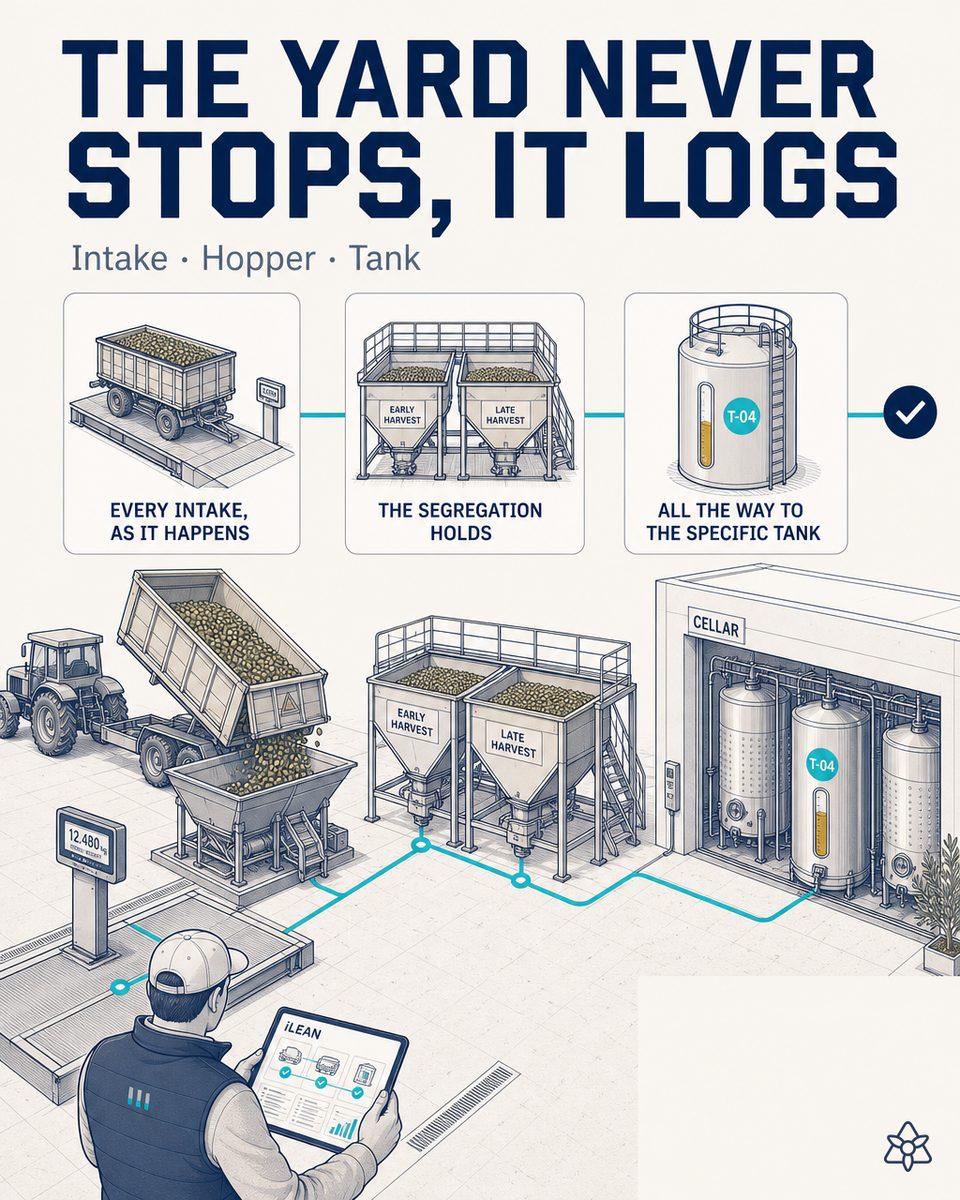
Ten weeks of 24/7 harvest — and a traceability record that gets rebuilt in January, when nobody remembers anything.
The milling season is short and extremely intense: a few weeks in which the mill runs 24 hours a day and the only rule that matters is not to stop the yard. Olive deliveries from hundreds of growers come across the weighbridge, each with its paper delivery note, its trailer and its hurry. And meanwhile:
- PDO and organic status demand demonstrable segregation — from the trailer all the way to the tank and the bottling line. Doing it right is not enough; you have to be able to prove to the certification body that the organic olives never crossed with the conventional ones in the hopper, on the line or in the cellar.
- The delivery note lives on paper — the weighbridge operator writes down what he can, the rest gets written up properly “when there's a gap”. At the height of the harvest that gap does not exist, and the records get rebuilt weeks later, from memory and from stacks of delivery notes.
- Cellar transfers get noted in the cellar operator's notebook — from tank 14 to tank 22, “half a load”, with no exact time. When the certification body asks for a batch's itinerary, the puzzle has to be reassembled backwards.
- The grower settlement depends on those records — kilos, oil yield, grade of each delivery. If the record was reconstructed after the fact, the argument with the grower gets settled on trust, not on evidence.
- The audit arrives once the harvest is over — and the team spends days assembling a dossier from papers sitting in three different filing cabinets.
The classic approach works as long as nothing goes wrong. But a single non-conformity in PDO or organic certification — or a serious dispute over settlement — costs more than a whole season's worth of paperwork put together.
iLEAN does not add more paper to the yard — it makes the record appear where the oil appears.
The bottleneck is not a lack of will to trace; it is that during the harvest nobody has a spare hand to type. The intake lives on a paper delivery note, the cellar lives in the cellar operator's notebook and the settlement lives in the cooperative's management software — and none of the three talks to the next one unless a person writes it all up weeks later. iLEAN is the putty that binds the three together — without changing the weighbridge, the management software, or the way the yard works.
Connect captures the intake by photo at second zero. The Tracer agent chains milling, tank and bottling, with every transfer recorded in one tap. The Writer agent generates the dossier for the certification body and the grower settlement with evidence. The person validates at every critical point.
The iLEAN pieces applied to olive oil mill traceability:
- Connect — captures the weighbridge intake exactly as it arrives: photo of the delivery note, trailer plate, weigh ticket. It links it to the grower, the declared parcel and the grade (PDO, organic, conventional) at second zero, with no typing from the weighbridge operator and no waiting for the truck. The critical information in an olive oil mill almost never comes in through an API; it comes in on paper, by photo and over the radio. Connect integrates it where it is born.
- Tracer agent — follows the delivery through the flow milling → cellar (tank) → bottling. Every transfer is recorded with one tap on the tablet and inherits the grade and history of the oil being moved; if a movement is about to mix grades, the alert fires before the valve opens. The master miller confirms the sensitive movements — without his signature, the system does not close the batch.
- Writer agent — generates the dossier by batch or by tank for the PDO/organic certification body with the evidence linked (delivery notes, weigh tickets, transfers, lab results), plus the settlement detail per grower with kilos, oil yield and grade for every delivery. What used to be days of filing cabinets is now one click — and the person reviews the dossier before it goes out.
The Brain that orchestrates the agents lives in Central; critical data stays in ring 1 of the mill, not in some generic cloud (see the IRIS architecture and the three safety rings).
Paper traceability vs. traceability with iLEAN
| Aspect | Paper delivery note + cellar notebook | With iLEAN Connect + Tracer + Writer |
|---|---|---|
| Weighbridge intake record | Whatever can be jotted down; written up properly weeks later | Photo at second zero, linked to grower and delivery |
| PDO / organic segregation | Done right, but hard to prove | Provable delivery by delivery, from trailer to tank |
| Cellar transfers | Cellar operator's notebook, with no time or name | One tap on a tablet, with time, name and inherited grade |
| Risk of mixing grades | Discovered at the audit — or never | Alert before the valve opens; master miller confirms |
| Dossier for the certification body | Days assembling papers from several filing cabinets | Generated by batch or tank in one click, with linked evidence |
| Grower settlement | Reconstructed records; disputes settled on trust | Detail per grower with delivery note, weigh ticket and lab result for every delivery |
Impact estimate for your mill — to be validated with your numbers.
The block below is an estimate to be validated with the specific data of your harvest. It is there so the board has an order of magnitude; we refine it during the diagnostic.
- Olive oil mill or cooperative with several hundred growers, one or two milling lines and multiple grades (PDO, organic, conventional). A harvest of 8 to 14 weeks worked in shifts.
- Deployment of Connect + Tracer/Writer agents built on the weighbridge and the management software you already have. First value expected within a few weeks, starting on a pilot harvest or on part of the yard.
- PDO/organic segregation provable without slowing the yard down at the height of the harvest; a drastic reduction in the time spent rebuilding records once the season ends. The hard lever is a single avoided certification non-conformity — or a settlement with no grower disputes.
- Indicative payback between 4 and 9 months (estimate to be validated), depending on intake volume, the number of segregated grades and the cost you assign to a non-conformity or a settlement dispute.
And the master miller's reasonable doubt
“What if the AI misreads the delivery note or the weigh ticket?” — hallucination is a problem of free generation, not of anchored tasks. Reading a delivery note, a plate and a weigh ticket and linking them to a grower on the member register is exactly an anchored task: the AI extracts specific data from a specific document and cross-references it against a closed list. In tasks like these, the best models brought error below 1.5% [1]. And even so, the person validates at every critical point — the weighbridge operator confirms the intake when the yard gives him a moment, and the master miller signs the sensitive movements. The three safety rings exist for exactly this.
[1] OpenAI paper “Why Language Models Hallucinate”, 2025 — on the reliability of AI in anchored tasks.
What people ask about olive oil mill traceability with AI
How is the weighbridge intake recorded without slowing the yard down mid-harvest?
Without typing anything. The weighbridge operator takes a photo of the delivery note and the weigh ticket — or the weighbridge camera captures it on its own along with the trailer plate — and Connect links the delivery to the grower, the declared parcel and the grade (PDO, organic or conventional) at second zero. The truck does not wait: human validation comes later, on the tablet, when the yard gives you a moment. During the harvest the priority is to keep milling; recording stops being a toll booth.
Does it prove PDO and organic segregation to the certification body?
Yes — that is the main lever. Every delivery comes in already graded and the system chains its journey: hopper, milling line, storage tank and bottling batch. If a transfer is about to mix grades, the alert fires before the valve opens, not during the audit. When the certification body arrives, the Writer agent generates the dossier by batch or by tank with the evidence linked (delivery notes, weigh tickets, transfers, lab results) in one click, aligned with Regulation (EC) 178/2002 on traceability and Regulation (EU) 2018/848 on organic production.
How are transfers between tanks in the cellar recorded?
With one tap on the tablet: source tank, destination tank and volume — the system automatically inherits the grade and the history of the deliveries that make up the oil being moved. If the destination tank still holds remains of another grade, iLEAN flags it and asks the master miller to confirm before accepting the movement. Nothing gets jotted on a scrap of paper in the cellar operator's pocket to be written up properly in January: the record is born at the moment of the transfer, with a timestamp and a name attached.
How does it help with grower settlements?
Settlement stops being reconstructed after the fact. Every grower has their intakes with linked evidence: photo of the delivery note, weigh ticket, oil yield from the lab analysis and the grade of each delivery. When the cooperative settles, the Writer agent generates the detail per grower with the kilos, the yield and the price applied — and a grower who disputes a delivery can look at the delivery note and the weigh ticket from that specific day. Disputes get resolved by looking at the evidence, not at the weighbridge operator's memory.
Do I have to change the weighbridge software or the cooperative's ERP?
No. Connect builds on what you already have: the weighbridge indicator, the cooperative's management software, the cellar sheet or even the paper delivery note. It captures the information where it is born — photo, screen, file or API if one exists — and structures it without demanding migrations. Deployment starts on a pilot harvest or on part of the yard, and the first value arrives within a few weeks, before the next milling run. The brain orchestrates in Central; critical data stays in ring 1 of the mill.
More cases in food
- Multihead weigher with AI — so you know which head is giving away grams.iLEAN detects per-head calibration drift, overfill and jams on multihead weighers — before the bag, not…
- NFC juice control with AI — premium doesn't sell with a Brix out of band.How iLEAN cross-checks Brix, color, pulp, cold chain and batch traceability to keep NFC juice quality…
- Automated nutrition labeling with AI — changing one ingredient shouldn't mean reviewing hundreds of labels.iLEAN computes the nutrition panel from the recipe, generates the Nutri-Score and mass-updates every…
- Predictive maintenance of HTST pasteurizers — the unplanned stop costs entire shifts.iLEAN combines vibration, differential pressure and temperature to predict HTST heat-exchanger failures…
- AI control of pâté and meat emulsions — a break is not discovered at packing, it is prevented at the cutter.How iLEAN cross-references cutter vision, bowl temperature and recipe to catch a broken pâté emulsion…
- PDO wine labeling with AI — a misplaced control seal is not a fine, it is a disqualified vintage.How iLEAN cross-checks the regulatory council seal, the bottled batch and the sulfite declaration to…
Tell us your case and in 48h we'll send you the estimated ROI of this AI project for your olive oil mill.
We work on the real data of your harvest and your member register, not on ours. Diagnostic with no commitment.
Request estimated ROI in 48h See food industry