Automated nutrition labeling with AI — changing one ingredient shouldn't mean reviewing hundreds of labels.
Changing one ingredient triggers a review of hundreds of labels. iLEAN computes the nutrition panel and the Nutri-Score from the recipe, checks functional claims and updates every affected SKU in a single pass. The person signs the list; the system regenerates the artwork.
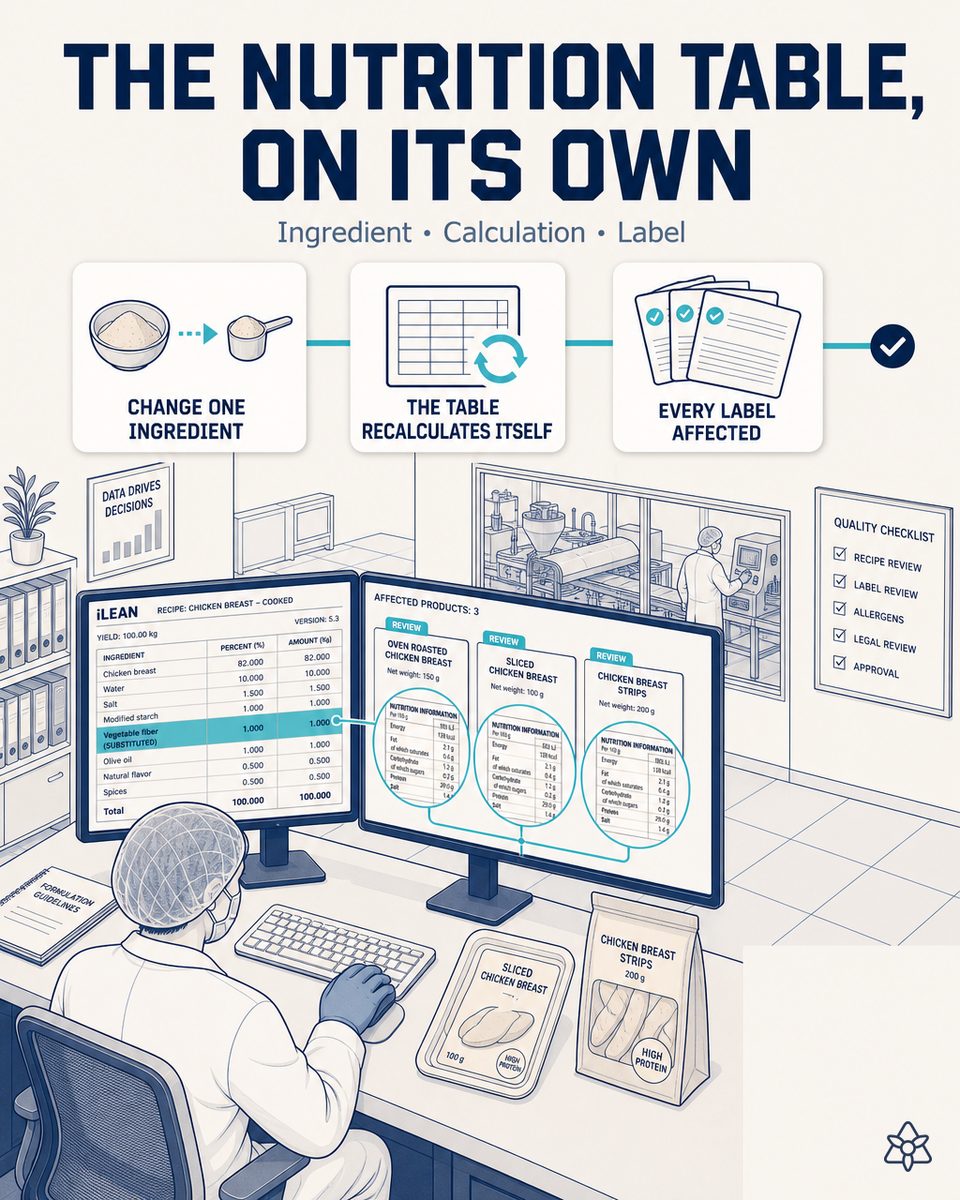
A supplier change turns the labeling team's morning into a Sunday at the office.
The quality manager gets the notice at 9:00: the oil supplier has changed origin and the technical data sheet is slightly different. What for him is “one more data point” means four days for the labeling manager, going through Excel sheets one by one to identify:
- Which SKUs use that ingredient — and here there is already room for one to slip through, because the recipe lives in the ERP, the percentages in an R&D sheet and the list of active SKUs in the retailer's ECM.
- What changes in the nutrition panel — recalculating calories, fat, saturated fat, carbohydrates, sugars, protein, salt. Multiply by the new data sheet, apply rounding, apply tolerance.
- Which claims fall — if the new fat pushes above the threshold of Regulation EU 1924/2006, the “low fat” claim is no longer legal and a reprint is due.
- Which Nutri-Score changes — the Santé Publique France algorithm is public but has nuances (fiber, fruit/vegetables/legumes, sodium); recalculating it by hand is slow and error-prone.
- Which retailer to notify — and with what lead time, because each one has its own in its label management system.
Four days later, the label ships. And sometimes an SKU slips through that nobody had flagged, because the recipe was duplicated in another folder. The classic system works 99% of the time. That 1% is what triggers the incident with the importer — and, in the worst case, the recall.
iLEAN does not add one more Excel sheet — it seals the gap between recipe, regulation and print shop.
The bottleneck is not the nutrition calculation itself (that is arithmetic); it is that the recipe lives on one island, the regulation lives on another (EU 1169/2011, FDA 21 CFR 101, EU 1924/2006, Nutri-Score) and the print shop lives on a third. None of them talks to the next unless a person plays messenger. iLEAN is the putty that joins the three — without asking you to change your ERP, your MES or the label management system you already have.
Connect captures the recipe wherever it lives. The Writer agent recalculates the panel and the Nutri-Score and verifies claims. The Tracer agent detects which SKUs change and prepares the resend to the print shop. The person signs the list — nothing gets printed without a signature.
The iLEAN pieces applied to automated nutrition labeling:
- Connect — captures the recipe whether it comes from a modern ERP, a vertical MES, an R&D sheet, or the technical data sheet PDF the supplier sent by email. Critical information almost never arrives through an API; it arrives by email, WhatsApp or phone call. Connect integrates it at second zero, without anyone forwarding anything.
- Writer agent — recalculates the nutrition panel applying the rounding and tolerance rules of EU 1169/2011 or FDA 21 CFR 101 depending on the destination market. It generates the Nutri-Score with the official algorithm and verifies functional claims one by one against Regulation EU 1924/2006. If a claim falls, the agent alerts marketing before printing.
- Tracer agent — cross-references the change with the inventory of active SKUs, identifies every affected one (including those living in duplicated folders), flags which need reprinting, regenerates the artwork and prepares the package for your print shop or your label management system (Loftware, NiceLabel, BarTender). The quality manager signs the list. Without a signature, nothing goes out.
The brain (Brain) that orchestrates the agents lives in Central; critical data stays in the plant's ring 1, not in just any cloud (see the IRIS architecture and the three safety rings).
Manual recalculation vs. automatic recalculation with iLEAN
| Aspect | Manual recalculation + Excel | With iLEAN Connect + Writer + Tracer |
|---|---|---|
| Time from ingredient change to label ready | Days, sometimes weeks | Hours — the person only validates |
| Affected SKUs detected | The ones the team remembers | 100% — including duplicates in other folders |
| EU 1169 vs FDA template | Two parallel calculations by hand | One recipe, two automatic outputs |
| Nutri-Score | Excel sheet with a homegrown formula | Official Santé Publique France algorithm built in |
| Claim verification (EU 1924/2006) | Manual check at the end, if there is time | Automatic — a claim that falls is flagged before printing |
| Delivery to print shop / label management | Email + attachment, package by package | Export to the right format (Loftware, NiceLabel, BarTender, PDF/X) |
Impact estimate for your plant — to be validated with your numbers.
The block below is an estimate to be validated with the specific data of your catalog. It gives the committee an order of magnitude; we refine it during the diagnostic.
- Company with 80-300 active SKUs in one or several markets (EU + UK + US, for example). Supplier or ingredient changes 2 to 6 times a year, multiplied by the number of retailers that demand their own artwork.
- Deployment of Connect + Writer/Tracer agents integrated with your ERP/MES and your label management system. First value expected within a few weeks on a pilot product family (sauces or cookies, for example).
- Expected reduction in mass regeneration time ≥30% (often much more, but that is the defensible floor). Fewer labeling errors from undetected SKUs: the hard lever is a single importer or retailer incident avoided.
- Indicative payback between 4 and 9 months, depending on SKU volume, frequency of changes and the average cost of reprints/claims in your chain.
And R&D's reasonable doubt
“What if the AI gets the nutrition calculation wrong?” — hallucination is a problem of free generation, not of anchored tasks. Recalculating a nutrition panel from a quantitative recipe is exactly an anchored task: the AI recontextualizes one piece of data (grams per ingredient) using another (unit nutritional value) and applies deterministic rules (rounding, tolerance). In this type of task, the best models brought error below 1.5% [1]. And even so, the person validates the list — without a signature, nothing goes to print. The three safety rings are there for this.
[1] OpenAI paper “Why Language Models Hallucinate”, 2025 — on the reliability of AI in anchored tasks.
What people ask about automated nutrition labeling with AI
How does it comply with EU 1169/2011?
Regulation EU 1169/2011 requires publishing the energy value and the six macronutrients in tabular format, with specific tolerances and rounding rules. iLEAN starts from the quantitative recipe (BoM) recorded in your ERP/MES, multiplies by the unit nutritional values of each ingredient (USDA, BEDCA, supplier data sheets) and applies the official rounding and tolerance rules. The panel comes out print-ready and always matches the current recipe, not the one filed away two years ago.
And for the US market (FDA)?
Same calculation, different template. The FDA requires the Nutrition Facts format with serving size, highlighted calories and the updated list of mandatory nutrients (vitamin D, calcium, iron, potassium). iLEAN maintains two parallel templates — EU 1169/2011 and FDA 21 CFR 101 — and generates the correct version for each SKU's destination market. When you export to the UK, Switzerland or Canada, we also add those as additional templates with each market's particularities.
When must the label be updated?
Whenever anything material changes: an ingredient, its supplier, its origin, its percentage in the recipe, the presentation. The regulation does not forgive “we forgot”; neither does the retailer. iLEAN traces the change at the source — the R&D manager edits the recipe, the system detects which SKUs use it, recalculates the panel, regenerates the label, flags the ones that need reprinting and resends the artwork to the print shop. The person validates the list before release; nothing gets printed without a signature.
What about functional claims?
“High in fiber”, “source of protein”, “low fat” and the rest of the claims are regulated by Regulation EU 1924/2006, and each one requires a specific threshold. iLEAN automatically verifies, against the freshly calculated nutrition panel, which claims are still legal and which have stopped being legal after the recipe change. If a claim falls, the system alerts the marketing team before the batch is printed — not after the importer's complaint.
Does it integrate with the label printer?
Yes. iLEAN exports the final artwork in the formats your print shop or your label management system uses (Loftware, NiceLabel, BarTender, PDF/X with GS1 codes). Mass regeneration includes versioning and change control, so you can show the IFS/BRC auditor on what date and for what reason each label was changed. And if the print shop is external, we generate the package ready to send.
More cases in food
- MAP packaging with AI — a bad mix or a micro-leak should not be discovered when the customer returns the product.iLEAN measures CO2/N2/O2 in line, detects MAP tray leaks and extends shelf life without pulling…
- Multihead weigher with AI — so you know which head is giving away grams.iLEAN detects per-head calibration drift, overfill and jams on multihead weighers — before the bag, not…
- NFC juice control with AI — premium doesn't sell with a Brix out of band.How iLEAN cross-checks Brix, color, pulp, cold chain and batch traceability to keep NFC juice quality…
- Olive oil mill traceability with AI — segregating PDO and organic without slowing the yard down at the height of the harvest.iLEAN captures every weighbridge intake by photo, follows the batch to the tank and generates the…
- Predictive maintenance of HTST pasteurizers — the unplanned stop costs entire shifts.iLEAN combines vibration, differential pressure and temperature to predict HTST heat-exchanger failures…
- AI control of pâté and meat emulsions — a break is not discovered at packing, it is prevented at the cutter.How iLEAN cross-references cutter vision, bowl temperature and recipe to catch a broken pâté emulsion…
Tell us your case and in 48h we'll send you the estimated ROI of this AI project for your SKU catalog.
We work on your plant's and your catalog's real data, not ours. Diagnostic with no commitment.
Request estimated ROI in 48h See food industry