Multihead weigher with AI — so you know which head is giving away grams.
A 14- or 24-head multihead weigher gives away product when nobody knows which head has drifted out of calibration. iLEAN cross-checks the curve of each head with the final weight and alerts the packing operator before the drift becomes a fixed cost of the week — without scrapping the weigher or the MES.
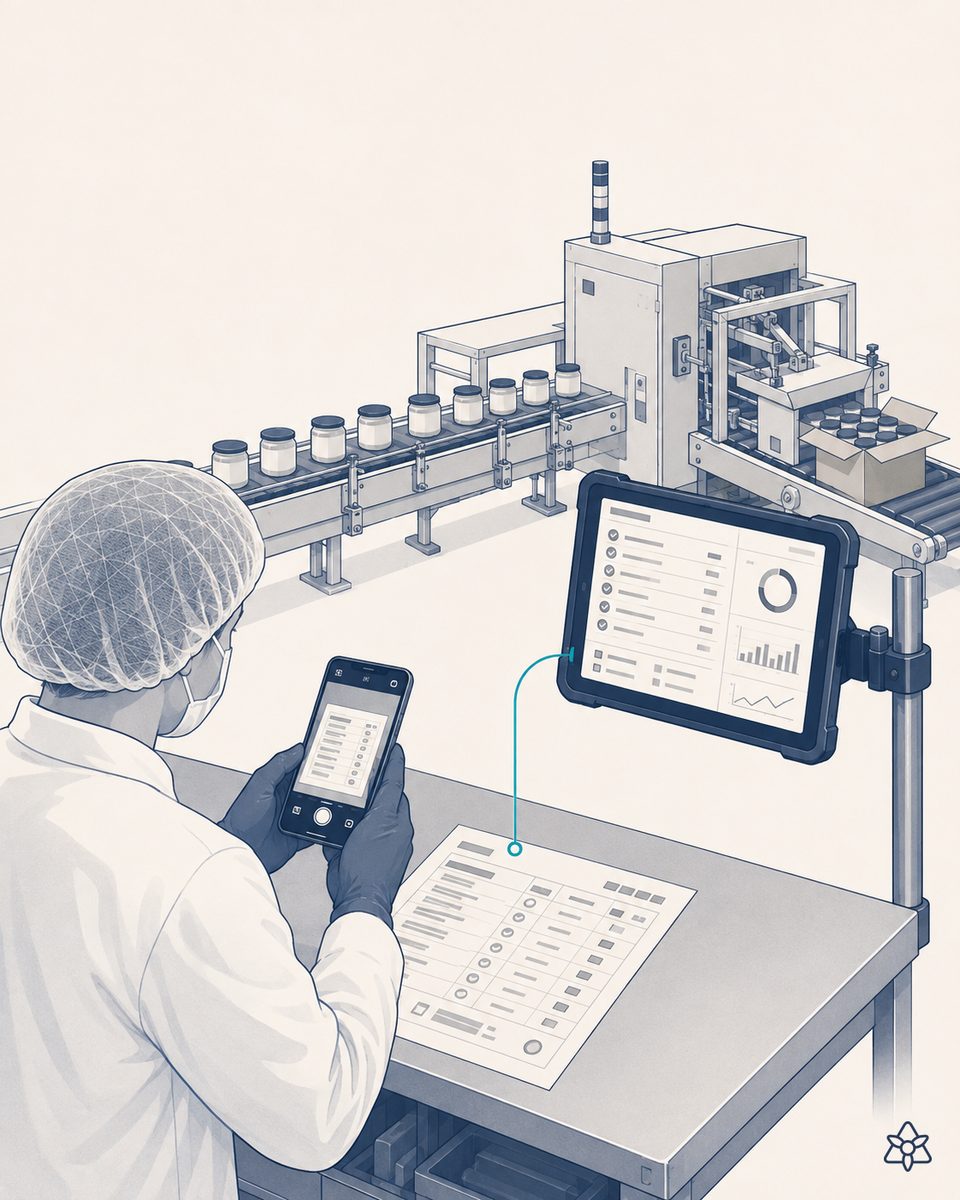
The weigher says "weight OK." The bag runs two grams over.
A multihead weigher works on a beautiful combinatorial trick: 14 or 24 heads, each with a partial weight, and an algorithm that picks the combination that best matches the product's target. It works very well — until one head starts to drift:
- The operator does not see it — the total weight of every bag stays within tolerance. The batch statistics do not raise a flag.
- The classic system adjusts the target — the packing operator nudges the setpoint up so as not to run short, and starts giving away grams on every bag.
- The secondary weight check downstream sees a slightly high weight, but since it "meets e-mark," nothing trips.
- Only at the weekly audit does someone weigh head by head and discover that head 7 has been running +1.3 g for three weeks.
Three weeks at +1.3 g on a line packing 50,000 bags/day is hundreds of kilos of product given away, plus extra bags in inventory that nobody expected. It is not a weigher failure — it is the consequence of weighing combinations without knowing which head is inside each combination.
iLEAN does not change the weigher — it puts an agent on top that reads head by head.
The problem is not a lack of data: the Ishida or the Yamato logs every partial weight of every head on every cycle. The problem is that that data lives isolated inside the weigher itself and is never cross-checked against the planned SKU, the secondary weight check or the head's history. iLEAN acts as the putty that binds the weigher to the rest of the system and lets an agent follow the data — without replacing the packing operator.
Connect reads the weigher whether the data comes from the native port or from OPC-UA. The agent analyzes per-head drift. Edge closes the loop when a camera is needed. The packing operator signs the adjustment — the packing operator always signs.
The three iLEAN pieces applied to multihead weighing:
- Connect — captures the head-by-head data on every cycle of the Ishida/Yamato/Multipond. If the weigher is old, it reads the touch panel with OCR or hooks into the checkweigher system downstream. The data comes in at second zero.
- Agent — analyzes each head's drift against its history, against the final per-bag weight and against the SKU target. It alerts the packing operator with an actionable message ("head 7, drift +1.3 g, suggest recalibrating") and leaves the decision to the operator. It keeps the per-batch dossier.
- Edge — when the product is troublesome (sticky, fragile, irregular geometry), a camera over the head or the bucket cross-checks the weight data with the image and tells a real jam from normal product behavior.
Weekly calibration vs. per-head adjustment with iLEAN
| Aspect | Weigher + checkweigher + audit | With iLEAN Connect + Agent + Edge |
|---|---|---|
| Detecting an out-of-calibration head | Weekly audit, weighing one by one | Per-head statistics in real time |
| Reaction to drift | Raise the overall target → give away grams | Recalibrate the affected head |
| Jam from sticky product | Operator sees it once there is a backlog | Alert from statistics + image, earlier |
| Average giveaway per bag | Accepted as a fixed cost | Cut down to real cost — hard lever |
| Per-bag traceability | Total weight only | The head combination that formed it |
| e-mark compliance | Same | Same, but with less product given away |
Impact estimate for your plant — to be validated with your numbers.
The block below is an estimate to be validated with the specific data of your plant. We put it forward so the committee has an order of magnitude; we refine it during the diagnostic.
- Packing line with a 14-24-head multihead weigher, snacks/nuts/confectionery/fresh meat/sliced cheese, volume between 20,000 and 100,000 bags/day.
- Connect pilot on the weigher + per-head drift agent, with no Edge camera at first. First value expected within a few weeks.
- Indicative payback between 4 and 9 months, dominated by the giveaway reduction. On SKUs with expensive product (nuts, sliced cheese), payback comes faster.
- Hard levers: giveaway reduction ≥ 30% over the current average giveaway, fewer jam-related stops, per-batch dossier for the e-mark audit.
And the packing operator's reasonable doubt
"What if the agent calls the drift wrong and I detune a healthy head?" — the agent proposes, it does not touch anything. The recalibration is decided and signed by the packing operator. And AI reliability on anchored tasks (cross-checking a head's weight with its history) sits below 1.5% error [1]. The three rings are there precisely so the operator decides what is critical.
[1] OpenAI paper "Why Language Models Hallucinate," 2025 — on AI reliability in anchored tasks.
What people ask about AI multihead weighing control
How does iLEAN detect which specific head is out of calibration?
By reading each head separately and comparing its individual statistics against the batch and against its own history. A 14- or 24-head multihead weigher puts several heads into every combination; if one head systematically shows up in combinations that weigh above target, that head is overweighing. The iLEAN agent isolates it by correlation and alerts the packing operator with "head 7, drift +1.3 g over the last two hours." No more stopping the batch to weigh head by head: the pattern shows up in the data.
Does it work with Ishida, Yamato and Multipond weighers?
Yes. iLEAN Connect talks to all three families through their native interface (Ishida i-Service / Yamato Dataweigh / Multipond MCC) or over OPC-UA if it is enabled. If the weigher is old with no exposed interface, Connect reads the touch panel with OCR or hooks into the secondary weighing system downstream. The final per-bag weight can always be captured — the trick is cross-checking it with the head combination that formed it.
Does it deliver a measurable cut in product giveaway?
Yes, and it is the project's hard lever. A weigher tuned to "never run short" typically gives away 1% to 4% of product per bag — on a 200 g SKU at 50,000 bags/day, that is 100 to 400 kg of product given away every day. iLEAN cuts that giveaway by calibrating the system with the real per-head drift, not with a generic margin. EU 1169 traceability on net quantity (e-mark) is still met — but without throwing product away.
Does it detect jams caused by sticky or fragile product?
Yes. A jammed head stops taking part in combinations; the statistics catch it before the operator does. For sticky products (sliced cheese, gummies, fresh meat), iLEAN cross-checks the weight, the head's discharge frequency and the image of the bucket (when there is an Edge camera) to tell a real jam from normal product behavior. It alerts the operator through the earpiece or the panel, without stopping the whole line over a false alarm.
Does it integrate with MES traceability?
Yes. iLEAN writes into the MES (Wonderware, Aveva, Hydra, in-house) the traceability of which heads formed each bag, what deviation each combination had and what calibration events occurred during the batch. That lets the quality manager answer a weight complaint in minutes instead of hours. And if an e-mark auditor shows up, the dossier already exists.
More cases in food
- Real AI cases in the meat industryReal AI cases in meat processing: vacuum pack leaks, curing chamber control and beef carcass…
- Milk fat control with AI — the lab knows, the line doesn't, and the batch is already made.iLEAN reads the MilkoScan/Foss, cross-references recipe and whole/skim balance and proposes the inline…
- MAP packaging with AI — a bad mix or a micro-leak should not be discovered when the customer returns the product.iLEAN measures CO2/N2/O2 in line, detects MAP tray leaks and extends shelf life without pulling…
- NFC juice control with AI — premium doesn't sell with a Brix out of band.How iLEAN cross-checks Brix, color, pulp, cold chain and batch traceability to keep NFC juice quality…
- Automated nutrition labeling with AI — changing one ingredient shouldn't mean reviewing hundreds of labels.iLEAN computes the nutrition panel from the recipe, generates the Nutri-Score and mass-updates every…
- Olive oil mill traceability with AI — segregating PDO and organic without slowing the yard down at the height of the harvest.iLEAN captures every weighbridge intake by photo, follows the batch to the tank and generates the…
Tell us your case and in 48h we'll send you the estimated ROI of this AI project for your packing line.
We work on your plant's real data, not ours. Diagnostic with no commitment.
Request estimated ROI in 48h See food industry