Milk fat control with AI — the lab knows, the line doesn't, and the batch is already made.
Closing out % fat in a dairy plant is hard because the analysis lives in the lab, the cream dosing lives on the line, and between the two there is an operator in a hurry. iLEAN reads the MilkoScan or Foss, cross-references it with the recipe and the tank balance, and proposes the adjustment to the operator before the batch drifts. The person signs.
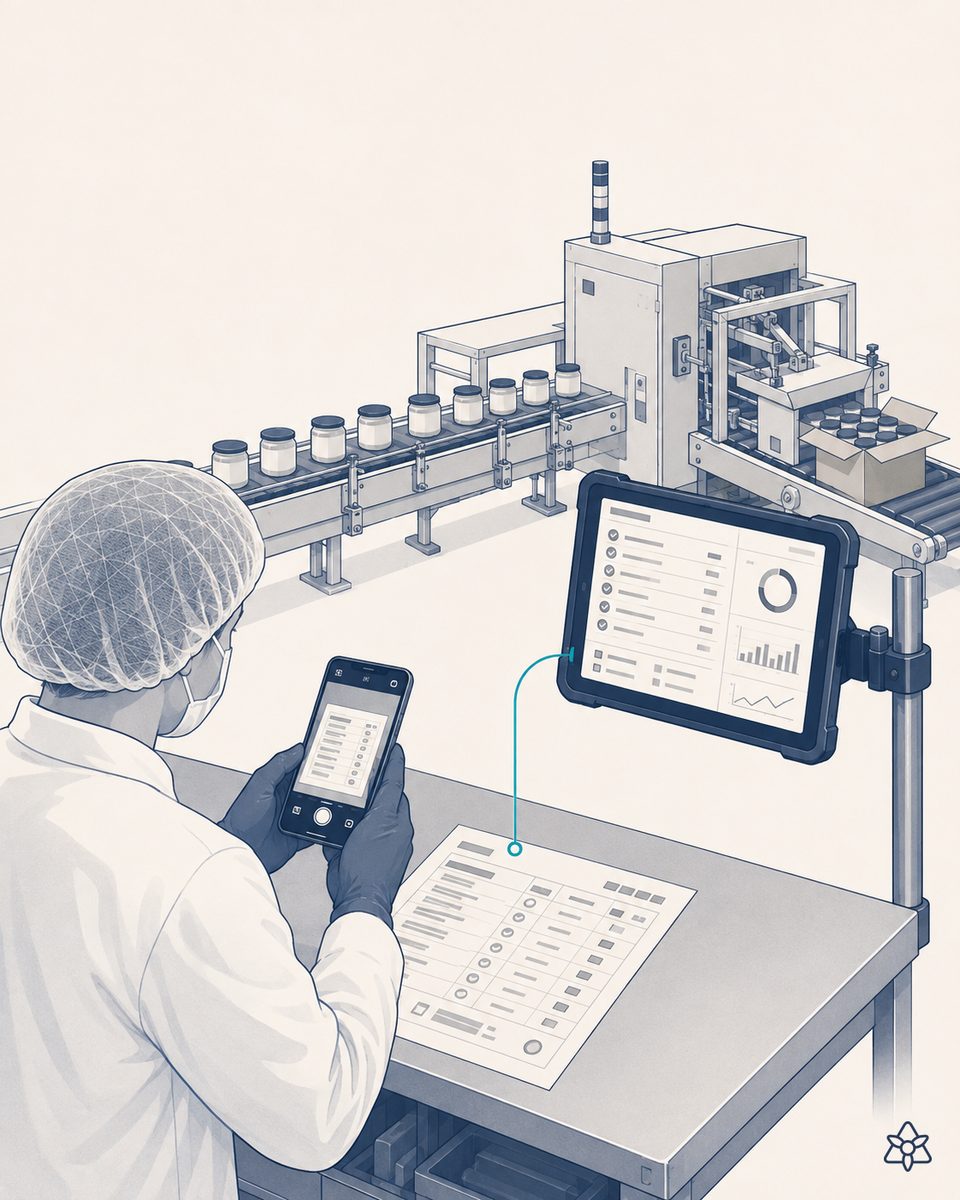
The lab confirms it once the batch is already made.
Controlling % fat in milk is a simple equation — whole milk, skim milk, recovered cream, target — but the data does not reach the person dosing in time:
- The MilkoScan/Foss analyzes the sample and spits out a result. In most plants, that result gets printed, jotted down or left sitting on the lab computer.
- The line operator doses cream with the recipe at hand, assuming the tank balance is the same as yesterday's.
- The lab re-runs the analysis when the batch is already bottled, packed or in the tanker.
- If the batch has drifted — a quarter of a point, half a point — the decision is: rework (slow, expensive, lost capacity) or sell below the spec sheet (a risk with the industrial customer).
And that assumes the MilkoScan is calibrated, that the lab computer talks to the ERP, and that the operator has time to read the panel. The classic system works 99% of the time. That 1% is the rework of the year.
iLEAN does not touch the MilkoScan or the line — it seals the crack between the two.
The milk fat problem is not a sensing problem: the MilkoScan already measures well. It is information living on islands that, at the critical moment — the seconds in which the operator decides how much cream to add — does not arrive in time. iLEAN acts as the putty that fills those gaps without asking you to change lab equipment or the standardization line.
Connect reads the MilkoScan and the tank balance. The agent cross-references with the recipe and proposes the adjustment on the operator's channel. The person signs — never the other way round.
The two iLEAN pieces applied to milk fat control:
- Connect — reads directly from the MilkoScan, Foss FT2/FT3, MilkoSpec, Lactoscope, Bentley FTS or whatever equipment you have. If the equipment is old and isolated, it reads from the screen or the local port; if all it does is spit out a ticket, a person photographs it. It also captures what arrives from outside (an email from the industrial customer with the new spec sheet, a WhatsApp from the cream supplier about a change in composition) at second zero.
- Agent — cross-references the reading with the batch recipe, the whole/skim/cream balance across tanks, the line flow rate and the history of the last few shifts. If the target is going to drift, it proposes the cream adjustment to the operator on their channel (earpiece, tablet, phone) with enough time to act. What is critical is never decided alone: the operator or the shift lead signs. If they decide not to apply it, that is recorded for later analysis.
Standardization by ear vs. assisted standardization
| Aspect | Classic standardization | With iLEAN Connect + Agent |
|---|---|---|
| MilkoScan reading | Printed ticket or the lab screen | Continuous reading, cross-referenced with the recipe |
| Tank balance | Previous shift's spreadsheet | Real-time status |
| Cream adjustment | Fixed recipe + the operator's eye | Suggested by the agent, signed by the person |
| Drift detection | When the lab re-runs the analysis | Before the batch is closed, with margin |
| Rework | Frequent in multi-SKU | Exceptional |
| Spec sheet to the industrial customer | Batch sometimes out of spec | Batch within spec, traceable per shift |
Impact estimate for your plant — to be validated with your numbers.
The block below is an estimate to be validated with your plant's data. We put it forward so the committee has an order of magnitude; we refine it during the diagnostic.
- Liquid milk plant + derivatives (yogurt, cheese or milk powder), MilkoScan/Foss in the lab, standardization with recovered cream, 3 shifts.
- Connect + Agents pilot on standardization. First value expected within a few weeks: assistance to the operator with the first adjustment suggestion based on cross-referenced data.
- Indicative payback between 4 and 9 months, with the hard lever in rework avoided, better yield downstream (cheese/yogurt) and spec-sheet compliance with industrial customers.
- A reduction in standardized-milk rework of the order of 30% or more is defensible as a conservative floor.
And the production manager's reasonable doubt
“What if the AI proposes the wrong adjustment and the batch goes out of spec because we followed it?” — hallucination is a problem of free generation, not of anchored tasks. In tasks where the AI merely cross-references a measured value with a recipe (the MilkoScan reading + the tank balance + the recipe), the best models brought error below 1.5% [1]. And even so, what is critical is never decided alone: the agent proposes, the operator or the shift lead signs. The three safety rings exist precisely for this.
[1] OpenAI paper “Why Language Models Hallucinate”, 2025 — on the reliability of AI in anchored tasks.
What people ask about milk fat control
Why is it so hard to close out % fat in a dairy plant?
Because the analysis lives in the lab (MilkoScan, Foss, MilkoSpec, Lactoscope), the cream dosing lives on the line, and between the two there is an operator in a hurry and a spreadsheet. By the time the lab confirms that a batch has drifted, the batch is already packed or, worse, blended into the next one. Reworking standardized milk is slow and expensive — and in derivatives (yogurt, cheese, powder) the deviation shows up as a yield hit downstream.
How does iLEAN reconcile the MilkoScan reading with cream dosing?
Connect reads directly from the MilkoScan/Foss — without asking you to change the equipment — and sends the reading to an agent that cross-references it with the batch recipe, the whole/skim tank balance and the flow rate on the standardization line. If the deviation is going to compromise the target, the agent proposes the cream adjustment to the operator on whichever channel they use (earpiece, tablet, phone). What is critical is never decided alone: the person validates and signs. The system does not touch dosing on its own.
And if the MilkoScan is old or isolated?
Connect adapts machine by machine. If the MilkoScan has a modern output, direct integration. If it has an old, isolated local computer, Connect reads from the screen or the local port. If all it does is spit out a printed ticket, a person photographs it and it enters as usable data. The lab equipment stays exactly as it is — Foss, FT2, Bentley, whatever you have. iLEAN sits on top; it does not replace.
How does this affect yield in cheese or yogurt?
A great deal. In cheese, a half-point deviation in fat changes yield (kg of cheese / kg of milk) and the final texture. In yogurt, it affects body and perceived sweetness. In milk powder, it shifts the fat/protein ratio and the composition on the spec sheet that goes out to the importer. iLEAN does not just close out the batch's fat — it records the traceability of every adjustment per shift, so the yield improvement is measurable downstream and the committee can actually see it.
What return should a mid-sized dairy plant expect?
As an order of magnitude — and always an estimate to be validated with your data — a Connect + Agents pilot on standardization delivers first value within a few weeks (the first shift with real-time assistance for the operator) and a reasonable payback between 4 and 9 months. There are three hard levers: (1) less rework of standardized milk, (2) better yield in cheese/yogurt/powder downstream, (3) fewer spec-sheet non-conformities with industrial customers. We send you the estimated ROI in 48h with your numbers.
More cases in food
- Real AI cases in ingredientsReal AI cases in ingredients: functional ingredient quality in line, plus the cross-cutting food…
- Jam and preserve control with AI — Brix, pH and closure, with no jar getting through on a doubt.How iLEAN cross-references Brix, pH, fill level and hermetic sealing on jam and preserve lines with Edge…
- Real AI cases in the meat industryReal AI cases in meat processing: vacuum pack leaks, curing chamber control and beef carcass…
- MAP packaging with AI — a bad mix or a micro-leak should not be discovered when the customer returns the product.iLEAN measures CO2/N2/O2 in line, detects MAP tray leaks and extends shelf life without pulling…
- Multihead weigher with AI — so you know which head is giving away grams.iLEAN detects per-head calibration drift, overfill and jams on multihead weighers — before the bag, not…
- NFC juice control with AI — premium doesn't sell with a Brix out of band.How iLEAN cross-checks Brix, color, pulp, cold chain and batch traceability to keep NFC juice quality…
Tell us your case and in 48h we'll send you the estimated ROI of this AI project for your dairy plant.
We work on your plant's real data, not ours. Diagnostic with no commitment.
Request estimated ROI in 48h See food industry