MAP packaging with AI — a bad mix or a micro-leak should not be discovered when the customer returns the product.
In MAP, a tray with a bad gas mix or a micro-leak shows up when the product comes back spoiled before its date. iLEAN cross-references the packing machine's mix, the seal image and the SKU recipe to hold the suspect cohort before palletizing, without destroying more product than necessary.
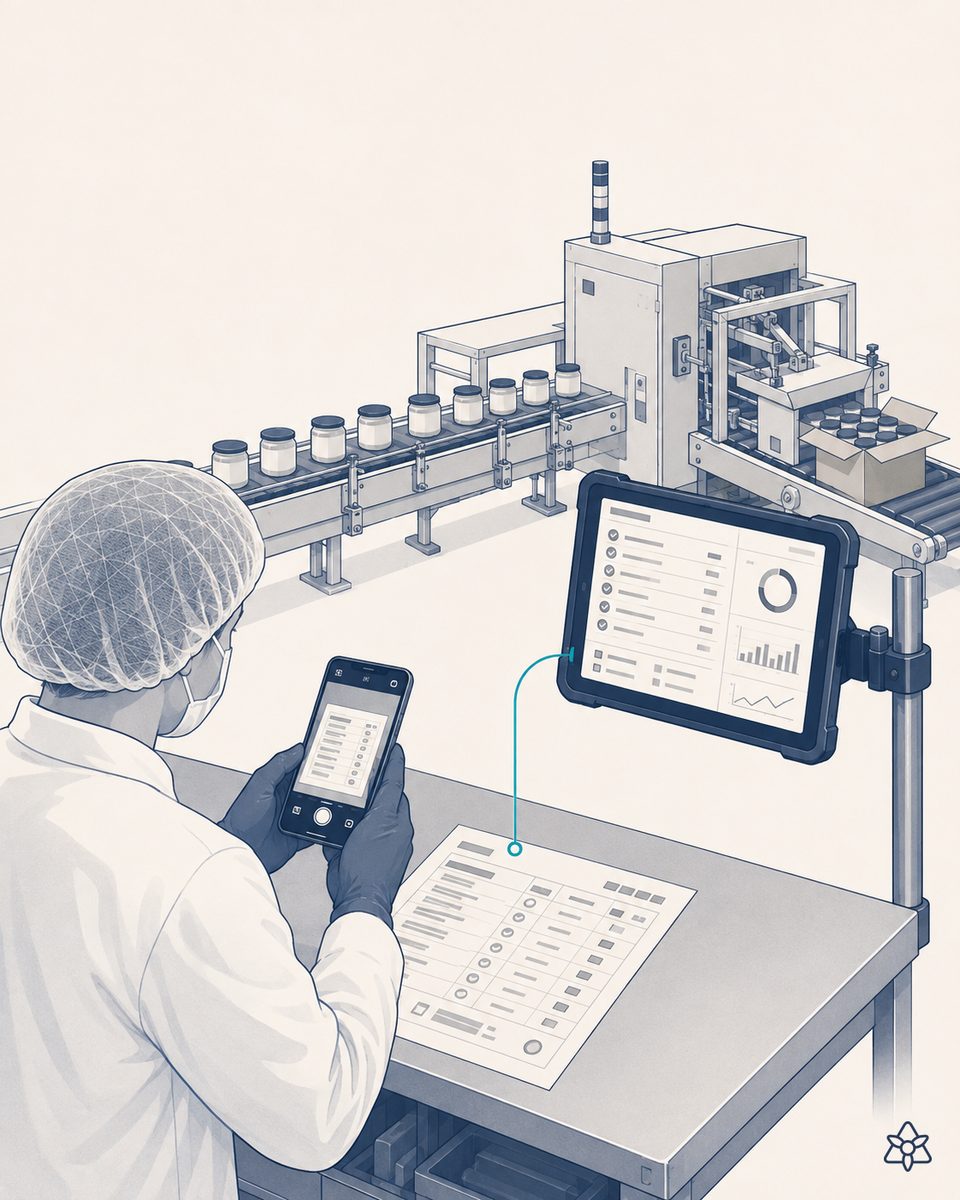
The destructive MAP test covers 1% of the batch. The other 99% goes to the pallet with whatever mix the spec sheet declares.
Modified atmosphere packaging protects the product's shelf life by replacing the air inside the tray with a gas mix (CO2, N2, sometimes controlled O2). The method works — but quality control has three classic gaps:
- The actual mix can drift — a misadjusted mixer, a saturated filter, a badly executed cylinder change, and the SKU ships with a composition the spec sheet does not reflect.
- The seal bead can fail — a fold in the film, a fragment of product on the bead, a worn tray sealer. The micro-leak is invisible to the eye but compromises shelf life.
- The leak test is destructive — the vacuum chamber with a submerged tray is only applied to a sample. If the defective cohort falls outside the sample, it reaches the shelf.
The quality manager knows this — but you cannot destroy all the product to get coverage. The classic system (sample analyzer + the operator's eye + random vacuum test) works 98% of the time. That 2% is a complaint about product spoiling before its date, which the retailer no longer accepts without a file.
iLEAN does not destroy more trays — it seals the cracks between the analyzer, the camera and the tray sealer.
The information is already in the plant: the Witt or Mocon analyzer gives the mix, the tray sealer has its parameters, the ERP has the SKU recipe. The problem is that those three pieces of data live on three different screens and only get cross-referenced after the fact, in the batch audit. iLEAN acts as the putty that crosses all three in real time and lets the operator make a decision before the cohort moves on.
Edge watches the seal bead. Connect reads the analyzer and the tray sealer. The agent cross-references the SKU recipe and, if something does not add up, holds the cohort before the pallet. The person signs — always the person signs.
The three iLEAN pieces applied to MAP:
- Edge — a vision terminal with a CNN trained to detect seal failure on the bead (fold, contamination, puckering, interruption). It flags the suspect tray for a targeted destructive test instead of a random one. Works without a network.
- Connect — captures the actual mix from the Witt/Mocon/PBI analyzer, the tray sealer's parameters (temperature/pressure/time) and the SKU recipe in the ERP/MES. All three enter the batch at second zero.
- Agent — cross-references the three data points against the SKU recipe. If the packer is dosing a sliced-cheese mix into a tray labeled as fresh meat, it holds the cohort. It maintains the per-batch dossier with the evidence for the retailer.
Sample-based MAP control vs. cross-referenced control with iLEAN
| Aspect | Sample analyzer + eye + destructive test | With iLEAN Edge + Connect + Agent |
|---|---|---|
| Mix coverage | One sample every X trays | Actual mix cross-checked against the recipe per batch |
| Micro-leak detection | Only in the vacuum-test sample | Edge flags suspect beads → targeted test |
| Wrong mix for the SKU | Found in a later audit | Hold before the pallet |
| Product destroyed in testing | Discarded in blind sampling | Only trays under real suspicion |
| Per-tray traceability | Per batch, not per tray | Image + mix + parameters per cohort |
| Retailer complaint | Answer in days, without fine-grained evidence | Dossier in minutes, with photo and data |
Impact estimate for your plant — to be validated with your numbers.
The block below is an estimate to be validated with the specific data of your plant. We put it forward so the committee has an order of magnitude; we refine it during the diagnostic.
- MAP line for fresh meat, sliced cheese or fresh-cut produce, 30-90 trays/min, horizontal tray sealer, Witt or Mocon analyzer already installed.
- Edge pilot over the seal bead + Connect to the analyzer + recipe cross-checking agent. First value expected within a few weeks.
- Indicative payback between 4 and 9 months, dominated by the hard lever: a single avoided recall for shortened shelf life pays for the pilot.
- Complementary levers: reduction of scrap from unnecessary destructive testing ≥ 30%, an automatic file for the retailer audit, better traceability against complaints.
And the quality manager's reasonable doubt
"What if the AI flags a leak that isn't one?" — the agent proposes a targeted test, it does not decide a recall. The destructive test is still run by the quality team; iLEAN only tells them where to look. AI reliability in these anchored tasks (comparing a bead image against a failure pattern, cross-checking mix against recipe) sits below 1.5% error [1]. The three rings are there precisely so the manager signs the cohort hold and the batch release.
[1] OpenAI paper "Why Language Models Hallucinate", 2025 — on the reliability of AI in anchored tasks.
What people ask about MAP packaging with AI
How does it detect a micro-leak without destroying the tray?
Today the standard MAP leak test is destructive (a vacuum chamber with the tray submerged) and sample-based. iLEAN does not replace it — it complements it: an Edge camera watches every tray on the belt and detects the visual signs of a bad film weld (a fold, seal-bead contamination, puckering, an interrupted seal) that statistically correlate with micro-leaks. When the image raises suspicion, the system flags the tray for a targeted destructive test — not a random one. Effective coverage goes up without destroying more product.
Does it work for fresh meat, sliced cheese, fresh-cut salad?
Yes. Every product has its characteristic MAP mix — fresh meat runs high CO2 + some O2 to keep the myoglobin's red color, sliced cheese runs N2/CO2 with no O2, fresh-cut salad runs a gentle mix so it can respire without oxidizing. iLEAN does not impose a recipe: it reads the mix from the packing machine and compares it against the recipe of the SKU planned in the ERP/MES. If the packer is dosing a cheese mix into a tray labeled as meat, the system holds the tray before sealing. The person signs — the line never restarts on its own.
Does it integrate with Witt/Mocon gas analyzers?
Yes. iLEAN Connect reads the sector's common analyzers (Witt, Mocon Dansensor, PBI/Gaslab) through their native output or via OPC-UA when enabled. The actual mix reading (CO2 / N2 / O2) enters the batch alongside the Edge seal image and the SKU recipe. The agent cross-references all three and maintains the shelf-life compliance dossier per sampled tray. If a complaint arrives, the file already exists.
Does it reduce shelf-life complaints?
Yes, and that is the project's hard lever. A complaint about product spoiling before its declared expiry date is almost always the fault of one of three things: a MAP mix off-recipe in some cohort, a film micro-leak in a run of trays, or a break in the cold chain. iLEAN covers the first two directly with Edge and Connect, and leaves the third traced with the transport data (cross-referenceable with our cold chain landing page). The per-batch dossier lets you answer with evidence, not with an apology.
And traceability for the retailer?
Large-scale retailers (Mercadona, Carrefour, Tesco, Aldi) increasingly demand documented evidence of the atmosphere at packing, not just the mix declaration on the spec sheet. iLEAN records for every batch: the actual mix sample, the seal image, the tray sealer's parameters, the product batch, the shift and the operator. When the retailer audits a complaint, the quality manager answers with a file, in minutes, not days.
More cases in food
- Jam and preserve control with AI — Brix, pH and closure, with no jar getting through on a doubt.How iLEAN cross-references Brix, pH, fill level and hermetic sealing on jam and preserve lines with Edge…
- Real AI cases in the meat industryReal AI cases in meat processing: vacuum pack leaks, curing chamber control and beef carcass…
- Milk fat control with AI — the lab knows, the line doesn't, and the batch is already made.iLEAN reads the MilkoScan/Foss, cross-references recipe and whole/skim balance and proposes the inline…
- Multihead weigher with AI — so you know which head is giving away grams.iLEAN detects per-head calibration drift, overfill and jams on multihead weighers — before the bag, not…
- NFC juice control with AI — premium doesn't sell with a Brix out of band.How iLEAN cross-checks Brix, color, pulp, cold chain and batch traceability to keep NFC juice quality…
- Automated nutrition labeling with AI — changing one ingredient shouldn't mean reviewing hundreds of labels.iLEAN computes the nutrition panel from the recipe, generates the Nutri-Score and mass-updates every…
Tell us your case and in 48h we'll send you the estimated ROI of this AI project for your MAP line.
We work on your plant's real data, not ours. Diagnostic with no commitment.
Request estimated ROI in 48h See food industry