Jam and preserve control with AI — Brix, pH and closure, with no jar getting through on a doubt.
A jam stakes the whole batch on four figures that rarely get cross-referenced in the plant: Brix, pH, fill level and hermetic closure. iLEAN joins the ERP recipe, the kettle SCADA and the capping image, and holds the defective jar before labeling. The person signs.
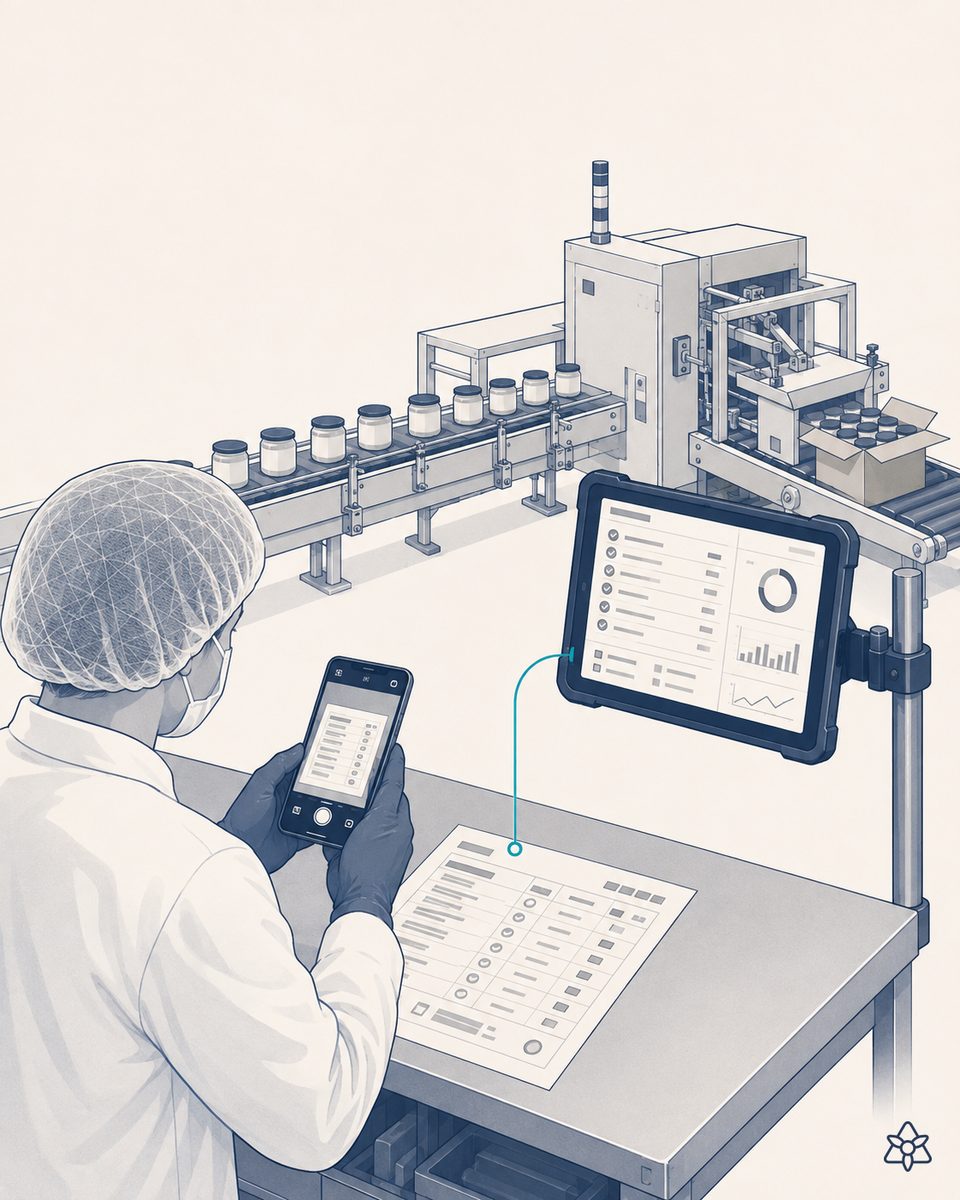
Brix, pH, fill, closure — four figures on four screens that almost never match up.
The quality manager of a jam plant lives among four dashboards that almost never get cross-referenced:
- Batch Brix and pH — on a lab refractometer and pH meter, logged once per shift in a notebook or an Excel sheet, not in real time at the kettle.
- Fill level of each jar — on the dosing machine, with a local screen very few people look at unless a beep goes off.
- Hermetic closure of the twist-off — checked by sampling or by eye, except on modern lines with dedicated vision.
- Batch recipe and designation — in the ERP, in the MES, or in an R&D department Excel sheet for the new "extra organic".
The classic system works because there are people with craft. The problem is that the craft leaves with whoever retires, and because even the best shift lead cannot be in four places at once on every SKU changeover. When a jam reaches the retailer with crystallization in the jar or mold at six months, the complaint is not argued: it is accepted, and the brand pays for it.
iLEAN does not add a fifth system — it seals the cracks between the four you already have.
Jam's problem is not a lack of data: the data lives in islands and only gets cross-referenced in the head of an experienced shift lead. iLEAN acts as the putty that closes those cracks, without asking you to change the kettle or the ERP.
Edge sees the closure before labeling. Connect reads Brix, pH and the recipe. The agent cross-references and holds the batch if the extra jam turned out not extra. The person signs — never the other way around.
The three iLEAN pieces applied to jam and preserve lines:
- Edge — a machine-vision (CNN) terminal over the capping and labeling line. It identifies a flat cap (defective closure), a bulging cap (overpressure), an off-center cap, a label swapped by mistake. It fires the ejector in milliseconds. It works without a network: if the plant loses WiFi, Edge keeps classifying jars.
- Connect — captures Brix, pH and kettle temperature whether they come from the SCADA, from the in-line refractometer/pH meter or from the lab notebook digitized by photo. It captures the batch recipe from the ERP/MES/Excel. And it captures what arrives from outside (the supplier's email about a pectin change, the retailer's email with the new labeling rule).
- Agent — cross-references the authorized recipe, measured Brix/pH, fill level, the closure image and the standards (Directive 2001/113/EC for the designation, EU Regulation 1169/2011 for allergens). If there is a deviation, it holds the batch before labeling and alerts the quality manager. The person signs; the batch does not leave on its own.
Sampling + the shift lead's Excel vs. cross-referenced control with iLEAN
| Aspect | Sampling + Excel | With iLEAN Edge + Connect + Agent |
|---|---|---|
| Batch Brix/pH | Spot reading once per shift | Continuous + cross-check against the authorized recipe |
| Closure verification | Sampling + eye | Edge vision jar by jar, with ejector |
| SKU changeover ("extra" to "light") | Paper checklist | Agent verifies recipe and label cross-checked |
| Supplier email (pectin change) | Mail folder | Connect escalates it to the batch in progress |
| Root cause of a closure defect | Assumption ("the twist-off came in bad") | Cross-check against filling temperature from the SCADA |
| File for the IFS/BRC auditor | Manual reconstruction | Automatic per-batch dossier with photo |
Impact estimate for your plant — to be validated with your numbers.
The block below is an estimate to be validated with the specific data of your plant. We put it forward so the committee has an order of magnitude; we refine it during the diagnostic.
- Plant with 1-2 jam/preserve lines, multi-SKU (extra, light, organic, private label), twist-off capping.
- Edge + Connect pilot on one line (camera over capping and labeling + integration with the kettle SCADA and the batch recipe). First value expected within a few weeks.
- Indicative payback between 4 and 9 months, depending on the current scrap rate from defective closures, the frequency of retailer complaints and the cost of a recall over unmet shelf life. A reasonable scrap reduction is ≥30%, to be refined.
- Hard lever: one serious complaint avoided pays for the pilot. The recurring scrap savings are a bonus.
And the plant manager's reasonable doubt
"What if the agent misclassifies a closure and we throw away hundreds of good jars?" — agents have no hands on the critical OT: the ejector is fired by Edge on clear criteria trained on your data. And in anchored tasks (classifying an image against a pattern), the best models brought error below 1.5% [1]. The ejection criterion is calibrated in the plant with you, not in an office, and is tuned as far toward "conservative" as you decide.
[1] OpenAI paper "Why Language Models Hallucinate", 2025 — on the reliability of AI in anchored tasks.
What people ask about jam control with AI
Why are Brix and pH critical in jam and preserves?
Brix (total soluble solids) and pH are the two levers that define microbiological stability in jams and preserves without aggressive pasteurization. A jam with low Brix and high pH is fertile ground for molds; one with excessive Brix crystallizes in the jar. European rules (Directive 2001/113/EC) set a minimum of soluble solids for designations such as "jam" (≥40-65% depending on type), and any recipe deviation can compromise both the legality of the label and the shelf life declared to the retailer.
How is a defective jar closure detected on the line?
By combining two readings that today almost never get cross-referenced: the image of the closure (AI vision over the capping line) and the vacuum measurement the twist-off produces as it seals while hot. iLEAN Edge identifies the correct concavity of the cap and fires an actuator (ejector) if the cap is flat, bulging or off-center. The agent cross-references the filling temperature from the SCADA: if the closure failed because the product went in lukewarm, the root cause is in the process, not the jar.
How are the minimum fruit contents for extra designations managed?
For "extra jam" or "extra preserve" the standard requires a minimum fruit content (≥45% in extra preserve, for example). That figure lives in the batch recipe, in the ERP or MES. iLEAN Connect captures it wherever it lives, cross-references it against the actual weight of fruit loaded that the operator records and the final viscosity from the SCADA, and the agent verifies that the authorized recipe matches what was dosed. If an R&D Excel sheet changed the recipe and it never reached the plant, the agent detects it and holds the batch before labeling.
Can iLEAN integrate with old kettle and dosing lines without replacing them?
Yes. iLEAN Connect grades the capture to what the machine has: if the kettle exposes data on a modern SCADA, direct integration; if there is only an old isolated panel, Connect hooks in and extracts; if the panel is analog, a person photographs it with the app and the data comes in all the same. iLEAN Edge adds vision on the capping and labeling line. It does not force you to change the line — the putty fills the cracks; it does not demolish.
What payback is reasonable to expect on a jam line?
An Edge + Connect pilot on a jam or preserve line (cameras over capping and labeling + integration with the kettle SCADA and the batch recipe) is in the order of magnitude of any Edge pilot in a food plant. First value within a few weeks; indicative payback between 4 and 9 months. The hard lever is the reduction of scrap from defective closures and out-of-recipe batches (a reasonable reduction is ≥30%), plus one serious retailer complaint avoided over unmet shelf life. We ask for your numbers and send you the estimated ROI in 48h.
More cases in food
- Allergens in infant food with AI — zero tolerance is not a slogan, it is a system.Zero tolerance for allergens in infant food. iLEAN covers recipe, cross-contact and packaging in a…
- Planning the ingredients plant around what is expensive to stop: the reactor, the dryer and the extruder.The iLEAN Planning Agent builds the plan for an ingredients plant around the reactor, the spray dryer…
- Real AI cases in ingredientsReal AI cases in ingredients: functional ingredient quality in line, plus the cross-cutting food…
- Real AI cases in the meat industryReal AI cases in meat processing: vacuum pack leaks, curing chamber control and beef carcass…
- Milk fat control with AI — the lab knows, the line doesn't, and the batch is already made.iLEAN reads the MilkoScan/Foss, cross-references recipe and whole/skim balance and proposes the inline…
- MAP packaging with AI — a bad mix or a micro-leak should not be discovered when the customer returns the product.iLEAN measures CO2/N2/O2 in line, detects MAP tray leaks and extends shelf life without pulling…
Tell us your case and in 48h we'll send you the estimated ROI of this AI project for your jam plant.
We work on your plant's real data, not ours. Diagnostic with no commitment.
Request estimated ROI in 48h See food industry