Allergens in infant food with AI — zero tolerance is not a slogan, it is a system.
In infant food there is no such thing as “acceptable traces”: the end consumer is an infant and tolerance is zero. iLEAN covers the three realities that have to line up — recipe, cross-contact and packaging — in a single chain, and holds the batch before sealing if anything does not fit. The person signs.
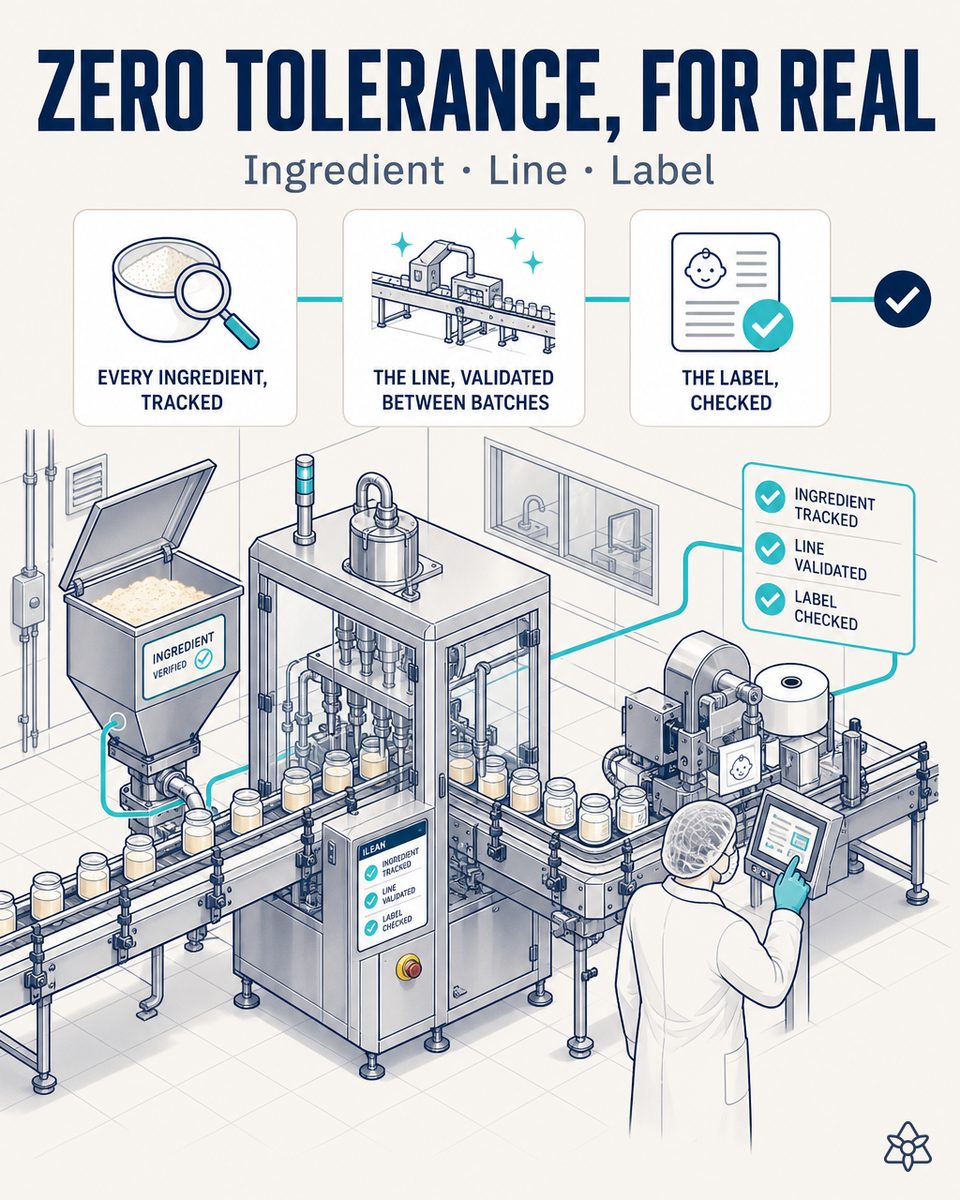
Four realities, four systems, one single label — and an infant at the end of it.
In an infant food plant, a correct label is the intersection of four pieces of data that are almost never in the same place:
- The batch recipe — exact to the gram, with supplier identification for every raw material (a single flour batch contaminated with gluten ruins the day). In the ERP, in the MES, or in the R&D manager's head.
- Production order and CIP cleaning — what ran on the line before, which CIP cycle was applied, whether it reached the validated temperature and time, and which lab result confirms it. Data scattered across the SCADA, the quality record and the operator's sheet.
- The image of the container at sealing — the actual label that goes to the shelf, the one a parent will read at two in the morning. Produced by packing, and not always checked against the recipe in real time.
- The destination country's rules — EU 1169/2011 + 609/2013, but also post-Brexit UK, FSMA if you export to the US, GB internal market. The rules change, and not always when the catalogs get printed.
The quality manager knows this. The managing director knows that a recall in this sub-sector is not an incident — it is a crisis with almost guaranteed press coverage. The classic system works 99.9% of the time. That 0.1% is the one that makes the front page. And in baby food, that is not something you manage: it is something you prevent.
iLEAN does not add a fifth system — it seals the cracks between the four you already have.
The problem with allergen traceability in infant food is not a lack of procedures: it is information living on islands that, at the critical moment (the recipe changeover, the CIP cycle that falls short, the SKU change at packing), does not reach the person who has to decide in time. iLEAN acts as the putty that fills those gaps, without asking you to change your ERP, MES, SCADA or packing line.
Tracer holds batch and recipe. Edge sees the label and measures the CIP. Connect captures what arrives from outside. The agent cross-references it with the destination country's rules and, if something does not add up, holds the batch. The person signs.
The three iLEAN pieces applied to allergen traceability in infant food:
- iLEAN Tracer — granular batch traceability from the raw material (with its supplier certificate of analysis) to the jar on the shelf. It is not an extra ERP module; it is the layer that joins the physical milestones and the documentary milestones into a single auditable chain.
- iLEAN Edge (Vision) — terminals with machine vision (CNN) on the packing line: they read the actual label, extract the list of declared allergens and check it against the batch recipe. And they read the CIP sensors to confirm that cleaning reached the validated temperature and time. They work with no network — what is critical does not depend on WiFi.
- iLEAN Agent — cross-references recipe + CIP + label + destination country rules. If there is a deviation, it holds the batch before sealing and prepares the file the quality manager will read in order to decide. If a recall becomes necessary for an external reason, the same agent bounds the exact scope in minutes, not days.
Classic traceability vs. cross-referenced traceability with iLEAN
| Aspect | Classic procedure + audit | With iLEAN Tracer + Edge + Agent |
|---|---|---|
| Source of the recipe | ERP, MES or spreadsheet — the operator checks one of them | All sources unified at second zero |
| CIP validation between batches | A sheet signed by the operator | SCADA sensors + photo of the record + an agent that validates temperature and time |
| Detecting a recipe-label mismatch | A later audit, or a complaint | On the line, before sealing, in milliseconds |
| Destination country rules | A catalog updated every few months | A live rule per market; a retailer change enters at second zero |
| File for auditor / authority | Rebuilt by hand, weeks of work | Per-batch dossier, automatic, with the full chain |
| Speed of bounding a recall | Days — broad scope out of caution | Minutes — scope pinned to the exact batch |
Impact estimate for your plant — to be validated with your numbers.
The block below is an estimate to be validated with the specific data of your plant. We put it forward so the committee has an order of magnitude; we refine it during the diagnostic.
- Infant food plant with multiple formats (jar, pouch, powder) and multiple recipes (with/without gluten, with/without dairy, with/without nuts), exporting to the EU + UK + possibly the US.
- Edge pilot on one critical packing line + iLEAN Tracer over batches from raw material receiving onward. First value expected within a few weeks: on-line holding of batches with a recipe-label mismatch.
- Indicative payback between 4 and 9 months, depending on the frequency of documented incidents, the average cost of a rework triggered by suspicion and your exposure to recall risk in regulated markets.
- A ≥ 30% reduction in the time needed to assemble the batch file for an auditor (FSSC 22000, customer brand, health authority) from the very first quarter. But that is not the hard lever: the hard lever is one avoided recall.
And the quality director's reasonable doubt
“What if the AI gets it wrong and lets a mislabeled batch through? This is infant food.” — hallucination is a problem of free generation, not of anchored tasks. In tasks where the AI recontextualizes a piece of data (reading the label and comparing it with the recipe, validating that the CIP reached temperature and time), the best models brought error below 1.5% [1]. And even so, what is critical is never decided alone: iLEAN holds the batch, prepares the file and the person signs. The three safety rings are designed for exactly this — in baby food, human validation at sealing is not up for debate, it is guaranteed.
[1] OpenAI paper “Why Language Models Hallucinate”, 2025 — on the reliability of AI in anchored tasks.
What people ask about allergen traceability in infant food
What do EU regulations require for infant food?
Infant food is governed by Directive 2006/141/EC (infant formula and follow-on formula), Regulation (EU) 609/2013 (food for special medical purposes and for infants) and Regulation (EU) 1169/2011 on food information, with its 14 allergens subject to mandatory declaration. The key difference from the rest of the food industry is that here blanket cover is not accepted — no “may contain traces of…”: the allergen management system has to justify every declaration with real plant data. And the recall criteria are far stricter: the end consumer is an infant.
How is cross-contact avoided on a baby purée line?
By cross-referencing four sources that almost always live on separate islands: the batch recipe, the line's production order (which purée ran before, which cereal or fruit it contained), the CIP cleaning record (not just “it was cleaned”, but at what temperature, for how long and with what analytical validation), and the image of the container at sealing that iLEAN Edge reads in real time. If the current purée declares “gluten free” but the previous one contained gluten cereals and the CIP cleaning did not reach the validated temperature, the system holds the batch before sealing and alerts quality. The person signs — the line does not restart on its own.
Is there a separate audit framework for infant food?
Yes. On top of IFS Food and BRCGS as they apply to the plant, infant food is usually audited against additional schemes: FSSC 22000 with specific modules, customer requirements (international baby food brands have their own internal standard) and periodic review of the HACCP plan by the health authority. The file the auditor asks for goes deeper: the batch's historical recipe, process parameters minute by minute, validated CIP records, operator identification at every step. iLEAN assembles that file automatically per batch — the agent gathers the evidence and the person signs.
Does it work with multiple formats (glass jar, stand-up pouch, powder in a can)?
Yes. The iLEAN Vision CNN is trained per format — glass jar with a twist-off lid, doypack or stand-up pouch with a cap, powdered milk can. Each format has its own geometry, its own label zone and its own critical inspection points. The training investment for a new format is measured in hours, not weeks, because the base format is already modeled and only the variant changes. And if you use an external co-packer for one of the formats, iLEAN Connect captures the partner's data (email, EDI, control sheet) and folds it into the same traceability chain.
How much does it reduce recall risk?
That is an estimate to be validated against your history. In the infant food sub-sector, a recall for an undeclared allergen is an event of extraordinary impact: product pulled off the shelf, mandatory public communication, lasting brand damage, possible intervention by the health authority. iLEAN works on prevention (holding product on the line before shipment) and on recall speed when one does happen: if an external cause forced a recall, granular traceability lets you bound the exact batch in minutes rather than days, which is the difference between a contained scare and a full crisis. It is a business continuity lever, not just a cost lever.
More cases in food
- AI control of IQF ice cream — a tunnel at −40 °C does not forgive, and neither does the shelf.How iLEAN cross-references IQF tunnel temperature, glazing, weight and clumping with Edge + Connect +…
- The industrial bakery line with AI — from mixing to packing, without paper as the glue.iLEAN connects the whole bakery line: data capture at every link, 100% inspection at the oven exit and…
- Industrial AI for high-volume breweries12 real industrial AI cases in high-volume breweries: shop floor capture, inline packaging vision and…
- Planning the ingredients plant around what is expensive to stop: the reactor, the dryer and the extruder.The iLEAN Planning Agent builds the plan for an ingredients plant around the reactor, the spray dryer…
- Real AI cases in ingredientsReal AI cases in ingredients: functional ingredient quality in line, plus the cross-cutting food…
- Jam and preserve control with AI — Brix, pH and closure, with no jar getting through on a doubt.How iLEAN cross-references Brix, pH, fill level and hermetic sealing on jam and preserve lines with Edge…
Tell us your case and in 48h we'll send you the estimated ROI of this AI project for your infant food plant.
We work on your plant's real data, not ours. Diagnostic with no commitment.
Request estimated ROI in 48h See food industry