AI control of IQF ice cream — a tunnel at −40 °C does not forgive, and neither does the shelf.
In IQF, the difference between a saleable batch and a scrap batch is tenths of a degree in the tunnel, seconds on the belt and a millimeter of glazing. iLEAN cross-references temperature, glazing, weight and clumping in line, proposes the adjustment to the shift lead and leaves every batch traceable. The person signs.
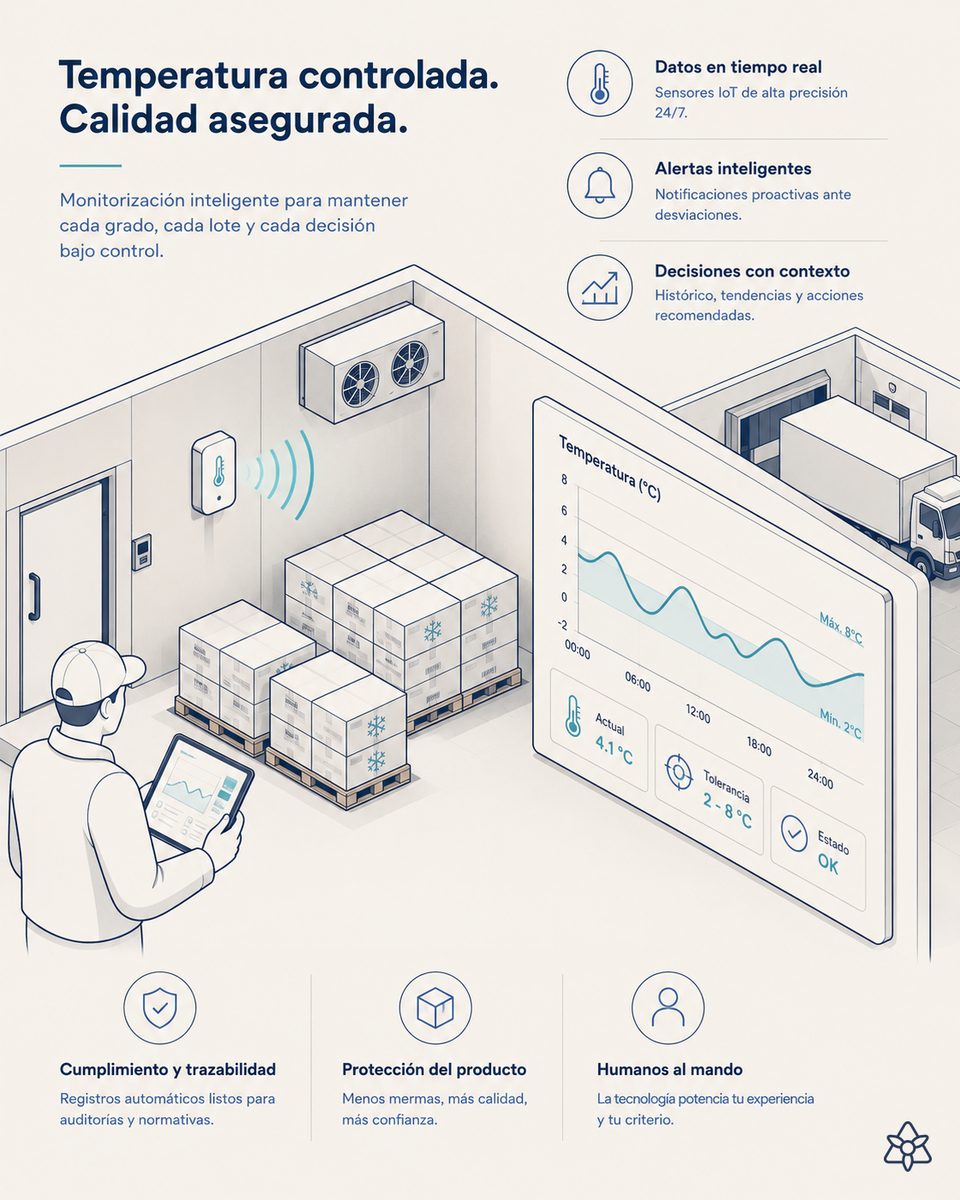
A thousand pieces a minute, four variables in play, and a tunnel that never stops.
On an IQF line, the shift lead lives between three pieces of data that no system ever serves him together in real time:
- Tunnel temperature and air flow — in the SCADA, with scheduled defrost cycles that move the real temperature away from the setpoint without warning.
- The condition of the pieces at the outfeed — visible only by eye, on a belt running at 30 pieces per second. If there is clumping, you find out when the bagging line has already put out twenty bad bags.
- Glazing thickness and final weight — on the checkweigher and in the bath, each with its own screen, and the operator decides by feel whether the setpoint goes up or down.
The consequence: by the time a deviation is detected, there are already hundreds of kilos of scrap in the bin, or dozens of bags reaching the retailer as a block and coming back as a complaint. The classic system works — but it leaves in the hands of the veteran's eye what AI can sustain without a break, shift after shift.
iLEAN does not replace your tunnel or your SCADA — it seals the cracks between the line and the decision.
The problem with IQF is not missing technology: it is that information travels slower than product. By the time someone looks at the screen, the problem piece is already bagged. iLEAN acts as the putty that closes the see-decide-act loop at belt speed, without touching the tunnel or the checkweigher.
Edge sees the outfeed belt in milliseconds. Connect reads the tunnel SCADA and the glazing bath. The agent cross-references and proposes the setpoint adjustment. The shift lead decides and signs.
The three iLEAN pieces applied to an IQF line:
- Edge — a machine vision terminal (CNN) over the tunnel outfeed belt. It identifies clumping, anomalous geometry and out-of-range glazing, and triggers an actuator (stack light, rejector, HMI alert) if the rate exceeds the SKU's threshold. It works with no network. If the plant loses WiFi, Edge keeps classifying.
- Connect — captures the tunnel parameters (temperature, air flow, defrost cycles), the checkweigher reading and the glazing bath temperature, whether they come from a modern SCADA or from the old PLC on an isolated line. And it captures what arrives from outside (an email from the supplier with a change to the bath recipe, a WhatsApp from the maintenance manager about a defrost brought forward) at second zero.
- Agent — cross-references the belt image, the tunnel parameters, the weight and the glazing bath. If clumping goes up, it proposes "lower air flow to X or bring the defrost forward by Y minutes" to the shift lead through whichever channel he uses. The person decides; the setpoint does not move without a signature.
Control by the veteran's eye vs. cross-referenced control with iLEAN
| Aspect | Control by eye + checklist | With iLEAN Edge + Connect + Agent |
|---|---|---|
| Clumping detection | At bagging, with scrap already piled up | On the outfeed belt, in milliseconds |
| Glazing thickness | By feel, adjusted once per shift | Vision + cross-check with weight, proposal to the lead |
| Scheduled vs. real defrost | Never cross-referenced with piece quality | The agent cross-references cycle and result |
| SKU changeover in the tunnel | Conservative setpoint by default | Optimal setpoint per SKU, energy saved |
| Retailer complaint about a block | Rebuild the batch after the fact | Per-batch dossier with image and trace |
| The veteran's knowledge | Leaves the day he retires | Captured as a permanent capability |
Impact estimate for your plant — to be validated with your numbers.
The block below is an estimate to be validated with the specific data of your plant. We put it forward so the committee has an order of magnitude; we refine it during the diagnostic.
- Plant with 1-2 IQF tunnels, multi-SKU (fruit, vegetables or ice cream), daily recipe and setpoint changes.
- Edge + Connect pilot on one line (camera over the outfeed belt + integration with the tunnel SCADA and the checkweigher). First value expected within a few weeks.
- Indicative payback between 4 and 9 months, depending on your current clumping scrap rate, the cost of complaints about blocks and the energy-saving potential of tuning the setpoint per SKU. A reasonable scrap reduction is in the order of ≥30%, to be refined.
- Hard levers: clumping scrap, tunnel energy savings and fewer retailer complaints.
And the maintenance manager's reasonable doubt
“What if the agent gets the setpoint wrong and burns out a compressor on me?” — the agents have no hands on the critical work order: they propose, the person decides and signs. And in anchored tasks (classifying an image, comparing against the SCADA setpoint), the best models brought error below 1.5% [1]. The second safety ring validates every proposal before it is shown to the shift lead; the setpoint never changes without a human signature.
[1] OpenAI paper “Why Language Models Hallucinate”, 2025 — on the reliability of AI in anchored tasks.
What people ask about AI control of IQF
What is IQF freezing and why is controlling it so sensitive?
IQF (Individually Quick Frozen) is piece-by-piece freezing in tunnels at temperatures in the order of −30 to −40 °C, which prevents large crystals from forming and preserves texture, color and aroma. Control is sensitive because any deviation in tunnel temperature, air flow or residence time produces clumping (pieces stuck together), uneven glazing or crystals that break the cell membrane — and all of that translates into scrap, or into a retailer complaint when the bag reaches the shelf as one block instead of loose pieces.
How is clumping detected in line without stopping the tunnel?
With machine vision over the tunnel outfeed belt. iLEAN Edge runs a CNN trained to identify stuck pieces, small blocks and anomalous geometry in milliseconds. If the clumping rate rises above the SKU's threshold (nut ice cream, bars, scoops), the system cross-references it with the tunnel temperature and the air flow from the SCADA to locate the root cause, and proposes the adjustment to the shift lead. The operator decides and signs — the setpoint does not move without a person.
How is glazing thickness controlled piece by piece?
Glazing (the layer of water or syrup that protects the piece from freezer burn) has a narrow range: too thin and the piece burns; too thick and you are paying for water as product while the weight goes out of balance. iLEAN Edge measures the thickness by vision in line, cross-references it with the checkweigher reading and the bath temperature coming in through Connect, and the agent tunes the setpoint proposal for the next cycle. It is jidoka in two stages: first it detects the out-of-range piece, then it learns to anticipate.
How is freezing-chain traceability documented for an audit?
iLEAN generates an automatic per-batch dossier: continuous logging from the tunnel SCADA (temperature, air flow, pressure, defrost cycles), a sampled image of the outfeed belt at every SKU changeover, checkweigher readings, glazing bath data and the shift lead's signature. For an IFS/BRC audit or a retailer request, the file comes out in minutes, not weeks. And the raw data still lives in the SCADA and the ERP — iLEAN joins it, it does not replace it.
What payback is reasonable to expect in an IQF plant?
An Edge + Connect pilot on an IQF line (cameras over the outfeed belt + integration with the tunnel SCADA and the checkweigher) is in the order of magnitude of any Edge pilot in a food plant. First value in a few weeks; indicative payback between 4 and 9 months. The hard lever is the reduction of scrap from clumping and out-of-range glazing, plus the energy saved by running the tunnel at the minimum setpoint each SKU needs instead of always operating at the coldest. We ask for your numbers and send you the estimated ROI in 48h.
More cases in food
- Skin packing of Iberian ham slices — the micro-leak you cannot see becomes a return from the shelf.How iLEAN Edge detects micro-leaks in skin packs of Iberian ham slices in line, with AI vision and a…
- Sobrasada IGP Mallorca — you do not touch the curing curve, you watch it better.How iLEAN Edge governs the curing curve and the traditional stuffing of Sobrasada IGP Mallorca with AI…
- Iberian ham slicing in a white room with AI — fat, bone and marbling slice by slice, pack weight intact.iLEAN Vision in the slicing white room detects fat, bone and marbling slice by slice and adjusts the…
- The industrial bakery line with AI — from mixing to packing, without paper as the glue.iLEAN connects the whole bakery line: data capture at every link, 100% inspection at the oven exit and…
- Industrial AI for high-volume breweries12 real industrial AI cases in high-volume breweries: shop floor capture, inline packaging vision and…
- Allergens in infant food with AI — zero tolerance is not a slogan, it is a system.Zero tolerance for allergens in infant food. iLEAN covers recipe, cross-contact and packaging in a…
Tell us your case and in 48h we'll send you the estimated ROI of this AI project for your IQF plant.
We work on your plant's real data, not ours. Diagnostic with no commitment.
Request estimated ROI in 48h See food industry