The industrial bakery line with AI — from mixing to packing, without paper as the glue.
Batch mixing, a continuous tunnel oven, discrete multi-SKU packing: three different logics that today are connected by paper and by the shift lead's memory. iLEAN puts one piece at every link — Connect captures the data where it lives, Edge inspects 100% of the pieces at the oven exit, and the Agents plan the oven and document batch traceability. Modular: you start with whatever hurts most.
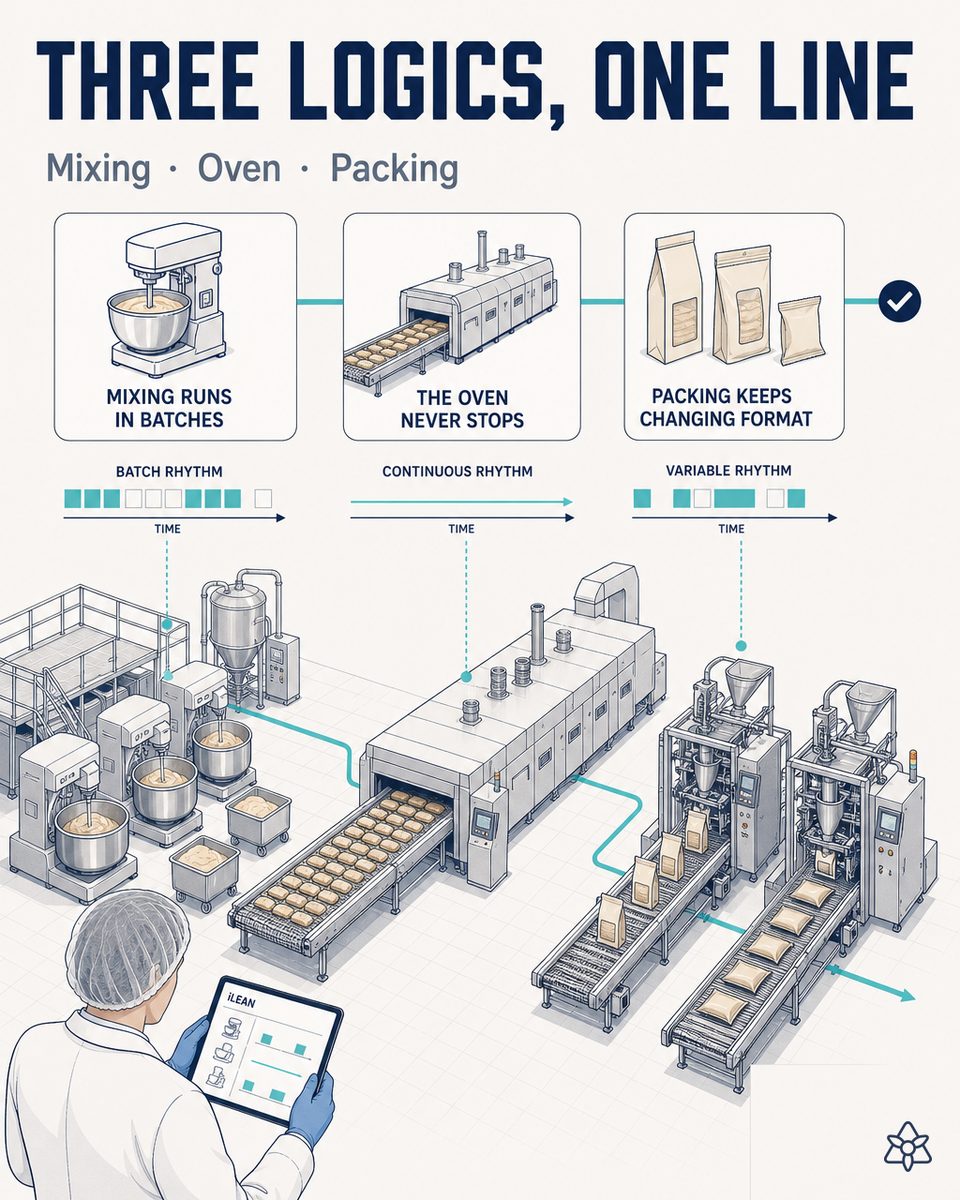
A bakery line is a chain of processes that do not speak the same language — and the translator is a notebook.
An industrial bakery line is really three factories chained together with incompatible logics: the mixer works in batches (one dough, one recipe, one time), the tunnel oven is a continuous process that is very expensive to start and to stop, and packing is discrete and multi-SKU (formats, bags, best-before dates, retailers). Between one link and the next, today, the glue is paper and the shift lead's memory:
- The work order comes down on paper — or in a spreadsheet somebody printed out — and every link interprets it its own way. The recipe lives in an R&D folder; the real mixer settings live in the head of the dough foreman.
- Proofing is controlled by looking at the dough — the chamber's temperature and humidity readings exist on a panel, but they are not recorded anywhere. If the batch turns out badly, nobody can reconstruct why.
- The tunnel oven is a continuous black box — its zone temperatures and belt speed sit on the mimic display of a panel from the nineties with no data port. Every start-up and every stop costs gas, waste and an hour of transient running.
- Quality control is a sample — a few pieces an hour, checked by eye, written on a sheet. A bake color drift can run for half a shift before anyone names it.
- Packing is where another factory begins — format changeovers, batches, best-before dates, and a traceability file that gets rebuilt by hand the day the IFS/BRC auditor asks for it.
The result: every link keeps its data on its own island — or nowhere at all — and the only whole-line view is the one the shift lead carries in their head. The day that shift lead retires, the line loses its information system.
iLEAN does not replace your machines or your ERP — it puts one piece at every link and joins them up.
The line's bottleneck is not any single machine: it is that mixing, the oven and packing do not share data, while the standards (IFS/BRC, batch traceability) demand that they be treated as one single process. iLEAN is the putty between links — without changing the mixer, without retrofitting the tunnel oven, without replacing the ERP or MES you already have. And it is modular: each piece is deployed separately, starting with whichever hurts most in your plant.
Connect captures the work order, the recipes and the machine panels where they live. Edge inspects 100% of the pieces at the oven exit. The Agents plan the oven as a continuous work center and assemble the batch file on their own. The person validates — the system releases nothing without a signature.
The iLEAN pieces applied to the complete bakery line:
- Connect — the data enters where it lives, not where it ought to live. It captures the work order and the recipe whether they come from the ERP, from a planning spreadsheet or from the paper that goes down to the floor. And it reads the panels of vintage machines with a camera — mixer, proofing chamber, tunnel oven — digitizing temperatures, times and alarms that today only exist on a display. No retrofit, no touching the PLC, with a timestamp and batch number from second zero.
- Edge — 100% piece inspection at the oven exit. Shape, color as an indicator of bake level and visible defects, piece by piece, at line speed. Where manual sampling checks a few pieces an hour, Edge checks all of them and turns a half-shift drift into an alert in minutes — with the result recorded by batch, ready for the file.
- Agents — the oven is planned as what it is: a continuous work center. The planning agent groups orders into long campaigns by temperature and format family, minimizing oven start-ups, stops and thermal ramps, and synchronizes the mixing and proofing batches backwards and the packing format changeovers forwards. In parallel, the traceability agent consolidates the batch file: raw materials, real process parameters, Edge's inspection and packing data. The human planner signs off the sequence; without a signature, nothing is released.
The Brain that orchestrates the agents lives in Central; critical data stays in the plant's ring 1, not in some generic cloud (see the IRIS architecture and the three safety rings).
The line on paper and memory vs. the line with iLEAN
| Aspect | Paper + spreadsheets + the shift lead's memory | With iLEAN Connect + Edge + Agents |
|---|---|---|
| Mixing and proofing data | On the machine panel, or nowhere | Captured by camera, with timestamp and batch |
| Tunnel oven start-ups and stops | Whatever comes out of fitting work orders by hand | Long campaigns by family — minimum start-ups and ramps |
| Quality control at the oven exit | A few pieces an hour, checked by eye | 100% of pieces: shape, color, visible defects |
| Detecting a bake drift | Half a shift, when somebody names it | Minutes — automatic alert on color trend |
| Mixing ↔ oven ↔ packing synchronization | Carried in the shift lead's head | Sequence proposed by the agent, signed by the planner |
| Batch file for IFS/BRC | Rebuilt by hand when it is requested | Consolidated automatically, retrievable by batch in seconds |
Impact estimate for your line — to be validated with your numbers.
The block below is an estimate to be validated with the specific data of your line. It is there so the committee has an order of magnitude; we refine it during the diagnostic.
- Industrial bakery with one or several tunnel oven lines, 20-80 active references, a mixed machine base (some modern, some with no connectivity) and batch records fully or partly on paper.
- Deployment piece by piece: you start with the link that hurts most (typically inspection at the oven exit or panel capture) and extend to the next one once the first is already paying for itself. First value expected within a few weeks on one pilot line.
- Expected value levers (estimate to be validated): fewer oven start-ups and stops thanks to campaign-based planning — every transient avoided is gas and waste that is not burned —, 100% piece control at the oven exit instead of sampling, and an automatic batch file that turns the IFS/BRC traceability exercise from days into seconds.
- Indicative payback between 4 and 9 months per piece deployed (estimate to be validated), depending on the number of references, the oven's energy cost, your current waste rate and the administrative effort the batch file takes in your plant.
And production's reasonable doubt
“What if the AI gets a piece classification wrong, or proposes the wrong oven sequence?” — hallucination is a problem of free generation, not of anchored tasks. Classifying the shape and color of a piece against a reference pattern, or sequencing orders against known temperature and format constraints, are exactly anchored tasks: the AI recontextualizes a measured value using deterministic rules. In this kind of task, the best models brought error below 1.5% [1]. And even so, the person validates: the planner signs the sequence before it is released and Edge's rejection thresholds are set by quality, not by the model. The three safety rings are there for exactly this.
[1] OpenAI paper “Why Language Models Hallucinate”, 2025 — on the reliability of AI in anchored tasks.
What people ask about the industrial bakery line with AI
Do we have to stop the line to deploy iLEAN?
No. iLEAN is deployed piece by piece and without touching the line: Connect captures the information where it already lives (paper, spreadsheets, ERP, machine panels), Edge is installed as one more camera over the belt at the oven exit, and the Agents work on the data the other two pieces generate. No PLC is reprogrammed and the tunnel oven is not stopped — which is precisely what nobody wants to stop. A typical deployment starts with a single link in the chain (the one that hurts most) and is validated in real production before extending to the next one.
How does iLEAN read a mixer or an oven from the nineties with no connectivity?
With a camera over the panel. A good part of the installed base of mixers, proofing chambers and tunnel ovens has no usable data port, or has one locked down by the manufacturer. Connect points a camera at the display or the mimic panel and digitizes what the machine already shows: zone temperatures, belt speed, cycle time, alarms. The data enters the system at second zero, with a timestamp and a batch number, with no electronic retrofit and no intervention on the machine.
What does Edge inspect at the oven exit?
Three families of attributes on 100% of the pieces, at line speed: shape (dimensions, symmetry, collapsed or burst pieces), color as an indicator of bake level (pale, correct, burnt, patchy by zone) and visible defects (blisters, cracks, incorrect scoring, foreign bodies on the surface). Classic manual sampling checks a few pieces an hour; Edge checks all of them and records the result by batch, so a color drift is detected in minutes rather than when the customer sends the pallet back.
How do the Agents plan a tunnel oven that should not be stopped?
By treating it as what it is: the continuous work center of a line that upstream works in batches (mixing) and downstream works discrete and multi-SKU (packing). The Agents group work orders into long campaigns by temperature and format family, so the oven chains compatible references with the minimum number of start-ups, stops and thermal ramps. They then synchronize backwards the mixing and proofing batches and forwards the packing format changeovers, so that the dough does not wait too long and the packing machine does not run out of product. The human planner validates the proposed sequence; the system never releases anything on its own.
Is the batch file iLEAN generates good enough for an IFS/BRC audit?
Yes — that is one of its main uses. For every batch, the system automatically consolidates what today is rebuilt by hand: the raw-material batches used (flour, yeast, improvers), real mixing and proofing parameters, the oven temperature curve read off the panel, the result of Edge's inspection on 100% of the pieces and packing data with its best-before date. The file is signed by the responsible person and can be pulled up by batch in seconds, which is exactly what the IFS/BRC auditor asks for and what a traceability exercise requires you to resolve in under four hours.
More cases in food
- Sobrasada IGP Mallorca — you do not touch the curing curve, you watch it better.How iLEAN Edge governs the curing curve and the traditional stuffing of Sobrasada IGP Mallorca with AI…
- Iberian ham slicing in a white room with AI — fat, bone and marbling slice by slice, pack weight intact.iLEAN Vision in the slicing white room detects fat, bone and marbling slice by slice and adjusts the…
- AI control of IQF ice cream — a tunnel at −40 °C does not forgive, and neither does the shelf.How iLEAN cross-references IQF tunnel temperature, glazing, weight and clumping with Edge + Connect +…
- Industrial AI for high-volume breweries12 real industrial AI cases in high-volume breweries: shop floor capture, inline packaging vision and…
- Allergens in infant food with AI — zero tolerance is not a slogan, it is a system.Zero tolerance for allergens in infant food. iLEAN covers recipe, cross-contact and packaging in a…
- Planning the ingredients plant around what is expensive to stop: the reactor, the dryer and the extruder.The iLEAN Planning Agent builds the plan for an ingredients plant around the reactor, the spray dryer…
Tell us about your line and in 48h we'll send you the estimated ROI of this AI project — piece by piece, starting with the one that hurts most.
We work on the real data of your plant and your line, not ours. Diagnostic with no commitment.
Request estimated ROI in 48h See all bakery cases See food industry